

Cryptocurrency Market Analysis [June 16 Issue]
Bitcoin last week's 1,060,000 yen
fell from around 1,060,000 to about 970,000,
*prices as of May 15
Bitcoin 4-hour chart
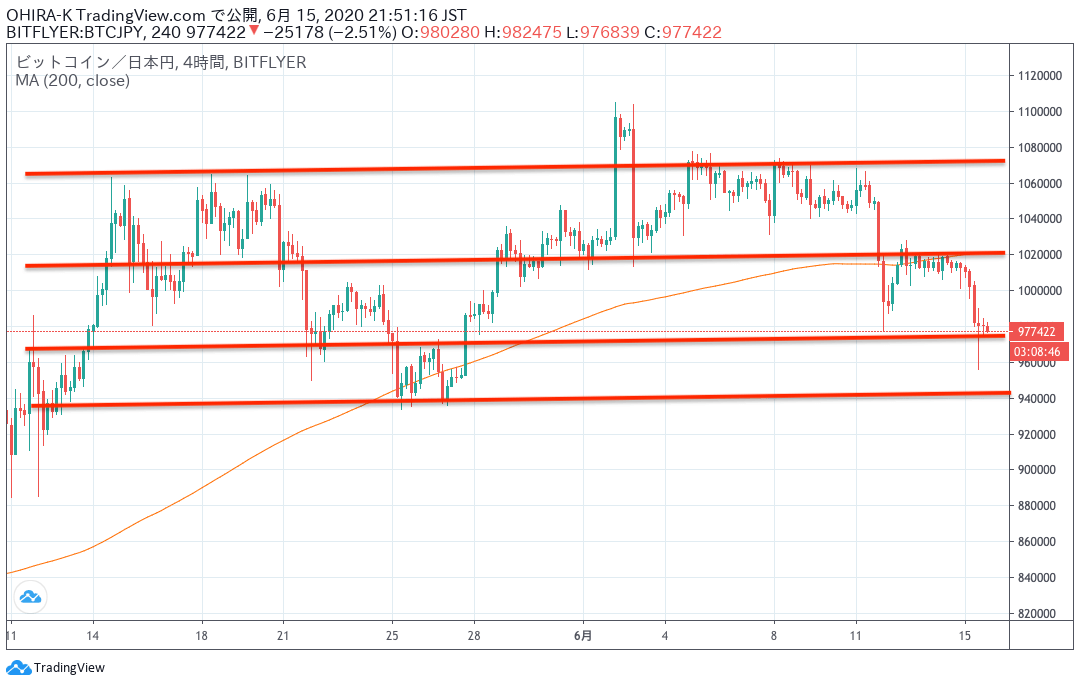
This drop is largely driven by a sharp
decline in the U.S. stock market,
and bitcoin is being dragged down with it.
is strong
In other words, the correlation between bitcoin and the stock marketCurrently at 970,000 yen; from here
on the downside, around 940,000 yen acts as a
support line,
and I am considering it as a buy line.
Last week, U.S. stocks
rose sharply, and the real economy
is detached, leading to expectations of a large drop
as written, but in reality
U.S. stocks fell sharply, and the Nikkei Stock Average
and Bitcoin also fell accordingly.
Among investors, some wonder if a secondary bottom
is possible for stocks as well.
If that happens, will Bitcoin
also be dragged down to some extent?
There is a possibility.
This is the daily chart for Bitcoin.
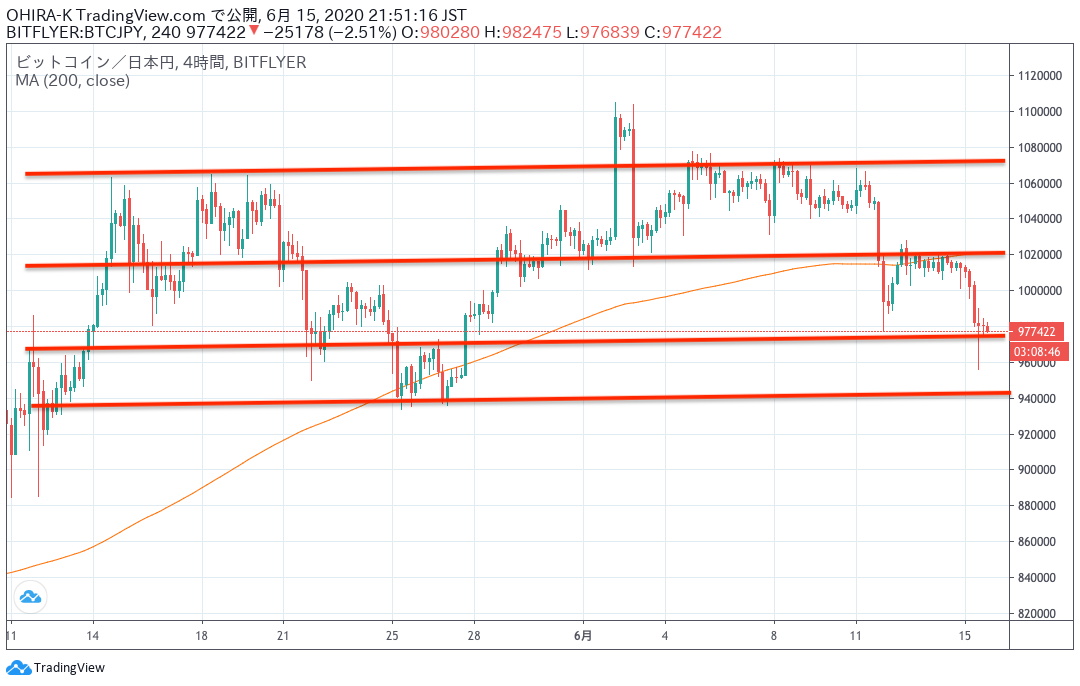
In terms of range, 700,000 to 1,200,000 yen
is the price range.
And the support lines (lines where a fall may
stop) are
94,000 yen and 85,000 yen.
I personally think that if it falls to these levels,
I would like to buy on dips.
I would like to buy on dips.
【Comparison with Major Financial Instruments】
From June 10, just before the recent decline,
the Dow Jones and Nikkei Stock Average
and Bitcoin will be compared.
June 10
Dow: 27,000
Nikkei: 23,100
Bitcoin: 106
Lowest price (June 10 to 15)
Dow: 25,000
Nikkei: 21,500
Bitcoin: 98
June 15
Dow: 25,700
Nikkei: 22,500
Bitcoin: 103
Decline rate
June 10 → 15
Dow−5%
Nikkei−3%
Bitcoin−3%
In this drop, it is clear that
U.S. stocks are falling sharply.
For both currencies,
they hit lows between the 10th and 15th,
and by the 16th they had somewhat rebounded
to some extent.
This is the situation.
What surprises me is the resilience of Bitcoin.
Compared with the Dow and the Nikkei, to date the market capitalization is still relatively small,
yet the decline rate is modest,
and it has kept around the 1,000,000 yen level.
On the 16th, President Trump announced
a trillion-dollar infrastructure plan, indicating substantial fiscal spending.
Will the economy recover by spending on infrastructure now?
(Is it to win votes in the 2020 presidential election?)
Bitcoin might be the main target...
【Lebanon's currency plunges 70%】
This year, in March, Lebanon announced default (inability to pay its debts),
and its currency has plunged by 70%.
In order to defend their own currency,
the government has restricted dollar purchases.
The public is reportedly buying Bitcoin.
There are reports of such activity.
From this, it seems
· in an economic crisis, cryptocurrencies are gaining influence as a safe asset
· more countries are facing economic crises.
· it becomes late to buy alternative assets after a crisis begins (government regulation prevents it)
This is the conclusion.
The value of currencies is relative to other currencies.
Thus, when one falls, the other tends to rise.
In Japan and other places, amid currency inflation, there is a motive to convert assets into something that will gain value in the future,
and this trend is spreading even among the wealthy.
Lebanon's currency collapse and the Bitcoin premium
Details here
https://bitcoin-newstart.com/lebanon
【Caiba Network's surge
Analysis】
The decentralized exchange Caiba Network
has risen fivefold within the year.
What is Caiba Network?
It is a decentralized exchange,
unlike user-hosted exchanges like BitFlyer,
where the exchange itself is run by programs
and users trade directly from their wallets,
reducing the risk of hacking considerably.
Another advantage is low fees.
And the advisors for Caiba Network include Ethereum’s
Vitalik Buterin
I bought Caiba Network in 2017, but
in 2018 and 2019 I experienced significant drops.
Caiba Network chart
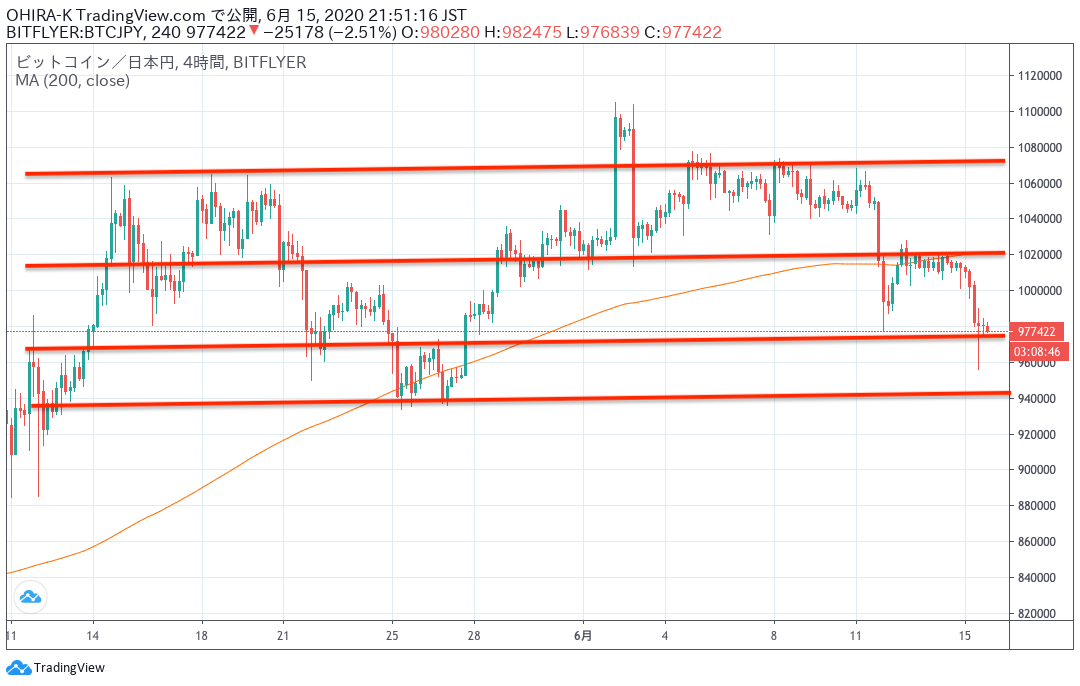
I left it as is, but this year it has surpassed fivefold
In May, trading volume exceeded 100 billion yen,
a new all-time high, drawing attention.
Decentralized exchanges themselves are touted as the next-generation exchanges,
and while Binance and Coinbase
have been expanding their businesses abroad,
their prices have not reflected this clearly.
(Excluding Binance Coin)
Also to watch is
Caiba Network
which is built on Ethereum,
and with Ethereum 2.0 released, Caiba Network
could see even higher processing capacity,
attracting more attention.
Caiba Network itself is available for purchase on overseas major exchanges such as
Binance and Coinbase,
but rather than forcing purchases, I think it is sufficient to consider investing in Ethereum domestically.
For details on Caiba Network, please see
here.
)