
Could natural rubber make a comeback? [Ryuji Sato]
Ryuuji Sato Profile

Sato Ryuuji. Born in 1968. After graduating from a US university in 1993, he joined Genesis Co., Ltd. (later Oval Next Co., Ltd.), a vendor of information on finance and investment, after working at a marketing company. He writes analyst reports on macroeconomic analysis, exchange rates, commodities, and stock markets, and is involved in trading. In 2010, he founded “H-Square Co., Ltd.”, writes analyst reports, plans and publishes “FOREX NOTE Currency Handbook,” etc., and serves as a radio program caster for investment-related content. Individual trader. International Federation of Technical Analysts – Certified Technical Analyst. Main caster on Radio Nikkei “The Money Onoote’s Market Forecast” (Mondays 15:00–).
Official site:Ryuuji Sato Blog
※This article is a republication/edit of an article from FX Strategy.com August 2020 issue. Please note that the market information described in the main text may differ from the current market.
A 12-year Low
When I wrote about the natural rubber market in this February issue, the Tokyo Rubber futures were above 200 yen per kilogram, with signs of a change in supply and demand dynamics and a potential for further gains. However, the market changed drastically due to the impact of the novel coronavirus. At one point it dropped to its lowest since March 2009, and later recovered somewhat, but the rebound was slow. This time, I will consider the future of the sharply fallen rubber market.
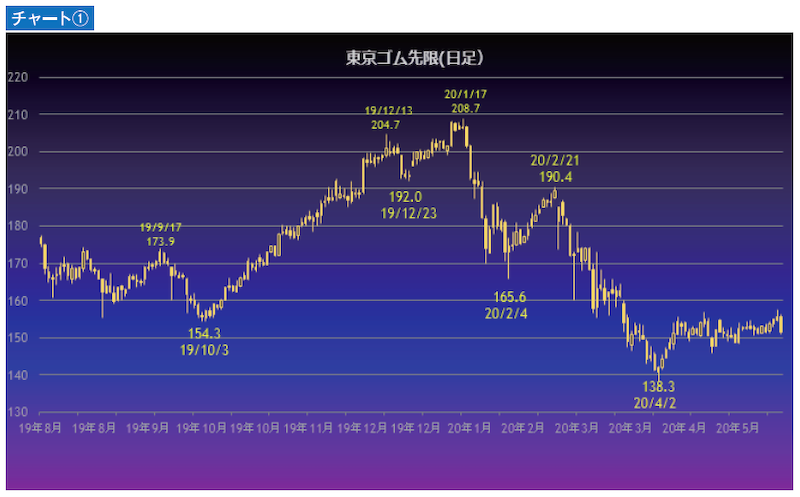
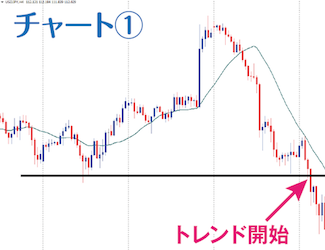
First, let’s briefly review the rubber market this year using the Tokyo Rubber futures chart (price quote per kilogram) (see Chart ①). As the U.S. Federal Reserve’s stress relief began to stimulate stock market gains since last October, natural rubber prices started rising, and on January 17 this year they rose to 208.7 yen. However, during the January rally there was no accompanying trading volume, and the nearby spread widened to over 32 yen (spot price rose slowly). It was exactly a peak-range movement.
At that moment, the novel coronavirus began to spread, centered in Wuhan, China. The rubber market began to plunge, breaking below 200 yen on January 21, and by January 27 it fell to 170.0 yen. That is an 18.5% drop in just six trading days. Furthermore, on February 4 it touched 165.6 yen, and on February 21 it recovered to 190.4 yen, but as the global pandemic spread, the decline became almost one-sided, and by April 2 it dropped to 138.3 yen, the lowest since March 17, 2009—about 12 years prior. A 33.7% drop in two and a half months. Since mid-April, it has been in a 5-yen range, fluctuating around 150 yen.

The official site for Japan’s only monthly FX specialized magazine “FX Strategy.com” is here