

Virtual currency market analysis [May 26 Issue]
Bitcoin fell from the early 1 million yen range last week
after starting to drop on the 24th,
and is trading around 950,000 yen.
Bitcoin 4-hour chart
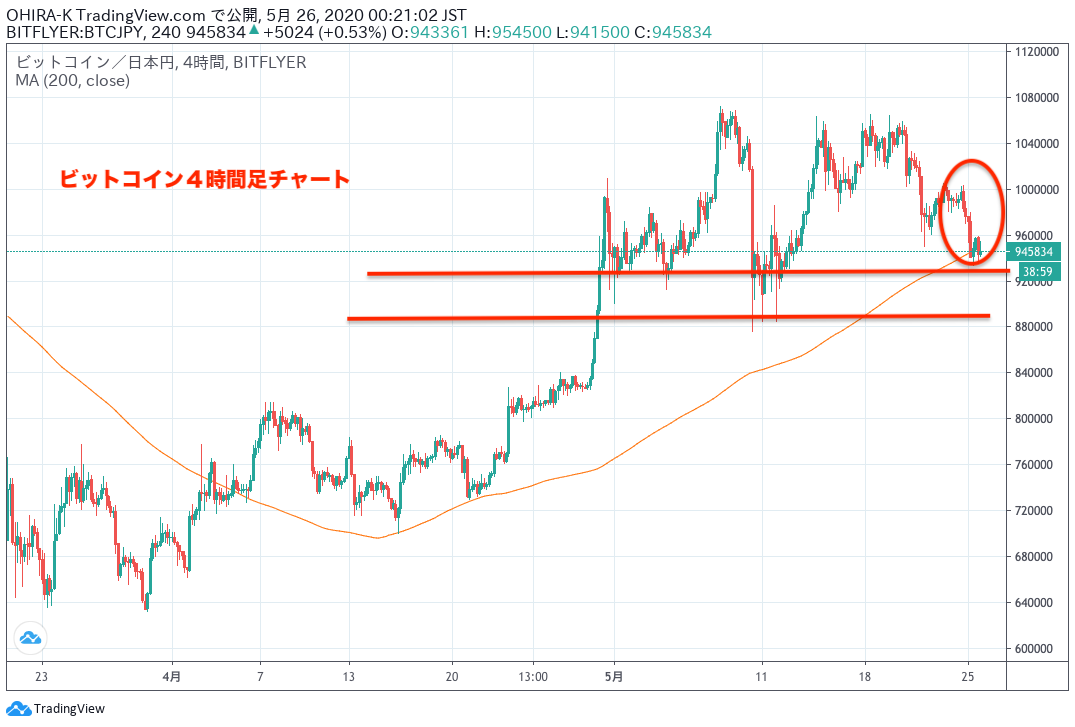
The current price is drawn down to 920,000 yen
to the price band of the red horizontal line
that is the range.
(Think of it as a zone with a certain width)
This line has been touched three times now,
in early May, mid-May, and late May.
There have been two previous rebounds rising from it,
and it remains to be seen what will happen next.
Next, I will look at the daily chart
Bitcoin daily chart
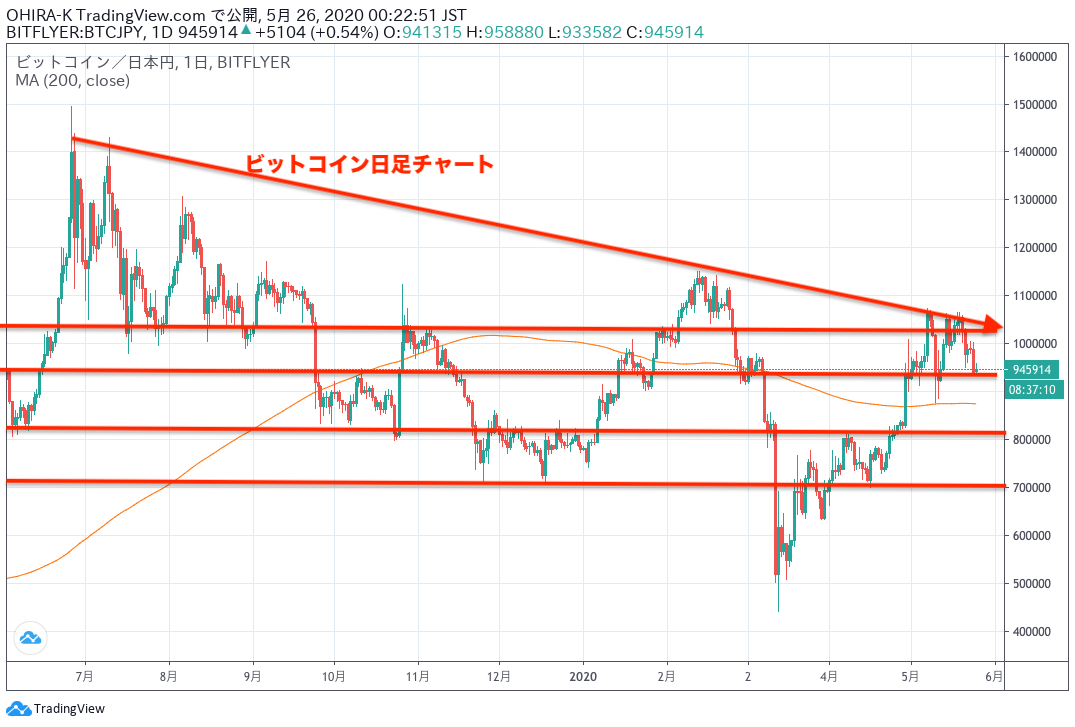
From last year to now, there isn’t much directional clarity, but
if we consider the 500,000 yen level from the COVID shock as an exceptional case,
roughly between 700,000 yen and 1,100,000 yen
the price has been oscillating within a range.
Many readers regularly buy Bitcoin every month,
but as one point,
when the price falls to a line drawn at such a low point,
it can be considered a buying point
to invest efficiently.
Because the market is in a certain range,
there are many cases where people end up buying at the same level,
but on average,
the acquisition cost, the buying price, is
lower.
That level and
the Bitcoin Fear Index
together allow for further
refinement of buying timing.
*The interpretation and timing of the Fear Index
are described in exclusive content for newsletter subscribers
that has not been published yet.
A somewhat large recent downturn is
attributed to
the rising mining difficulty.
On May 12, Bitcoin halving occurred,
and the reward for miners was halved.
Because of this, some say mining is unprofitable
and selling pressure from Bitcoin holders has increased.
*Another factor is an address from early Bitcoin
that is believed to belong to the creator Satoshi Nakamoto,
which saw a large amount of Bitcoin move, prompting concerns of large-scale selling.
There is talk of selling pressure from that possibility as well.
【Staking Ethereum to earn rewards】
Ethereum is planned to be updated this year,
and with the update,
a system called POS will be introduced,
where simply holding Ethereum in an exchange will earn interest.
In this case, exchanges will manage customers' Ethereum
and distribute the corresponding interest to themselves and customers.
In Japan,
POS interest rewards are already distributed on Coincheck
using cryptocurrency risk every Wednesday.
https://bitcoin-newstart.com/coincheck-staking
People who manage the investment are called validators,
but recent news regarding validators
states that to become a validator one must deposit “32ETH” into the platform, and the annual reward is estimated to be between 2% and 18% depending on the amount ETH used for network security. At the time of writing, with a price of 1ETH = 22,000 yen, a 32ETH deposit is worth about 7 million yen.
and up to 18% annual yield is possible.
This means it can be possible to operate with up to 18% annual yield.
Regarding Ethereum, at first it is expected that the return would be around
about 10% or less as the return, if you allocate it with the operator.
However, the subsequent interest may decrease depending on market conditions.
In Japan, many people are expected to deposit Ethereum, and domestic exchanges are expected to be the first to start Ethereum staking.
However, the interest may be significantly taken by the overseas platforms.
Considering the risks of Coincheck, etc., foreign exchanges such as Binance tend to distribute more interest to customers.
*But domestic exchanges are under the supervision of the Financial Services Agency, so in case of emergency, customer assets are currently safeguarded in full.
In any case, buying Ethereum and staking it to earn interest implies that prices become more stable.
Therefore, at least before Ethereum 2.0, I personally think it is better to have Ethereum in place.
About Ethereum 2.0
see here
https://bitcoin-newstart.com/eth2-0
【Buying points based on Bitcoin mining difficulty?】
There is a method to explore buying points for Bitcoin by looking at mining difficulty.
This method examines Bitcoin's buying points using the difficulty ribbon.
The difficulty ribbon
is a ribbon formed by the moving average of difficulty.
This is what the ribbon chart looks like.
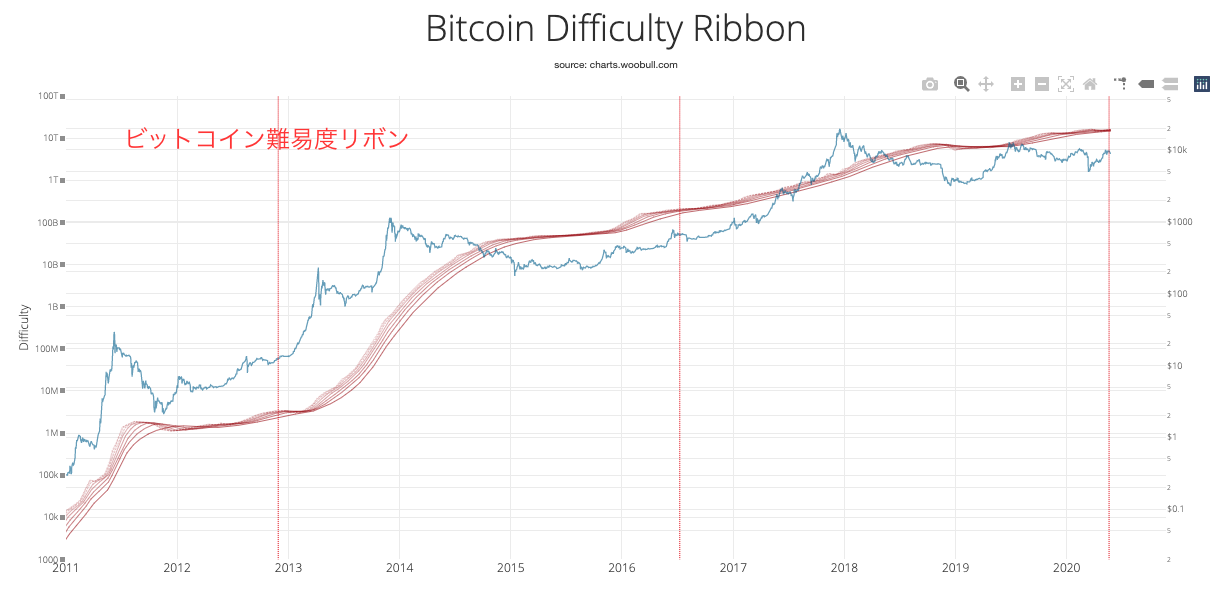
Bitcoin's difficulty and
the moving average (ribbon) are displayed on the chart.
Official site for the Bitcoin Difficulty Ribbon
https://charts.woobull.com/bitcoin-difficulty-ribbon/
The method for verification from here is,
)