
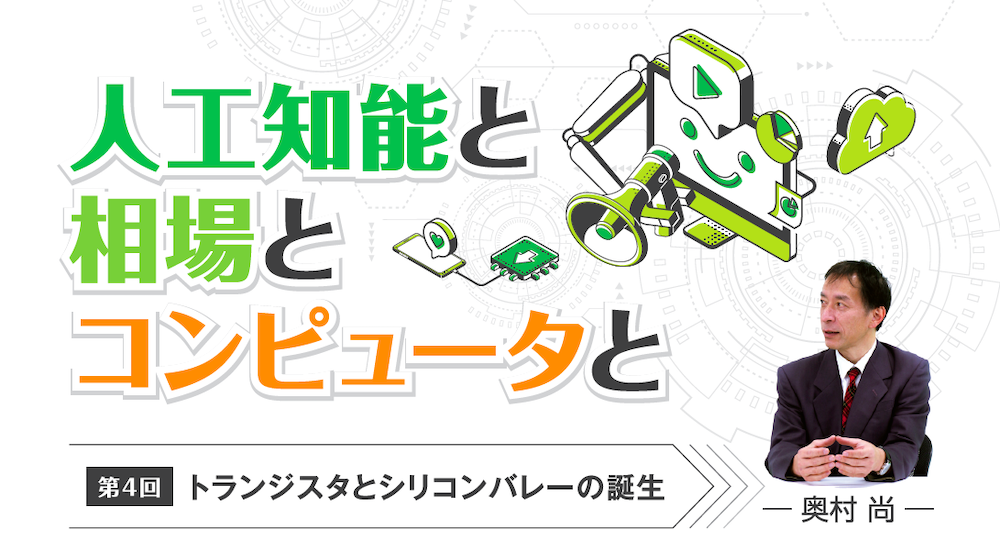
Artificial Intelligence, Markets, and Computers | Episode 4: The Birth of the Transistor and Silicon Valley [Naomura Okumura]
Ogura Hisashi Profile

Okumura Hisashi. Graduated from the Master’s program in Engineering in 1987. Focus: AI (Artificial Intelligence). Developed numerous mathematical models at Nikko Securities. Co-developed an investment model with Stanford University professor Dr. William Sharp (Nobel Prize in Economics 1990) and led the world’s first online distribution of Tokyo Stock Exchange prices. Furthermore, he established venture companies with Israeli MOSSAD science consultants, commercialized AI technology, and introduced it to major airports. He has a strong track record at the intersection of finance and IT. Currently provides models that evaluate analyst ratings with AI, “MRA,” AI-estimated near-future FX rates, “FXeye,” and chart analysis that displays risk and return, “Twilight Zone.” To raise financial literacy in Japan, he hosts a Financial Literacy School.
Hobbies include audio and sports. He began aerobic competition 15 years ago, winning NAC Master Division Singles 9 consecutive times, 2nd place in Seniors in 2016, represented Chiba Prefecture in the 2014–2016 Japan Championships, and was Runner-up in 2017–2018 Japan Championships Masters 3. Although described as athletic, he is actually “poor at ball sports.” His motto is “There is no such thing as being too late to make any decision.”
Blog:https://okumura-toushi.com/
※This article is a reprint/edit of FX攻略.com July 2020 issue. Please note that the market information described in the text may differ from current market conditions.
Three Bell Labs scientists who developed the transistor
The transistor’s official invention date is December 23, 1947. The first transistor was called a point-contact transistor, but its operation was unstable and would stop functioning after about an hour.
Both vacuum tubes and transistors operate as signals amplifiers or switches. Vacuum tubes consume a lot of heat and power because they heat the heater by applying high voltage to the electrodes. Before the heater warms up, electrons do not flow, so it does not operate. The filaments used in heaters also had limited lifespans (a few thousand hours at most). They were glass, large and heavy, and vulnerable to vibration and shock, making mobile use difficult.
Transistors overcome almost all the drawbacks of vacuum tubes: they are small, consume less power (and thus generate less heat), and withstand shocks. However, early transistors were not stable in operation. The team that developed the transistor at Bell Labs consisted of John Bardeen, Walter Brattain, and William Shockley, with Shockley taking a leading role in development. The point-contact transistor was not suitable for mass production, so the junction transistor, which achieved stable operation around Shockley’s leadership, was developed (Figure 1).
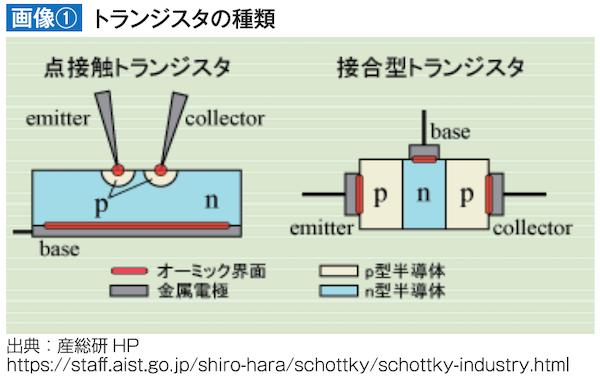
The patent took effect in 1951. Shockley received the Nobel Prize in Physics in 1956 for this achievement. It seems he was not happy about sharing the prize with the two teammates who also received it simultaneously (as he recalled in his autobiography).
Marvin B. Runyan, director of Bell Labs who oversaw the project, believed that transistor development should not be confined to Bell Labs. He defied the U.S. Department of Defense’s opposition to keeping the technology as a national secret and decided to publish the patent. The patent was published in 1954, with a reasonable license fee of $25,000. This led to widespread adoption of the transistor and a drastic transformation of the world.

The official site of Japan’s only monthly FX specialized magazine “FX攻略.com” is here