
The Market Tide of "Demand-Supply Oni" Tetsuo Inoue — Professional Market Analysis Know-How and Notable Stocks Revealed! | Episode 3
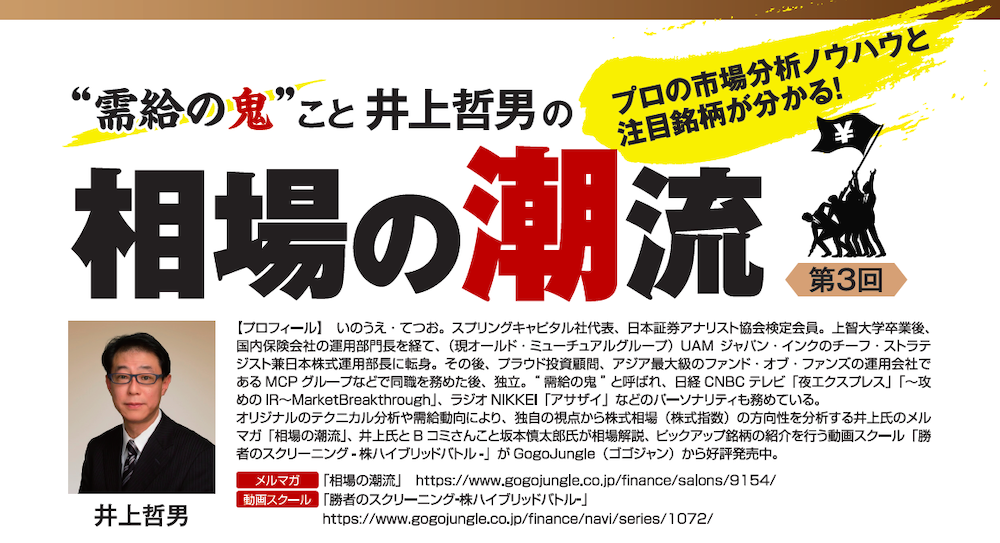
Profile of Teppei Inoue

Inoue Tetsuo. Representative of Spring Capital, member of the Certified Members of the Japan Securities Analysts Association. After graduating from Sophia University, he served as head of operations at a domestic insurance company, then became chief strategist and head of the Japanese equity operations at UAM Japan Inc. (now Old Mutual Group). He later held similar positions at Proud Investment Advisory and MCP Group, one of Asia’s largest fund-of-funds operators, before going independent. Known as the “demand and supply demon,” he also serves as a broadcaster on Nikkei CNBC TV programs “Evening Express” and “〜Aggressive IR〜 Market Breakthrough,” and on Radio Nikkei programs such as “Asuzai.”
From his original technical analyses and demand-supply trends, Inoue analyzes the direction of the stock market (stock indices) from his unique perspective in his newsletter “Market Trends,” and in the video school “Winner’s Screening – Stock Hybrid Battle –” where Inoue and B Komi’s Shintaro Sakamoto discuss market commentary and introduce highlighted stocks; these are well-received on GogoJungle (GogoJungle).
Newsletter:Market Trends
Video School:Winner’s Screening – Stock Hybrid Battle –
*This article is a reprint/edit of an article from FX攻略.com June 2020 issue. The market information described herein may differ from current market conditions, so please note.
The U.S. cash-out movement has not stopped yet
The unstable market caused by the novel coronavirus initially involved a tug-of-war between stocks/oil and gold/bonds in terms of risk-on/risk-off. As the gold price collapsed and the Fed’s zero-interest-rate policy prevented a “promotional market” that would push further high in the bond market, the flow shifted to “securities vs. cash.”
With an expected $2 trillion economic stimulus package, on March 24 the Dow logged the largest single-day rise in history, up 2,112 dollars, and continued to rise on March 25. However, that day’s NYSE trading volume was 1.8 billion shares, more than twice the normal benchmark of 800 million, indicating that cash-out movement had not yet subsided.
For reference, the first major shake in the U.S. market occurred on February 24, when the Dow fell 1,031 dollars. Excluding the SQ day, the average trading volume on all business days was 1.73 billion shares, and it cannot be said the market has stabilized unless it does not drop below 1.2 billion shares.

Here is the official site of FX攻略.com, Japan’s only FX specialty magazine.