
"Market Storyteller" Koichiro Ameya 8000-character interview "Tales of the Rough Riders in the Foreign Bank Era and the Future of the FX Industry"
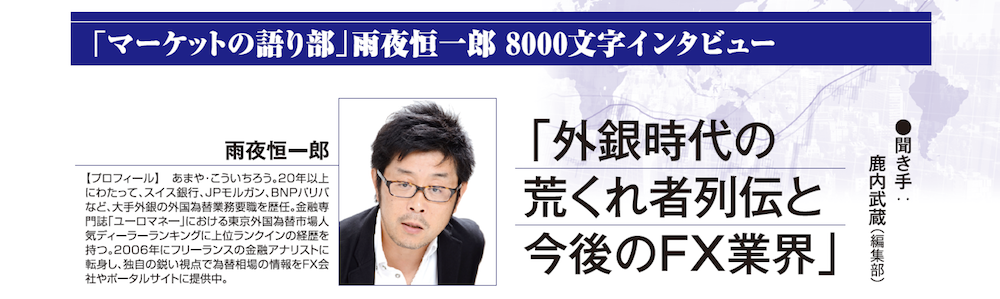
Profile of Abeiya Ichirou
For over 20 years, he has held senior foreign exchange positions at major foreign banks including Credit Suisse, JP Morgan, and BNP Paribas. He also has a track record of ranking highly in the Tokyo foreign exchange market as reported by the financial trade publication Euro Money. In 2006, he became a freelance financial analyst, providing FX market information to FX companies and portal sites from his sharp and unique perspective.
● Interviewer: Takeshi Kanna (Editorial Department)
Sharpening instincts in foreign banks during the dawn of the FX era
Kanna: Mr. Abeiya, you’re known for moving through major foreign banks, but why did you decide to work in foreign banks after graduating from university?
AbeiyaOriginally, I took the city bank entrance exam, but I failed. I decided to try foreign banks as well, which was the initial motivation. When I tried it, I realized that path seemed more interesting.
When I was job hunting in 1985, foreign banks like JP Morgan and Chase Manhattan were just starting to be recognized by Japanese students. It was just before the bubble era, so job hunting was quite tough. After applying to several foreign banks, I chose First Chicago Bank because of my English ability and because they were the strongest in the industry at the time.
Kanna: At that time, was it common for people to join foreign banks?
AbeiyaEven if you mentioned the company name, not many people knew it. Our同期 who joined as new graduates was about 10 people. However, First Chicago Bank stood out dominantly in the industry at the time. Also, it was an era when the yen was strengthening, so it was possible to make substantial profits. Since compliance wasn’t as strict as now, we held as many positions as we liked.
Kanna: Today, traders can access a lot of information from the Internet, but how did you gather information back then?
AbeiyaBack then, the information sources were Reuters, Dow Jones, and in Japan Jiji Press. The company’s computer could only display rates. News was output on a telex-like machine with rough printouts, and even if you wanted to review the same news later, it wasn’t easy. Also, all sources were in English, so I translated everything with great effort.
Kanna: If you don’t understand English, it’s impossible to talk...
AbeiyaI read English all night. Then, when senior staff arrived the next morning, I’d show them, “There was this news!” They told me to summarize the news overnight and teach it to them the next morning.
Today you can view all information for free on the Internet, but back then no one knew when which country’s financial policies would be announced.
Kanna: Now information is open to everything, and the information gap has disappeared, right?
AbeiyaBack then, central banks were not always willing to publish information. Sometimes financial policy changed abruptly. I would directly call the head office and have FOMC minutes faxed to Japan, then translate them into Japanese. The effort to gather information was many tens of times greater than now.
Kanna: It’s a far cry from today, when you can see information for free online.
AbeiyaIn that sense, I think the dealers who were active then already had a foundation. If you didn’t move on your own, you wouldn’t receive any information at all. Still, foreign banks tended to have more information. We had connections, like asking an economist in New York for necessary materials to be sent. In a sense, I was fortunate.

This is the official site of FX攻略.com, Japan’s sole monthly FX specialty magazine.