
Artificial Intelligence, the Market, and Computers | Episode 1 Prologue [Naohiko Okumura]
Naoto Okumura Profile

Okumura Hinshi. 1987, completed Master in Engineering. Field: AI (Artificial Intelligence). Developed numerous mathematical models at Nikko Securities. Co-developed investment models with Stanford University professor Dr. William Sharpe (1990 Nobel Prize in Economics) and led the world’s first online transmission of Tokyo Stock Exchange prices. Established a venture with Israel’s Mossad science advisor, commercialized AI technology, and implemented it at major airports, with many achievements at the intersection of finance and IT. Currently offers models that evaluate analyst ratings with AI “MRA,” AI-estimated near-future FX rates “FXeye,” and chart analysis “Twilight Zone” displaying risk and return. To improve Japan’s financial literacy, hosts a Financial Literacy School.
Hobbies: audio and fitness. Began aerobic competitions 15 years ago, NAC Master Division Singles 9 consecutive titles, 2016 Senior 2nd place, 2014–2016 Japan Championship Chiba Prefecture representative, 2017–2018 Japan Championship Master 3 runner-up. Athletic and versatile in claims, but actually “tone-deaf,” and not good at ball games. A motto: “No decision is ever too late.”
Blog:https://okumura-toushi.com/
The History of Artificial Intelligence in Board Games
Artificial intelligence realizes human wisdom, know-how, and judgment through machines. It is a technology by which machines can think, decide, and act on their own. The world’s pride in its existence is most evident in the overwhelming achievements in board games such as chess, shogi, and go.
Shogi and chess originate from Indian board games. Both aim to capture the opponent’s king, and the roles and movements of pieces are similar. Pieces move in units of squares; chess uses 8×8 squares, shogi 9×9. Shogi offers a wider action range and captured pieces can be reborn as opponent’s pieces, making the rules more complex. Go has different rules for piece movement and victory, and the board is 19×19 thus even more complex.
I may dive deeper into AI in these games in the future, but for now, what comes to mind is chess. It has fans worldwide, with an estimated 500 million enthusiasts. Go has an estimated 40 million enthusiasts (less than chess by about one-tenth), and shogi is not widely spread globally, estimated at about 10 million (all figures include overlapping enthusiasts in the world population; sources: Leisure White Paper by The Productivity Center, etc., as estimated by the author).
Chess has many enthusiasts and simple rules, which helped it become the earliest game to undergo computer analysis and AI development.
One observation is that there are often debates on whether a technology is artificial intelligence. This article is not a contribution to an information engineering journal, so I will not focus on precise AI definitions or classifications. I will use terms I intuitively think are easy to understand, such as computer, artificial intelligence, algorithm, and program, in various expressions.
Now, the first participation of a computer chess program in a human chess championship was in 1967. Even then, it had a certain level of completeness and was considered somewhat strong among amateurs. It was a good result for a first challenge. AI continued to evolve, but it did not beat top professionals until the late 1990s.
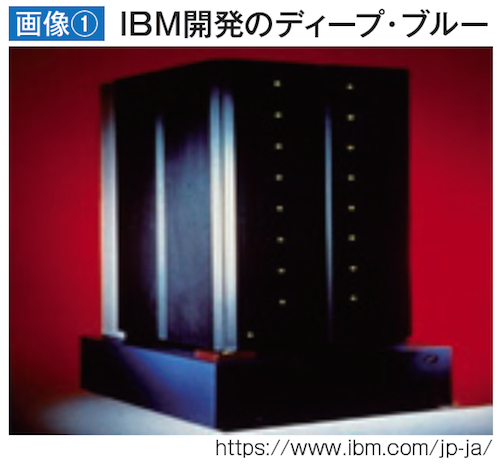
The turning point came in 1997. In that year, the world champion in chess was defeated by an AI machine named IBM “Deep Blue.” Garry Kasparov, the then world champion, lost to Deep Blue (Image ①). Kasparov had defeated Deep Blue the year before, but lost one year later. It caused a huge stir that “computers surpassed humans.”
In shogi, in the 2015 Denou Sen (Japan), a match between 5 pros and 5 computers showed near parity. Pros used machine-driven quirks and surprising moves to induce bugs and win 3–2. However, in 2016, pros suffered a losing streak, and AI showed overwhelming strength.
In go, in 2016 Google’s program “AlphaGo” defeated the world’s strongest professional Go player, Lee Sedol, 9-dan. This is evidence that AI has reached beyond human capabilities.
If AI capabilities could be applied to investing, money could be increased automatically. Winning at shogi and chess is not as lucrative as making money. This is the dream pursued by major capital and geniuses around the world.
This time we will trace AI’s long history. Since AI runs on software in computers, the hardware capabilities of computers are also important. Along with software evolution, I would like to introduce hardware history as well. FX, especially the history of the USD/JPY, is contemporaneous, so we will progress while discussing FX history as well.