
"The Evangelist of Scalping" FX Demon 8000-character interview "Behind the Scenes of the FX Dawn and the Dream and Reality of Scalping"
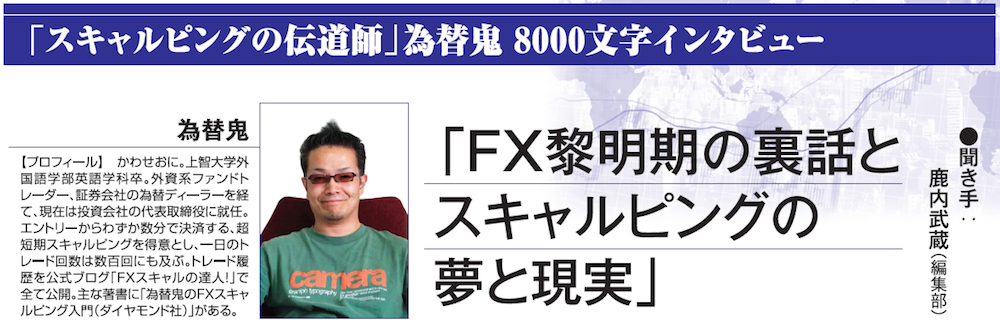
Profile of the FX Oni
FX Oni. Graduated from Sophia University, Faculty of Foreign Languages, Department of English. A former foreign fund trader and a former FX dealer at a securities company, now serving as the representative director of an investment company. Specializes in ultra-short-term scalping settled in just a few minutes from entry, with hundreds of trades per day. All trading history is disclosed on the official blog "FX Scalping Master!" His major book is "FX Scalping Introductory Guide by FX Oni" (Diamond Publishing).
● Interviewer: Takeshi Kanna(Editorial Department)
Even at 400x leverage, the costs were in the dawn of the industry
Kanna: First, could you tell us about the early days of the FX industry? This magazine was launched in 2008, but FX Oni had been trading FX even before then, right?
FX OniYes. I started FX around the end of 2001.
Kanna: FX was legalized in Japan in 1998, so you entered quite early, didn’t you?
FX OniI suppose so. Before that, I was doing stocks, but when I tried FX I was shocked that you could start with a very small amount. After all, to trade stocks you typically need 5–10 million yen, but with FX you could trade with only tens of thousands of yen. I was really struck by this world—a real culture shock.
Kanna: So it was a completely different world from stock trading. Were you successful in stocks as well?
FX OniStocks gave me no good memories. I was a cram-school instructor at the time, and although my salary was decent, I would put all my money into stocks, lose, and then be required to make up the losses—the cycle.
Kanna: Given your FX track record, that’s surprising. By the way, cram-school instructors aren’t highly paid, are they?
FX OniIt’s a high-demand business. Even young, popular people can earn 10 million yen a year as a matter of course. Mr. Hayashi from Tohshin High School probably earns several hundred million yen.
Well, that's beside the point. Anyway, I couldn’t win at all in stocks. There’s a cognitive dissonance—people tend to avoid unpleasant things. When the unrealized losses grew, I stopped looking at them. I’ve lost several tens of millions in total on stocks.
Kanna: From there you entered the FX world, but what was FX industry like back then?