
U.S. employment statistics a relic of the past? [A Water Travel Journal]
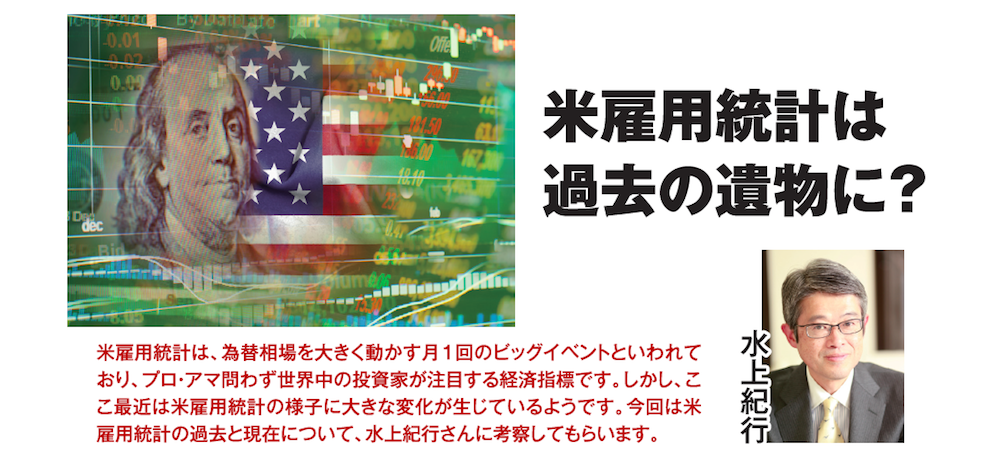
The U.S. employment statistics are considered a monthly big event that moves forex markets substantially, a key economic indicator that investors around the world watch, regardless of professional or amateur status. However, recently there seems to be a major change in the state of the U.S. employment statistics. This time, Nobuyuki Mizukami will give his thoughts on the past and present of U.S. employment statistics.
Profile of Noriyuki Mizukami

Mizukami Noriyuki. President of Banya Market Focus. After graduating from Sophia University with a degree in economics in 1978, he joined Sanwa Bank (now Mitsubishi UFJ Bank). After five years in branch operations, he worked as a forex dealer in London, Tokyo, and New York. He is known in the Tokyo Foreign Exchange Market as “Mizukami of Sanwa.” He served as Foreign Exchange Department Head at Dresdner Bank. From 1996 at RBS Bank, he served as Foreign Exchange Head and then Foreign Exchange Sales Director. Since 2007, he has been the President of Banya Market Focus. His highly accurate market forecasts, based on decades of experience and knowledge, are well regarded.
What happens at the time of the release is not investors but speculators
As a rule, the U.S. employment statistics released on the first Friday of every month has been the most watched economic indicator by the entire market for over the past 20 years. On the day of the U.S. employment statistics release, traders from around the world would be on standby in trading rooms, creating a festival-like atmosphere. Recently, however, the situation has changed.
Recently, only speculators participate in real time in the U.S. employment statistics, and the presence of investors, as before, has almost disappeared. If investors participate, they view the market from a long-term perspective, but if only speculators participate, the focus shifts to short-term trading, making it hard for a clear trend to form, often resulting in a short-term “beat and reverse” market.
Recently, investors do not draw conclusions from a single indicator result, but decide their strategy by looking at multiple indicators in chronological order, in other words, they are extremely cautious. When that happens, what remains in the market is only the speculators.