
Foreign Exchange Online: Makoto Sato’s Practical Trading Techniques | Technical and Fundamental Analysis Predicting the Future of the 3 Major Currencies [This Month’s Theme | From Year-start Crash to Spring Rebound!? Testing the Year-end/ New Year Market
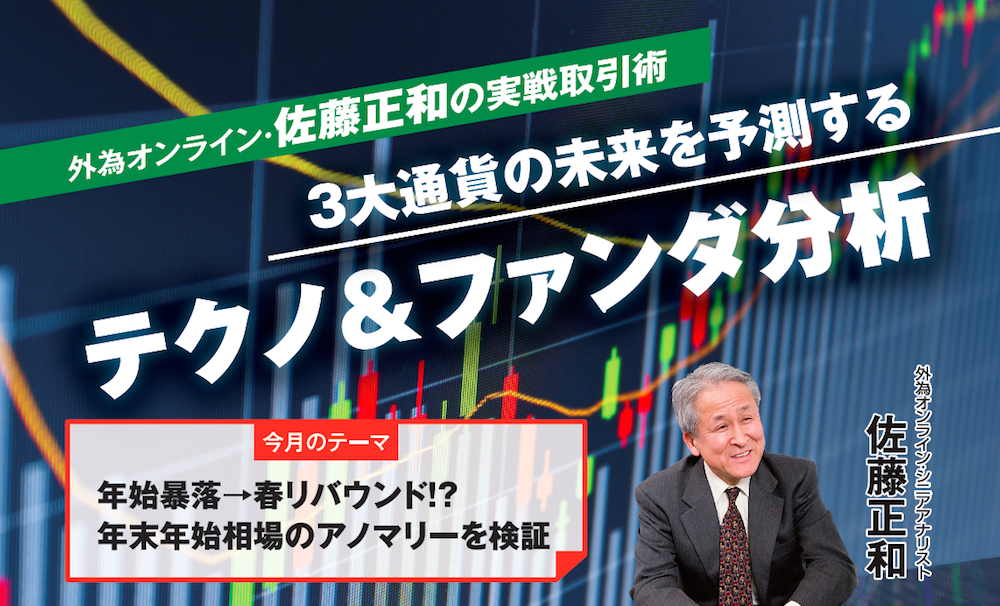
The year-end and New Year market for 2020 is finally entering its climax. For the past five years, the forex and stock markets have always crashed around year-end and New Year. Will this year be different? The focal point will be progress in the US-China trade talks, though that may be only a pretext in part. By reviewing past movements and the causes of sharp swings on the USD/JPY chart, we explore the tendencies of year-end and New Year markets and possible countermeasures.
Note: This article is a reprint/edit of FX攻略.com's February 2020 issue. Please be aware that the market information written here may differ from current market conditions.
Profile of Masakazu Sato

Sato, Masakazu. After working at a domestic bank, he joined the French Parisbas Bank (now BNP Paribas). He has served as Interbank Chief Dealer, Head of Capital, Senior Manager, and other roles. Later, he joined OnlineFX as Senior Analyst, a platform boasting the highest annual trading volume. He has been involved in the currency markets for over 20 years. He also appears on Radio NIKKEI's “Complete Live Commentary on Stocks! Stock Channel↑,” Stock Voice’s “Market Wide - Foreign Exchange Information,” and regularly provides market information on Yahoo! Finance.
As waves of volatility hit at the start of the year, 2018–19 saw an unusually early crash in December
As 2020 approaches, is the forex market buzzing with the usual Christmas Rally, or has the US-China trade talks hit a snag and returned to a volatile, whipsaw market? As of the late November drafting, the situation was shrouded in fog, but one thing is certain: the outcome hinges entirely on whether progress is being made in US-China trade talks. In recent years, year-end and New Year markets have been highly volatile. However, when viewed over a span of 10, 20 years, the USD/JPY and stock prices typically begin to rise around September and end the year on a safe high. Therefore, this time we will examine past year-end and New Year markets to forecast the remainder of 2019's year-end and the upcoming 2020 New Year market.

First, please look at Chart ①. It shows the USD/JPY movement from September 2018 to March 2019, just around the year-end of the previous year. The USD/JPY rose steadily from the March low in the 104 yen range to the October high in the 114 yen range, buoyed by a strong US economy and successive Fed rate hikes. In November and December, the highs were held, but on December 5, the vice chairman of Huawei, a Chinese telecom giant, was arrested in Canada at the request of the United States, heightening tensions between the US and China. The government faced government shutdowns as the federal budget failed to be signed over the border wall issue. The situation that pushed the market into a “total pessimism” turning point was the December 19 Fed FOMC decision to raise rates for the fourth time that year. A hawkish Fed raised concerns that the US economy might be overkill, and the USD/JPY plummeted. On January 3–3, 2019, amid thin liquidity at the start of the year, a long, deep intraday trough around 104–105 yen emerged.
However, on January 4, the unexpectedly strong US jobs data and Chair Powell’s comparatively dovish remarks about monetary policy shifted the market sentiment. From early January, there was a gradual rebound, and by mid-April the market, buoyed by expectations of progress in the US-China trade talks, reached around 112 yen. There have been sharp fluctuations at the start of the year before, but it was quite unusual for the entire financial market to be so unsettled in December as markets move into the Christmas holiday mode with major financial institutions reporting earnings. Since 2016, the start of the new year has often been marked by market turbulence, and the belief that “the year begins with a storm” has perhaps driven investors to seek risk-off positions in a preemptive manner, contributing to the 2018 December Fed rate hike shock. In light of this, even as we approach 2020, it would not be surprising if volatility has already begun at year-end. Naturally, there is a substantial possibility that the 2020 New Year market could also experience turbulence. Investors who brace for year-end and New Year market turmoil could help create stormy conditions themselves due to their anxiety.