
Tell me, Borihira-san! The World’s Most Hands-On Guide to Getting Started with Cryptocurrency — Episode 3: Cryptocurrencies Forks and Mount Gox
FX traders are probably hearing a lot about cryptocurrencies lately. In this feature, for those who are interested but don’t know how to start, veteran trader Borihei (Yazawa Akemi) explains the basics of cryptocurrencies from the ground up. This month’s topic covers new cryptocurrencies that emerged from forks of Bitcoin and the market conditions around 2013–2014.
Note: This article is a reprint and revision of an article from FX攻略.com, July 2018 issue. Please be aware that the market information stated in the main text may differ from the current market.
Characters
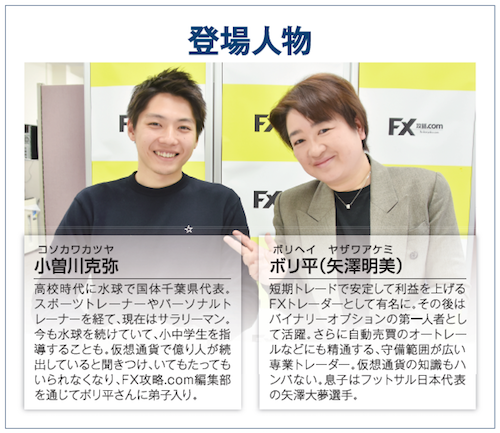
Borihei (Yazawa Akemi)
Famous for consistently earning profits through short-term trading as an FX trader. Later became a leading figure in binary options. He is also well-versed in automated trading systems like AutoRale and other areas, making him a versatile full-time trader. His knowledge of cryptocurrencies is immense. His son is Daemu Yazawa, a player on the Japan national futsal team.
Katsuya Ozu
Represented Chiba Prefecture in national championships in swimming during high school. After careers as a sports trainer and personal trainer, he is now a company employee. He still swims and coaches elementary and junior high school students. Hearing that there are many crypto millionaires, he could not stay still, and through FX攻略.com’s editorial team, he apprenticed under Borihei.
What is a Bitcoin fork?
Ozu: How many types of Bitcoin are there?
BoriheiBitcoin itself is only one type, but there are countless coins that are like relatives derived from Bitcoin (Note 1).
Well-known examples include Bitcoin Cash and Bitcoin Gold. Both were created in 2017.
Ozu: First of all, why do cryptocurrencies fork in the first place?
BoriheiForks can occur due to differing opinions among the people involved in managing the system. Forks are categorized as soft forks and hard forks. A soft fork can be understood as an addition of features that remain compatible. After the new specifications, it continues to exist as the same coin, so technically it does not fork.
In contrast, a hard fork adds incompatible features. The coin with the new features and the coin without them coexist. Both the new and old versions can be mined, so at a certain point they become two separate coins.
Ozu: I see…
BoriheiEthereum has also forked in the past. A hard fork occurred following a hacking incident. Initially, the old version was expected to be left as is and disappear, but there were factions that continued mining, and exchanges added the token as Ethereum Classic, so it exists under that name.
Also, when a hard fork occurs, those who held the original coin receive the same number of new coins.
Ozu: That’s advantageous!
Note 1: While not much information enters Japan, overseas there are countless forks, including some questionable ones.