
Sogo Online - Masakazu Sato's Practical Trading Techniques | Technical and Fundamental Analysis Predicting the Future of the 3 Major Currencies [This Month's Theme | How to target a rebound market after a sharp decline. What useful technical indicators?]

The dollar/yen had remained largely unreactive to the rise in stock prices and was in a stalemate, but it plunged sharply in February. In 2018, a theme of “bad rate hikes” and “inflation acceleration” seems likely, suggesting more unexpected drops could occur in the future. Therefore, this time we thoroughly examine past rebound markets after various currency pair crashes. We introduce highly useful technical indicators and buy/sell signals to target rebound rises that inevitably follow sharp declines.
Note: This article is a reprint and revision of an article from FX攻略.com May 2018 issue. Please note that the market information described herein may differ from current market conditions.
Profile of Masakazu Sato

Sato Masakazu. After working at a domestic bank, he joined French Paribas Bank (now BNP Paribas Bank). He has served as Interbank Chief Dealer, Head of Funds, Senior Manager, and other positions. Subsequently, he became Senior Analyst at FX Online, which boasts the highest annual trading volume. He has been involved in the forex world for over 20 years. He appears on Radio Nikkei’s “Complete Stock Market Commentary! Stock Channel,” Stock Voice’s “Market Wide—Foreign Exchange Information,” and regularly delivers market information on Yahoo! Finance.
An odd development where the US economy is so strong that the dollar/yen falls sharply. Is 100 yen the lower target for USD/JPY?
In February 2018, after the US stock market, which had been at all-time highs up to January, experienced a large drop, the USD/JPY, which had previously shown little reaction to stock gains, fell sharply due to the stock market crash and rising long-term interest rates. The trigger was the January US employment report released on February 2. The surprise was that average hourly earnings rose 2.9% year over year, reaching a nine-year high, a remarkably good figure.
Rising average wages → inflation acceleration → expectations of more Fed rate hikes in 2018 caused long-term rates to rise above 2.9%. The stock market, wary of higher rates, sold off, and the impact spread to the FX market.
It is mysterious that the economy is so strong that stocks and USD/JPY fall. Normally, US rate hikes would be a dollar-positive factor, but because they are seen as potentially harming the economy, US interest rate rises led to dollar weakness, and the side effects included yen strength and euro strength. Even though the stock market had stabilized by mid-February, USD/JPY fell to around 105.50 yen per dollar. It remained unclear how far it would drop.
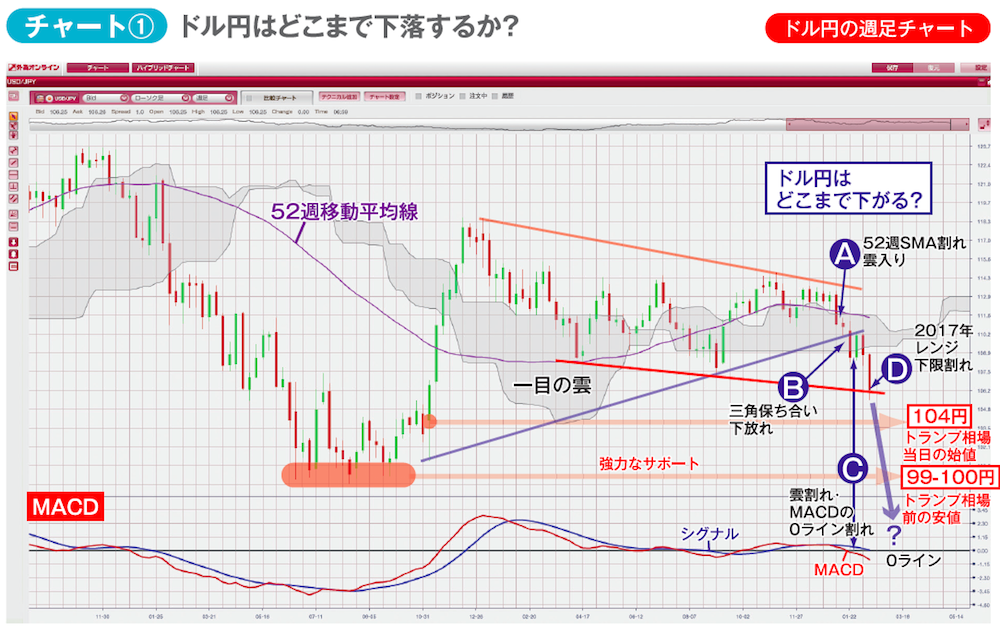
Since 2016, the weekly chart for the past two years formed Chart ① to identify the downside target for USD/JPY. In 2018, the weekly chart showed signals such as A: breaking below the 52-week moving average, entering the Ichimaku cloud, B: a breakdown from a triangle consolidation, C: cloud break, MACD breaking below the 0 line, and D: breaking the lower bound of the 2017 range. I personally think the decline may soon bottom out, though further declines are possible.
Thus, when deriving a support band from past highs and lows at the bottom, the first threshold seems to be around the 104 yen area, where the opening price on November 9, 2016—the day Trump’s presidency was decided—and prior highs sit. If that level is broken, the next target would be the lowest point of the pre-Trump downtrend, around 99–100 yen. This line coincides with the lower bound of the monthly Ichimaku cloud, forming a strong support band.
It seems unlikely that USD/JPY would drop below 100 yen per dollar as long as U.S. rate hikes continue and the BoJ under Governor Kuroda, who decided to continue substantial monetary easing, maintains its stance in Japan. I think a 90-yen level is unlikely unless the U.S. economy peaks or the long-running U.S. stock bubble collapses for some reason. However, there is no absolute rule in FX, and a renewed crash in U.S. stocks could cause an overshoot below 100 yen per dollar.
That said, after a sharp decline, a rebound rise always occurs in the FX market. Therefore, this time we will examine past declines and crashes across various currency pairs to identify reliable technical indicators and investment methods that work for rebound-up phases.