
"The leading authority in astrology" Yasushi Yamanaka 15000-character interview "What technical analysis experts think about gut feeling, textbooks, and the positions of the stars"
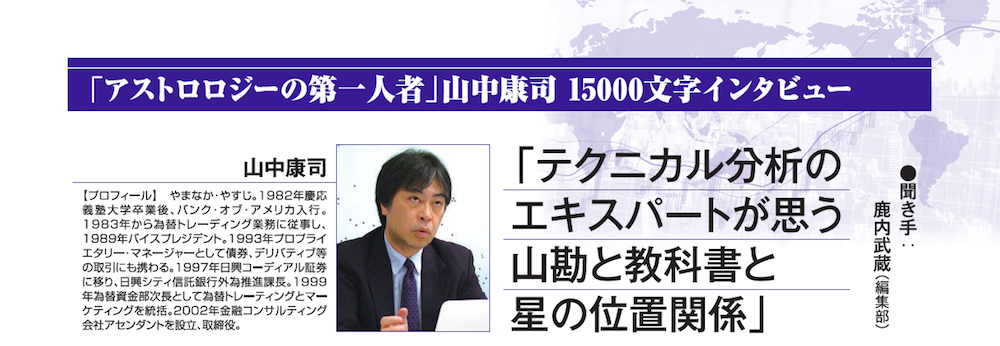
Koji Yamanaka Profile
After graduating from Keio University in 1982, he joined Bank of America. From 1983 he was engaged in foreign exchange trading, becoming vice president in 1989. In 1993 he became a proprietary manager, involved in bond and derivative trading. In 1997 he moved to Nikko Cordial Securities as head of the Foreign Exchange Promotion Section of Nikko City Trust Bank. In 1999 he was named Deputy Head of the Forex Reserve Department, overseeing forex trading and marketing. In 2002 he founded the financial consulting firm Ascendant and became a director.
● Interviewer: Takeshi Kannai (Editorial Department)
※This article is a reprint/edited version of a June 2018 issue of FX攻略.com. Please note that the market information written in the text may differ from current market conditions.
Why Not Read a Global Bestseller
Kannai: Mr. Yamanaka, you give a strong impression of being proficient in technical analysis. When trading, what ratio do you use to reference technicals vs. fundamentals?
YamanakaIn trading, the most influential factor is gut instinct.
Kannai: Haha
YamanakaI often make decisions assuming there is no choice but to buy or sell. I’ve been involved in foreign exchange since 1982, and through long involvement I’ve developed a sense that it must go up or it must go down. If that sense is reflected in the charts, then 70–80% would be technical analysis. Fundamentally, charts assume that all price movements are reflected in the chart.
On the other hand, fundamental analysis is a prerequisite before charting; it helps solidify one’s market view. In 2018, until early March, the USD/JPY was predominantly in a selling trend, and there were fundamental reasons: once the U.S. tax reform settled, Trump’s remaining campaign promises pointed to addressing trade imbalances and a wall on the Mexican border. The wall is a minor issue, so the main question is how to handle the trade imbalance. Under these conditions, the USD/JPY would strengthen the yen, i.e., it would move lower. After that, I would look at the chart and decide where a break would lead to further declines. If the price breaks the previous month’s low, that’s a definite sell. Even if it finds a support once, selling again at a rebound usually yields profit.
This year this strategy has worked, but such large-scale scenarios are built only a few times a year. That requires fundamental analysis. However, I don’t pay attention to individual economic indicators. Employment data, given the current climate, will surely show good numbers. Even if a single month shows bad data and the dollar briefly sells off, it does not affect the overall trend.
Kannai: I see. So this decision-making approach, incorporating fundamentals, is what you called gut instinct at the beginning.
YamanakaYes. It may look like gut instinct to others, but it’s a judgment based on experience.
Kannai: Do you use moving averages or oscillator-type indicators?
YamanakaI don’t look at them for my own trading. A chart with nothing displayed is easier to read. However, when I teach others at seminars, I may explain using technical analysis that closely matches my own sense. I trade mostly on intuition, but that doesn’t lend itself to explanations.
Kannai: That’s a sense backed by experience.
YamanakaYes. As I used moving averages, Bollinger Bands, and RSI, I realized that “if you view it this way, it would be good for beginners and intermediates to learn from my experience, and to gain experience themselves.”
Kannai: So you usually trade on a fairly simple screen.
YamanakaYes. I pay attention to Fibonacci Retracements and Fibonacci Expansions; it’s important to know how far stocks may go up or down.
Kannai: If you had to specify the ratio of technical analysis to fundamental analysis in a nuanced way, what would it be?
YamanakaTechnical 80, Fundamentals 20. The share of technical analysis is overwhelmingly high. However, technical analysis isn’t 100%. In 2018, by early March, I had 44 trades, all selling. If I relied only on technical analysis for trading, there would have been some buying trades too.
Kannai: For individual investors like you, with extensive experience, how should one relate to technical analysis and fundamentals?
YamanakaIn terms of ratio, 1 to 1. It’s better not to cling to one method with preconceived notions; study various approaches. Fundamentals also have depth.
Kannai: I understand. If there are any good books to study, please tell us.
Yamanaka“Financial Market Forecast Handbook for Investors” published by NHK Publishing is good. The author is from Sumitomo Mitsui Trust Bank Market Operations. It reads like a university textbook, covering Japan, the U.S., and Europe, and explains various financial policies. If you know this, you can perform fundamental analysis. So I tell individual investors: if you really want to study FX, read this book.
During my time at the bank, I was approached by various media outlets for interviews. When that happens, I first ask, Have you read this book? It’s been published for over twenty years. If you haven’t, please read it first before contacting us.
As for technical analysis, John J. Murphy’s “Technical Analysis of the Financial Markets.” This book explains the basics of technical analysis. Reading such textbooks and researching the unclear parts will help you naturally learn both fundamental and technical analysis.
Kannai: It’s a textbook for improving FX skills. However, these classic reference books are probably not read by many people.
YamanakaIf you want to know what books those people read, for example, FX books piled up on bookstore shelves exist because of publishers’ promotions. The world’s most-read technical analysis book is Murphy’s book, as mentioned earlier. If you go to the U.S. Wall Street, this book is the best-seller. It covers chart analysis, technical indicators, and all the basics. There may not be a FX book that surpasses it, and if there is, it’s unlikely to be translated into Japanese.
Kannai: Do you also read Western books?
YamanakaBasically I don’t read many Japanese books. The amount of information is overwhelmingly in English.
Kannai: Many books are not translated into Japanese.
YamanakaSometimes a book I read in English more than ten years ago becomes popular and finally gets a Japanese translation.
Technical analysis is a global commonality, so I think you should read global bestsellers. Yet there is no absolute right answer in technical analysis. It’s a world where the winner is whoever makes money, so eventually you need your own interpretation and thinking. To build that, you should know the basics and theories well.
Kannai: Many FX books published in Japan are built on knowledge from those global bestsellers, so touching primary sources is better. There are some that are already in Japanese, after all.