
Trend is a Friend [Water Journey]
As the saying goes, “The trend is a friend” (the trend is on your side), in FX it is important to prioritize following the trend. However, even in a trending market, prices do not move in a straight line, but progress with ups and downs, so you may worry about entry points. Therefore, this time we asked Noriyuki Mizukami to teach us the ideal entry method in a trend market.
Note: This article is a reproduction and re-edit of an article from FX攻略.com, June 2018 issue. Please note that the market information written in the body is not the same as the current market.
Noriyuki Mizukami’s Profile

Mizukami, Noriyuki. Representative of Banya Market Focused. After graduating from Sophia University with a degree in economics in 1978, he joined Sanwa Bank (now MUFG Bank). After five years in branch operations, he worked as a currency dealer in London, Tokyo, and New York. In the Tokyo Foreign Exchange Market, he is known as “Mizukami of Sanwa.” He served as head of the Foreign Exchange Department at Dresdner Bank. From 1996, at RBS Bank, he served as head of the Foreign Exchange Department and later as head of the Foreign Exchange Sales Department. Since 2007, he has been representative of Banya Market Focused. He is known for highly accurate market forecasts based on many years of experience and knowledge.
Dealing Effectively with Trend Markets
In English, one might say, “The trend is a friend,” but to make it more intuitive, we’ll use the Japanese-made English phrase “The trend is on your side” here.
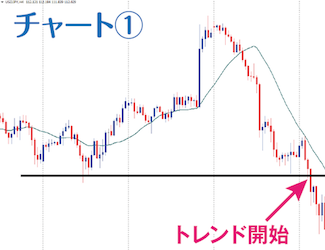
Even in a trend market, if you look closely, it moves up and down in a meandering pattern, and in a downtrend it moves lower. If the market is truly in a downtrend, the market is a friend to the downside. In other words, no matter how much it rebounds, it will eventually decline again, and it will continue to push lower, setting new lows.
Therefore, if you believe the market is in a downtrend, it is prudent to enter a short position after pulling in the rebounds as much as possible. After that, whether you hold that position or take profits after a suitable pullback and wait for the next move is up to the individual’s preference.
Also, it varies with the scale of the market, so in a larger scale you may maintain the position, whereas in a smaller scale you might repeatedly buy and sell as needed, showing flexibility.
However, these pullbacks tend to be larger than one might predict, and it is common to struggle because you sold at a rather mid-point level.