
Learn from Yen Exchange Brokers how to create a trading plan | Episode 15: Incorporating the Three-Wave Theory into USD/JPY Market Analysis (8) [Toshirou Asano]
Mr. Toshiro Asano will fully share his trading methods and market insight construction based on his own experience and knowledge in this project. As before, he will continue to interpret the recent and future USD/JPY market, and then present the most suitable trading plan.
*This article is a reprint and editing of FX Strategy.com July 2018 issue. Please note that the market information described in the body may differ from the current market.
Toshiro Asano Profile

Toshio Asano. He has worked at Tokyo Forex Co., Ltd., a foreign exchange brokerage affiliated with the Tohkansha Group, and at EBS (now ICAP), which once boasted over 80% of the world’s share in currency trading. He has firsthand experience with historic markets such as the Plaza Accord of 1985, the era of extreme yen strength, the bubble burst, and the euro integration in 2000, cultivating his market sense. He later founded two FX trading companies and also worked as a dealer for a private FX fund. Currently, he writes for the daily blog of the Investment School Group. He is also a popular advocate of easy-to-understand video works, leveraging his strength in video editing.
A Half-hearted Long Strategy Is Not Likely for Now
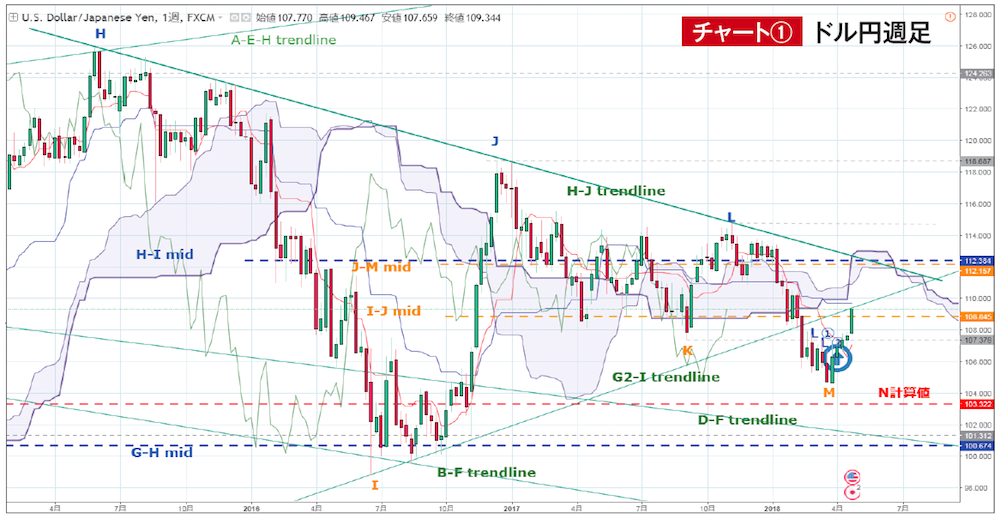
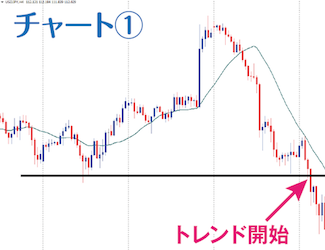
Chart ① Source:USD/JPY chart by TradingView
In the previous month's issue, the latest weekly candlestick of the USD/JPY weekly chart showed a reversal from the recent bearish candlestick, and in the comments we warned that this movement did not fit the “breakout from consolidation.” As you can see in this month's weekly chart (Chart ①), since the week of the reversal, five consecutive bullish candles have formed, and they have even surpassed the recent low K at the low ③, with the I–Jmid level recovering slightly.
However, there are still many aspects that are not sufficient to classify this as a trend reversal. We will delve into that area, but since the low ③ has already risen by nearly 4 yen, we provisional designate ③ as M and delete the interim points ① and ②.
Now, again, to consider my trading plan’s decision criteria:
① When the price moves under the Leading Span, the bias should be bearish
② When the turning line and baseline invert while rising, do not consider new long entries within the trading range
In addition, as long as the price keeps making lower lows from M, the downtrend from J has not yet been denied. From this perspective, since the most recent clear high is only L, for some time a half-baked long strategy is unlikely. In other words, although you should unwind any existing short positions, there is no situation where entering the current apparent strong upmove is advisable.
On the other hand, given the extent of the retracement to this point, the prospect of decline after the high J is quite fragile, and if the N calculation cannot be achieved, it is unfortunate that the caution from last month’s issue happened to be correct. Overall, it seems at least that a range-bound market should be anticipated.