
Introduction to European Fundamentals | Session 5 The Importance of Doing Prep Work! [Miko Matsuzaki]
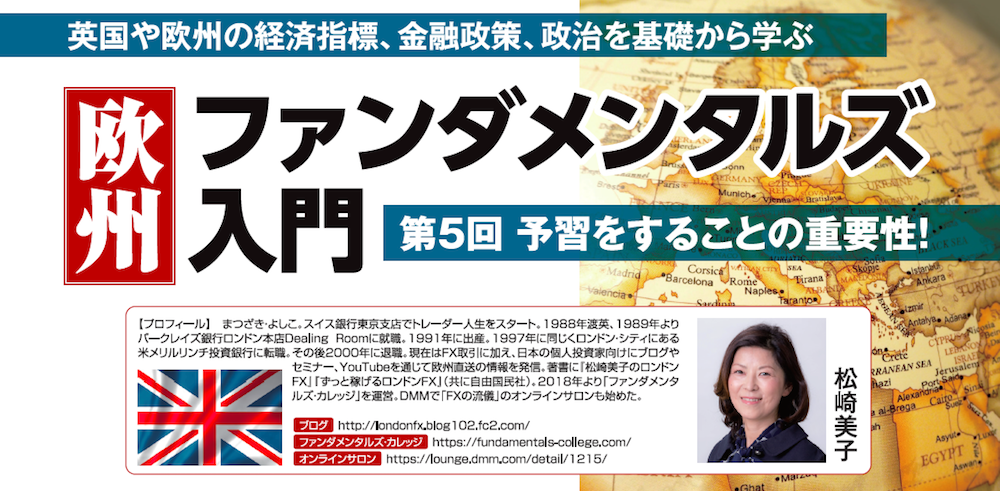
Miko Matsuzaki Profile

Matsuzaki Yoshiko. Her trading career began at Swiss Bank Tokyo Branch. She moved to the UK in 1988, and from 1989 she joined Barclays Bank London Main Office Dealing Room. She gave birth in 1991. In 1997 she transferred to Merrill Lynch Investment Bank in London City. She left in 2000. Currently, in addition to FX trading, she shares direct-from-Europe information to Japanese individual investors through blogs, seminars, and YouTube. Her books include “Matsuzaki Miko’s London FX” and “London FX That Always Makes Money” (both published by Jiyu Kokuminsha). Since 2018, she has operated the “Fundamentals College.” She also started an online salon on DMM called “FX Style.”
Blog:http://londonfx.blog102.fc2.com/
Fundamentals College:https://fundamentals-college.com/
Online Salon:https://lounge.dmm.com/detail/1215/
※This article is a reprint/re-edition of an article from FX攻略.com December 2019 issue. Please note that the market information written in the body may differ from the current market situation.
Understanding Monetary Policy is Important in FX!
Monetary policy is the economic support from the financial side controlled by central banks. All central banks around the world operate with the responsibility of “maintaining price stability.”
I will describe the systems and operations of the European Central Bank and the Bank of England in subsequent posts, but for now I’ve summarized the article to give you a rough understanding of monetary policy. First, I will explain inflation targets and the Monetary Policy Committee.
● Inflation Target
Specifically, how do central banks stabilize prices? The answer is setting an “inflation target.” To prevent runaway inflation or deep deflation, central banks adjust policy rates to decide interest rates.
● Monetary Policy Committee
Central banks hold meetings regularly to decide policy rates, called the “Monetary Policy Committee” (hereafter referred to as the Committee). Among them, the committees in the United States (Dollar), Eurozone (Euro), Japan (Yen), and the United Kingdom (Pound) are undoubtedly the ones that greatly influence the foreign exchange market due to high trading volumes. Since the 21st century, financial policies of emerging economies such as China, South Africa, and Turkey have also become factors that disrupt the market.