
The Future of Foreign Exchange Markets: Episode 100 [Tomotaro Tajima]

Tomotaro Tajima Profile

Economic analyst. Alfinaunts President & CEO. Born 1964 in Tokyo. After graduating from Keio University, he shifted career from working at Mitsubishi UFJ Securities to analysis and research spanning finance and the economy in general, strategic corporate management, and ultimately individual asset formation and fund management. He serves as a lecturer for lectures, seminars, and training organized by private companies, financial institutions, newspapers, local governments, and various商工 organizations, with about 150 talks per year. He has numerous published columns and comments in print media, including Weekly Gendai "Rules of Net Trading" and Examina "Money Maestro Training Course," and writes stock, FX, and other columns on many websites, earning high regard as a stock and FX strategist. He also writes for the Home Economy section of Jiyu Kokuminsha's "Basic Knowledge of Contemporary Terms." After regular appearances on TV (TV Asahi "Yaji-uma Plus," BS Asahi "Sunday Online") and radio (Mainichi Broadcasting "Atsu-chan's Asa-ichi Radio"), he is currently a regular commentator on Nikkei CNBC's "Market Wrap" and Daiwa Securities Information TV's "Economy☆Marche." Main DVDs include "Very Easy to Understand: Tomotaro Tajima's FX Introduction" and "Very Easy to Understand: Tomotaro Tajima's FX Practical Technical Analysis." Notable books include "Manual for Reassessing Wealth" (Paru Publishing), "FX Chart 'Formula for Profit'" (Alchemix), "Why Can You Become Asset Rich with FX?" (Texts), among many others. The latest title is "How to Make Money Riding the U.S. Economy on the Rise" (Jiyu Kokuminsha).
*This article is a reprint/reedit from FX攻略.com August 2018 issue. Please note that the market information described herein does not reflect current market conditions.
Dollar/Yen may temporarily adjust and then potentially break above the triangle top...
In the previous update, I suggested that the upper level of USD/JPY for the near term was around 110 yen, and that this was due in part to “a movement mindful of the triangle’s upper edge.” By triangle I mean the formation defined by the resistance line connecting the June 2015 high and December 2016 high as the upper edge, and the support line connecting the June 2016 low and the March this year low as the lower edge, a middle consolidation pattern in my view.

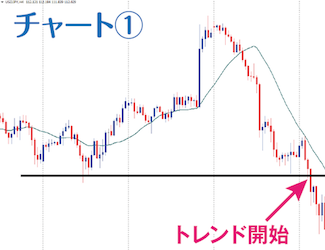
Furthermore, as shown in Chart ①, this triangle is expected to become a 5-wave structure A-B-C-D-E, and if the correction from the December 2016 high is labeled as Wave C, then the March 23 low of 104.64 yen would be the end of Wave C and simultaneously the start of Wave D (the rebound wave).
If we treat this as a 5-wave structure ending with Wave D, of course the triangle would not be considered completed by Wave D. In other words, I would like to see Wave E complete the triangle, but as is well known, Wave E often reverses before reaching the support level, stopping short and turning around.
This view is only one hypothetical scenario, but on that basis, the most recent high as of May 21 of 111.40 yen could have been the end of Wave D. If so, the Wave E adjustment would start from that level, and the Wave E’s retracement would not reach the aforementioned support level (it would not make a deep pullback).
To estimate the May 21 high’s adjustment, given that by the time of writing the 200-day and 21-day moving averages had already broken lower, we apply a standard Fibonacci retracement approach: a 38.2% pullback of the rise from the March 23 low to the May 21 high equals around 108.82 yen, and a 50% pullback is around 108.02 yen.
In any case, if Wave E’s end point is reached and it reverses, the next likely move would be a break above the triangle’s upper edge, increasing the likelihood of a further rise. If the triangle is clearly broken upward, there could be substantial upside potential from there.