
The Millennial Generation as the Driver of U.S. Personal Consumption: Most Vulnerable to Rate Hikes? [Sawako Yasuda]
Sayaka Yasuda Profile

Yasuda Sawako. North America Correspondent Researcher at Mitsubishi Research Institute. After gaining experience as a forex writer focusing on central bank policies and macroeconomics around the world, she moved her base to New York in 2005. While conducting reporting on the front lines of finance and economics on Wall Street, she also delivers information unique to the local scene from a street-watcher perspective, including New York real estate trends, commercial activity, urban development, and culture. Since 2011, she launched the comprehensive information site “My Big Apple NY” and has been reporting on the state of the United States from New York.
Comprehensive Information Site:My Big Apple NY
※This article is a reprint/edit of an article from FX攻略.com August 2018 issue. Please note that the market information written in the main text may differ from current market conditions.
The most populous generation in the United States is the Millennials
In the United States, graduation ceremonies are generally held in June. For college students, considering the timeline, they would need to start job hunting about a year in advance, but unlike Japan, there is no concept of a new graduate hiring quota. This is why internship programs were introduced, allowing students to demonstrate potential and for companies to acquire talent early.
Conversely, even if one pays high tuition to enter university or graduate school, the future is not guaranteed. A friend of the author, who is known as an authority in political science at a graduate school in Washington DC, previously worked as a congressional staffer but was not hired by the federal agency or top think tanks he hoped for. Utilizing the ability to speak multiple languages, he finally found employment in a foreign media outlet as a third-choice option.
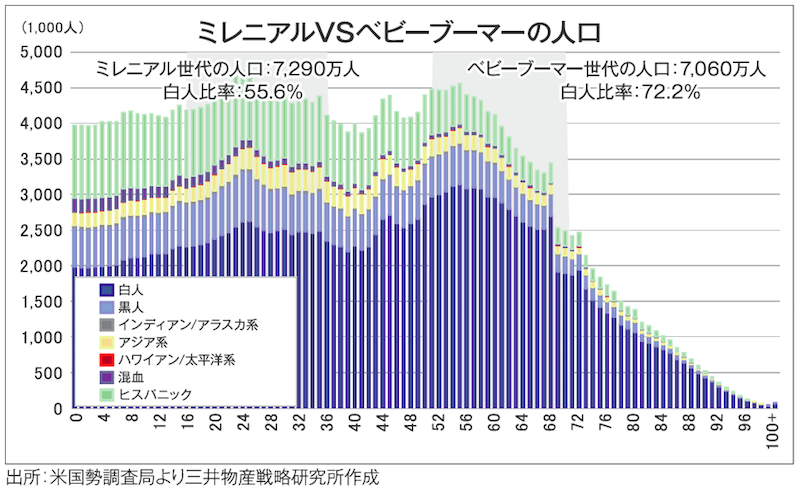
That is why the younger generation, especially the Millennials (primarily those born between 1980 and 2000), poses a very critical issue for the future of the United States. If Millennials surpass Baby Boomers to become the most populous generation in the U.S., it becomes even more pivotal, since they drive almost 70% of the GDP—consumption.