
Learn How to Create Buy/Sell Plans from a Foreign Exchange Broker|Episode 16 Incorporating the Three-Wave Concept in USD/JPY Market Analysis (9) [Toshiro Asano]

This企画 features a book where Toshio Asano generously shares his trading methods and market-view-building know-how backed by his own experience and knowledge. This time as well, he will continue to analyze the recent and future USD/JPY market and then present the most suitable buy/sell plans.
※This article is a reprint and revision of an article from FX攻略.com, August 2018. Please note that the market information stated in the text may differ from the current market.
Toshio Asano Profile

Asano To-shiro. He has worked at Tokyo Forex, a foreign exchange trading intermediary of the TOHKU Group, and at EBS (now ICAP), which boasted over 80% world share in the foreign exchange trading market. He has firsthand experience with historic markets such as the Plaza Accord in 1985, the subsequent era of ultra-strong yen, the bubble burst, and the euro introduction in 2000, which nurtured his market sense. He later founded two FX trading companies and also worked as a private FX fund dealer. Currently, he writes for the Daily Blog of the Investment School Group. He is also a popular proponent of clear video works that leverage his skill in video editing.
Consecutive bullish candlesticks occur, but the 9th week turns bearish
From the previous issue to the present, the market has risen further, and while it briefly showed a single doji, it ended the 9th week with a bearish candlestick by exceeding both the high and low of the 8th week, forming a engulfing-like pattern (inverted harami).
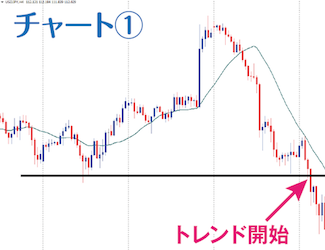
Now, I will inform you of changes in this month’s issue. First, we had set the near-term low as the current M in the previous issue, but when replacing J-Kmid with J-Mmid we failed to adjust the level correctly, so we will correct it to the proper position. Also, a near-term high/low wave labeled L-M has been confirmed, so I have added L-Mmid as half-way level, and added the I–M trendline connecting the recent low M and I (Chart ①).

Chart ① Source:TradingView USDJPY Chart
For those interested in Ichimoku Kinko Hyo, we recommend studying it separately on your own. In Ichimoku, the number 9 is one of the essential basic time-related numbers, and since it also refers to the period of the turning lines, it represents a kind of absolute reference period. After the M wave, although a single doji was interposed, there are few historical instances where the USD/JPY pair has shown bullish candles for 9 weeks in a row, so it is hard to expect bullish candles to continue for 10 or 11 weeks in the future.