
The Course of the Foreign Exchange Market from Here Onward [Series 100th Episode Commemoration] Special Interview with Tomotaro Tajima / Let’s Imagine and Walk Freely in the Foreign Exchange Market (Part 1)
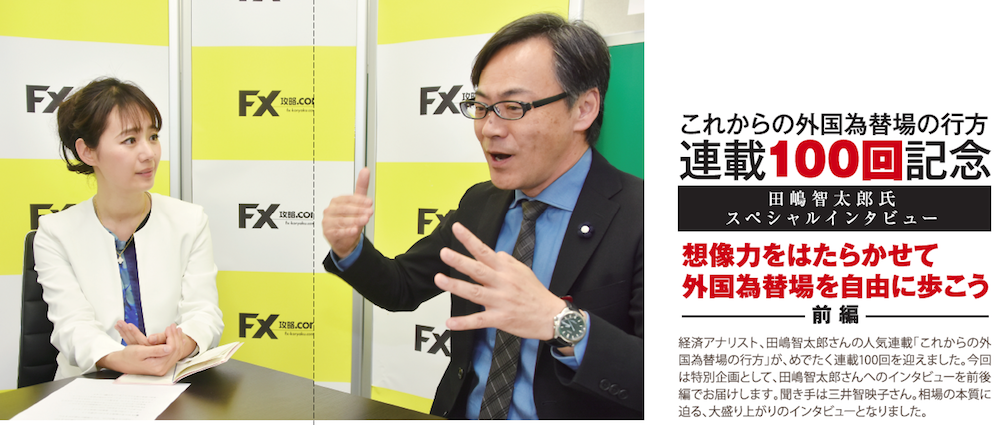
Economics analyst Tomotaro Tajima’s popular series “The Future of the Foreign Exchange Market” has joyfully reached its 100th installment. This time, as a special feature, we’ll deliver an interview with Tajima Tomotaro in two parts. Interviewer is Tomoe Mitsui. It turned into a highly engaging interview that probes the essence of the market.
*This article is a reprint and revision of an article from FX攻略.com August 2018 issue. Please note that the market information described in the text may differ from the current market conditions.
Profile of Tomotaro Tajima ( Tajima Tomotaro )

Economic analyst. Alfinants Co., Ltd. President and representative director. Born in 1964 in Tokyo. After graduating from Keio University, he worked at the current Mitsubishi UFJ Securities before moving on. He analyzes and researches a wide range from finance and economics to strategic corporate management, and ultimately personal asset formation and fund management. He serves as a lecturer at lectures, seminars, and training organized by private companies, financial institutions, newspapers, local governments, and various business organizations, with about 150 lecture appearances per year. He has numerous serialized writings and comments in print media, such as Weekly Gendai’s “The Rules of Net Trade,” and Examina’s “Money Maestro Training Course.” He also writes columns on many websites about stocks, FX, etc., and is highly regarded as a stock and FX strategist. He also writes the Home Economics section of the publisher Free Press “Understanding Contemporary Terms.” He has regular appearances on television (TV Asahi “Yaji-uma Plus,” BS Asahi “Sunday Online”) and radio (MBS “Toshiyo’s Asairo”), and currently serves as a regular commentator on Nikkei CNBC’s “Market Wrap,” and Daiwa Securities Information TV’s “Economi Marche.” His main DVDs include “Very Easy to Understand: Tomotaro Tajima’s FX Intro,” “Very Easy to Understand: Tomotaro Tajima’s FX Practical Technical Analysis Edition.” His major books include “Wealth Reassessment Manual” (Paru Shuppan), “FX Chart: The Formula for Profit” (Alchemix), “Why Can FX Make You Asset Rich?” (Texts), and many others. His latest book is “How to Profit by Riding the Rising US Economy” (Free Press).
Profile of Mitsui Tomoeko

Mitsui Tomoeko. FiSCo Market Reporter. From Otaru, Hokkaido. Debuted on NHK Educational’s “Italian Conversation,” and made her MC debut at the 2011 Tokyo Motor Show. Currently active on TV, in commercials, and on stage. In November 2013, at the Osaka Shinkyōza, and in January 2014, appeared as Yaetsu in Hiroshi Itsuki’s special performance. Also appeared in 2013 on TV Asahi’s “Shirotora” and “Nohime 2,” and in 2014 on TV Osaka’s “Takajin No Money BLACK.” Since October 2012, she has been a FiSCo Research Reporter forecasting stock prices on Yahoo! Finance, while expanding her activities across TV, magazines, and the Web.
In 2013, published “Learn from the Strongest Analyst Team: Stock Investment from Zero” (Kōbunsha), and in 2015, “First-Year Stock Price Chart” (Asuka Publishing). She has been a topic of discussion as a “too-beautiful financial analyst.” She specializes in selecting stocks with a feminine approach and in easy-to-understand explanations and beginner-oriented seminars.
A grand drama: The US stock bubble is only the prologue
Mitsui: First, in the latter half of 2018, how do you expect the currency market to move on the big trend?
Tajima: As a fundamental premise, since Donald Trump became the US president, it has become a source of sorrow for investors and commentators alike.
Mitsui: They call it Trump risk.
Tajima: It applies to finance in general, but for those involved in the FX market in particular, it is undoubtedly difficult to foresee. As you all know, there is a mid-term election this fall in 2018. If a certain share of votes and seats isn’t gained, Trump will be in a very difficult position.
Mitsui: Perhaps he could become the first president to be removed from office.
Tajima: There’s also the question of whether he will be impeached, making it even harder to foresee. Even assuming a four-year term, the US economy is currently in a booming condition and is implementing unprecedented levels of stimulus as policy. No one could have foreseen this, and since something unprecedented is happening right before our eyes, we cannot predict the future with certainty.
Mitsui: I see.
Tajima: Honestly, even the most seasoned FX professionals can’t say they understand it. Anyone who says “I understand it” is lying (laughs). Because we don’t know, if we look at the period from April 2017 to March 2018, the USD/JPY movement was the lowest in history.
Mitsui: When you say “the lowest in history,” what do you mean?
Tajima: It moved only about 10 yen or so. That’s the lowest level in history. There was almost no price movement.
Mitsui: So it stayed in a range, right?
Tajima: Yes. Ordinary investors, and even so-called professionals, all think “I don’t know.” For example, if you bet on buying dollars, something could betray you somewhere, or if you bet on buying yen, that could betray you as well... so people haven’t been able to commit strongly in either direction.
Taking into account that the range-bound market has continued, and with the 2018 midterm elections in autumn, as we think about actions toward the end of the year, we must not forget that there is a core trend as well.
Mitsui: What is the core trend?
Tajima: The core trend is basically the fundamentals. Is the US economy strong or weak? It is currently strong, but will it become weak later? Or is it still strong and will only become stronger? How will the US economy fare? In terms of whether the economy is strong or weak, how will US policy be? How about Japan’s policy? These are what I consider the core, and I think it’s important to base your thoughts on that. I’ve always said, “The market is a drama.”
Mitsui: A drama?
Tajima: Yes. In modern dramas, there is usually a cover story spanning an entire season. At first, there’s a parental issue, or a story about a deceased father, or the hospital director who is actually a bad guy, who schemes but presents a good face and then there’s a twist in the final episode... With such a cover story, most dramas have a self-contained episode. For example, in a doctor’s story, a patient appears, undergoes surgery, and you see whether they can be cured... In detective dramas, the criminal always appears, and you see whether the issue can be resolved... Sometimes it spans two episodes.
Mitsui: That’s the classic drama.
Tajima: While that happens, the cover story is the key: what is the protagonist’s background? The same goes for the FX market. For example, looking from a mid- to long-term perspective, there may be a setup where the basic trend is dollar appreciation. The cover story may indicate the direction toward dollar strength, but at certain points the chart may spike toward yen strength. Of course, the cover story can align with a dollar-strong direction as well. I look at those interactions first.
Mitsui: The background, the overall trend.
Tajima: Returning to the fundamentals, the interest rate gap between Japan and the US could widen further, and I personally think the US economy will accelerate even more. Frankly, I believe we are moving toward a genuine bubble. Some FX commentators already say we are approaching the first and second stages of a bubble.
Mitsui: Indeed, in the US, monetary policy and economic policy are aligned. Because of that, among government officials there are those who say things like “we can create a bubble.”
Tajima: A bubble is born from being set up; if you set it up, it would be a lie not to have a bubble. After Lehman, in response to the financial crisis, major economies carried out monetary measures that spilled the seeds of a bubble. In order to sprout, those seeds received plenty of water and efforts were made to prevent the shoots from withering. That policy has continued in monetary policy around the major central banks, led by the US Federal Reserve. Since the central banks of major countries worked hard to set up a bubble, a bubble only appears to be good when it actually forms.
We are only now beginning to see the US economy turning into a bubble, but among those who say it has already entered stage one or two, there are those who think it will soon end, and others who think it will continue into stage ten. I belong to the latter—the early stage, perhaps just entering the entrance.
Mitsui: So the US economy will grow even more.
Tajima: Yes. As the bubble accelerates, I see the basic trend as dollar appreciation and yen depreciation. However, within that rise of the dollar and fall of the yen, political factors, such as statements by Trump or actions by North Korea, could become a trigger and push the market toward yen strength. When the market moves in a direction opposite to the cover story, we must think, “I have to buy somewhere.” I believe that is the most crucial part.
Mitsui: I see. The cover story would be that the US economy continues to accelerate and remains strong, leading to a dollar-strong/yen-weak trend, but the episodic stories may diverge and move up and down—that’s the image, right?
Tajima: Yes. For example, while assuming a medium- to long-term trend of dollar strength, pursuing a high price can be a very brave move.
Mitsui: Indeed.
Tajima: In pursuing high prices, selling when the upper range is reached requires even more courage, doesn’t it?
Mitsui: Following the trend is scary, and labeling it a range and then trading against it is also questionable...
Tajima: We should consider a gently inclined range toward dollar strength. Also, although this series is reaching its 100th episode, there is a cover story that spans a long period. “The 75-yen rate at end of October 2011 marked the end of a 40-year history of yen strength. From November 2011 onward, a long history of dollar strength and yen depreciation for the next 30 to 40 years began,” is my cover story for the 100th installment. As to how far the yen would weaken from 75 yen, it reached 125 yen in 2015.
Mitsui: Yes. It peaked there and then fell again.
Tajima: It fell to 100 yen. A rise of 50 yen, followed by a drop of 25 yen, i.e., a half-wave retracement. From here, whether it will be wave 3, A→B→C, or 1→2→3, is unclear, but if wave C or wave 3 has begun, the ideal target would be 100 + 50 = 150 yen. If pressed to guess when it would reach 150 yen, I would say possibly in 2023. I have such a scenario in mind.
Mitsui: In terms of the golden ratio, that seems right.
Tajima: I’ve mentioned the so-called “8-year high cycle” many times in my series. It isn’t a coincidence that the next high after June 2007 was June 2015. That means there was a high eight years earlier, and eight years earlier still. It is reasonable to expect the dollar price peak against the yen every eight years, and after yen appreciation once, the next peak would be in June 2023. However, predicting the exact high for June 2023 is a tricky matter.
Mitsui: I see.
Tajima: The horizontal axis (time) is quite accurate—eight to nine years—while the vertical axis (price) is much more difficult. It’s not that I’m poor at predicting; it’s that no one can predict with precision. Still, I want to keep in mind that it will be at an expensively high level relative to the previous high, and in terms of dollar strength.
Mitsui: It seems good to read Tajima-sensei’s series carefully and use that cover story as a reference for market forecasts.
Tajima: It’s only my personal cover story, though. I hope everyone uses Tajima’s view as one perspective, or maybe as a counterpoint to their own thinking, and use the cover story accordingly.