
Learn how to create trading plans from a currency exchange broker|Episode 31: Dollar-Yen market analysis incorporating the concept of the three waves (24) [Toshio Asano]

This book project features Toshirou Asano, who will thoroughly teach his trading methods and market-structure insights grounded in his own experience and knowledge. As before, this edition continues to have him interpret the recent and upcoming USD/JPY market, and then present the most suitable trading plan.
※This article is a reprint/edited version from FX攻略.com November 2019 issue. Please note that the market information described in the text may differ from current market conditions.
Toshirou Asano Profile

Asano Toshiro. He has worked at Tokyo Forex, a foreign exchange brokerage of the Tokyo Short Group, and at EBS (now ICAP), which boasted over 80% world market share in currency trading, among others. He experienced historical markets firsthand, including the 1985 Plaza Accord, the era of the strong yen, the burst of the bubble, and the euro introduction in 2000, which helped him develop his market sense. He later founded two FX brokerage firms and worked as a dealer at a private FX fund. He currently writes for the Nikkan blog of the Investment School Group. He is also a supporter of easy-to-understand video works that leverage his skill in video editing.
Could a new low (S) be the near-term bottom?
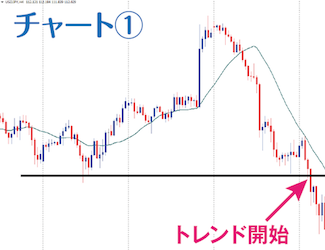
Last month, the USD/JPY market was in a stage of searching for a bottom after a sharp drop from the high R. Since then, the market has repeatedly shown a range-bound movement with relatively wide price swings, marking the first time since 2018 that a new low was set. Therefore, in this month’s weekly chart (Chart 1), the change is to add this new low as S to the chart, and to change the previously presumed lower boundary M of the range to S. The horizontal guideline near R, which indicated the lower bound on the monthly lead line, has already moved away and has been removed.

Chart 1 Source:USDJPY chart by TradingView
Now, from the analysis of the weekly Chart 1. First, as a new half-price level, P–Smid and R–Smid are already understood to be near-term important levels, and the decline from the high P is still young, with each corresponding to a base line and a conversion line. The market has actively declined to this point, but if we treat the near-term low as S, the conversion line will move horizontally at this position for about four more weeks, and unless the high R is renewed, the market will transition into a passive downtrend thereafter. The focus, then, is whether the market will drop in line with the conversion line or consolidate, for example, if the market remains capped by the conversion line, an additional downtrend becomes possible.