
Foreign Exchange Online - Masakazu Sato's Practical Trading Techniques | Technical and Fundamental Analysis Predicting the Future of the 3 Major Currencies [This Month's Theme | How to Handle 2018 Range Market: Swing Point Targeting Also in View]

The initial impact is strong, but perhaps due to Mr. Trump's rhetoric and policies that tend to fizzle out in the end, the foreign exchange market, led by USD/JPY, has been in a range-bound pattern with triangles and consolidation. At least until the November U.S. congressional midterm elections, the market is likely to stay in a stalemate. Considering further potential hikes in U.S. policy rates, a range-trading strategy aimed at swap points could be effective.
*This article is a reprint/edit of an article from FX攻略.com, September 2018 issue. Please note that the market information described in the text may differ from the current market.
Profile of Masakazu Sato

Sato Masakazu. After working at a Japanese bank, he joined the Paris-based Barings Bank (now BNP Paribas). He has served as Interbank Chief Dealer, Head of Funding, Senior Manager, and others. Later, he became Senior Analyst at Foreign Exchange Online, which boasts the highest annual trading volume. He has been involved in the forex world for over 20 years. He also appears on Radio Nikkei’s “Stock Live Commentary! Stock Channel,” Stock Voice’s “Market Wide – Foreign Exchange Information,” and regularly distributes market information on Yahoo! Finance.
Riding Trump’s Range-Bound Market: “Hit Hard First, Then Find the Floor”
As August approaches, I believe there is still strong attention on President Trump’s protectionist policies and his diplomacy toward North Korea and the Middle East. Ahead of the November 6 U.S. congressional midterms, President Trump is likely aiming to win favor with his ardent base of American conservatives by pushing policies that are popular there but may be unpopular for the global economy, including the exchange market, in order to swing the election in his favor.
With tariffs on imported cars among the measures, Trump’s trade war is expanding beyond China to Europe as well. “Hit hard first, then find the floor” is Trump-style diplomacy. In the forex market, the initial “hit” drives risk-off yen strength, but once the floor becomes clearer and the situation stabilizes, the market tends to shift back to risk-on yen weakness.
U.S. policy rates have risen to 2% and further increases of twice more are expected this year. Relative to interest rate differentials, more dollar buying could be expected. However, the lingering “Trump risk” of “not knowing what comes next” has prevented a full-blown dollar rally.
That said, nearly two years into his term, the market has grown accustomed to Trump’s behavior patterns. A catastrophic event like a “Trump crash” is less likely in the future, and the forex market is expected to stay in a range at least until the U.S. midterm elections in November. Hence, this time we will explore FX trading strategies in the broader market’s “range market” and “triangle consolidation market.”

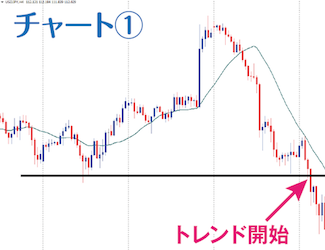
Chart ① is the weekly USD/JPY chart since May 2015, when the pair reached highs around 125 yen per dollar. In one word, the USD/JPY is best described as being in a “triangle consolidation market,” where the range of exchange rate moves gradually narrows.
The resistance zone formed by connecting the May 2015 high in the 125 yen area with the December 2016 high in the 118 yen area (Line A) provides a strong upper resistance. Conversely, the lower support zone initially connected the September 2016 low in the 100 yen area and the September 2017 low in the 107 yen area (Line B), but it was broken in February 2018. However, the decline did not become steep, and the March low in the 104 yen range halted the fall; now the low from that level forms Support Line C, establishing a triangle consolidation between A and C.
From late March onward, the retest of the USD/JPY fell short of breaking Resistance Line A, forming a tight range on the downside. It’s also notable that the previously broken Support Line B has turned into a ceiling that caps the upside for USD/JPY.
Going forward, the debate will be whether the pair can fall again without crossing Resistance Line A, or break above 114 yen per dollar where the upper limit of the 2017 range and the extension of Line B lie, to reach the line D area.
Overall, from summer to autumn there is a strong possibility of a renewed decline toward testing 100 yen per dollar. However, even now the swap points for USD/JPY are 40 yen per 10,000 units per day, amounting to about 15,000 yen per year. That interest-rate differential is attractive and could provide strong support for USD/JPY.