
Foreign Exchange Online - Masakazu Sato's Practical Trading Techniques|Technical and Fundamental Analysis Predicting the Future of the 3 Major Currencies [This Month's Theme | Good News or Bad News? The Path of the Autumn 2019 Market]
The imposition of additional tariffs by President Trump on China and the shift by the U.S. Federal Reserve (FRB) to cutting rates are shaking financial markets. Therefore, from the autumn to year-end, we will examine what trends might emerge for major currency pairs. Compared with the FRB and the European Central Bank (ECB), our Bank of Japan has little room to unleash new policy measures. In that sense, a sharp rise in the yen appears likely, but…
Note: This article is a reprint and revision of an article from FX攻略.com, October 2019. Please note that the market information described in the text differs from current market conditions.
Masakazu Sato's Profile

Sato Masakazu. After working at a Japanese bank, he joined Paris-based Paribas (now BNP Paribas Bank). He has served as interbank chief dealer, head of funding, senior manager, and other roles. Subsequently, he became Senior Analyst at Foreign Exchange Online, which boasted the highest annual trading volume. He has spent over 20 years in the foreign exchange world. He appears on radio show Nippon Cultural Broadcasting “Stock Market Live Commentary! Stock Channel” and on Stock Voice’s “Market Wide – Foreign Exchange Information,” and regularly provides market information on Yahoo Finance.
Dollar-yen likely to stay in a high yen stance on Trump’s China tariffs and expectations of FRB rate cuts
“More rate cuts, or wait and see.” The FRB’s monetary policy has been a major factor moving the currency markets recently. Normally, the relationship between policy rates and the economy is that a weakening economy prompts rate cuts to stimulate it. However, the FRB’s stance has been that rate cuts are intended to prevent a worsening economy. In August, the U.S. jobs report showed nonfarm payrolls rising by 162,000, slightly below expectations, but good numbers in economic indicators are seen as reasons for the FRB to stay in a rate-cut path, causing stock prices to fall. Conversely, when indicators show the U.S. economy to be a bit weak, rate-cut expectations rise and stocks rally. In this environment of “good news is bad news, bad news is good news,” U.S. stock indices such as the S&P 500 reached record highs across the board.
Moreover, on August 1, President Trump, frustrated with stalled trade negotiations, tweeted that he would implement a fourth tranche of tariffs on China from September. Financial markets were rattled, leading to a risk-off surge in the yen and a stock plunge. Although the U.S. economy remains healthy and U.S. equities are near all-time highs, the future remains highly unpredictable.
In the currency market, trends born in the autumn often persist into year-end and early next year. Therefore, this time we use the 120-day and 200-day moving averages, the Ichimoku Cloud, and the MACD to explore the price action for major currency pairs through the end of 2019 amid expectations of rate cuts.
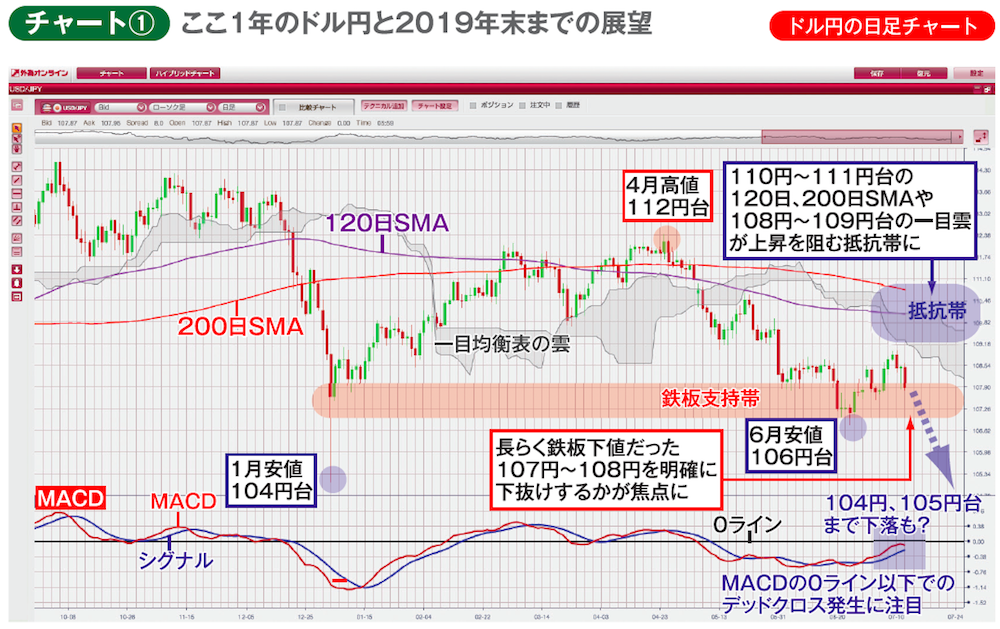
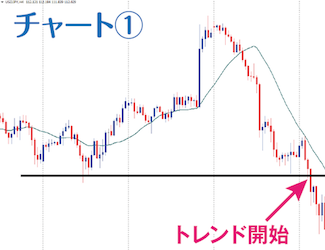
Chart ① is the daily chart of USD/JPY since September 2018. The high for USD/JPY this year has been in the 112 yen range in late April. Notable lows include the 104 yen area during an abrupt drop in early 2019, and the 106 yen range around June when tensions of the U.S.-China trade war peaked before the G20, and the August low when additional tariffs were announced.
Looking at the chart, the 120-day and 200-day moving averages turned lower around the 110 yen level (a death cross by March), and the Ichimoku Cloud hanging around at 108–109 yen seems to form a ceiling. If the FRB’s rate-cut turn becomes clearer, the key question for year-end will be whether the pair can break below the “solid lower bound” around 107–108 yen per dollar.
Meanwhile, the MACD has risen toward the 0 line but looks set to lose momentum and possibly form a death cross. Given the ongoing deterioration in rate cuts and the U.S.-China trade war, it is highly likely that the pair will test the crucial 104 yen level, the low end of the long-standing range since President Trump took office.
In a currency market where rate-cut expectations linger, the equation “cut rates → stronger yen, no cut → weaker yen” seems likely to continue. However, if U.S. economic resilience becomes more evident, a stop to rate cuts could still allow a shift toward “strong dollar, weak yen, higher stock prices.” Conversely, if tensions in the U.S.-China trade war intensify as in August–September, a negative spiral of “yen appreciation and stock declines” could take hold.
An unusual development is that economic indicators showing “moderate bad news” fuel rate-cut expectations and a yen appreciation trend against the dollar. Through the end of the year, attention will remain on U.S. economic indicators such as nonfarm payrolls, consumer and producer price indices, and the ISM Manufacturing and Non-Manufacturing Indices.