
Aim to become a full-fledged trader with Nanami Nonaka! Learn FX with Nanamin, Episode 4
FX actress Nanami Nonaka will join forces with FX specialist Yasushi Yamanaka to learn with everyone everything needed to improve trading performance. This time, he will also teach the basics of fundamental analysis.
※This article is a reproduction and re-edit of an article from FX攻略.com September 2019 issue. Please note that the market information written in the text may differ from the current market.
Click here for the list of serialized articles
【Table of Contents】Aiming to become a one-person trader with Haruka Nanami! Learn FX with Nanamin
Profile of Yasushi Yamanaka

Yamanaka, Yasujin. Joined American Bank in 1982, became Vice President in 1989, Proprietary Manager in 1993. Joined Nikko Securities in 1997, became Deputy Head of Currency Funds at Nikko City Trust Bank in 1999. Established Ascendant Co. Ltd. and served as Director in 2002.
Official blog:FX information delivery site provided by Ascendant/Yamanaka Yasujin
Twitter:https://twitter.com/yasujiy
Profile of Nanami Nonaka

Nonaka, Nanami. Born March 17, 1997. From Fukuoka Prefecture. While appearing in movies, stage plays, and commercials, she is active as an FX actress, hosting a regular program on Radio Nikkei. She updates her daily trading on her blog.
Official blog:FX Actress Arrives! Serious Real-Time Trading Diary of Rising Actress Nanamin
Twitter:https://twitter.com/himnas03
Relationship between Interest Rate Markets and Economic Cycles
NonakaThis time as well, we will learn about FX fundamentals from Mr. Yamanaka. The theme this time is “Interest Rates.” Thank you in advance.
YamanakaThe most influential and important factor in the currency market is the interest rate market. There are two main types of interest rates: short-term rates and long-term rates (Figure 1). Generally, short-term rates cover up to one year, and long-term rates are for more than one year.
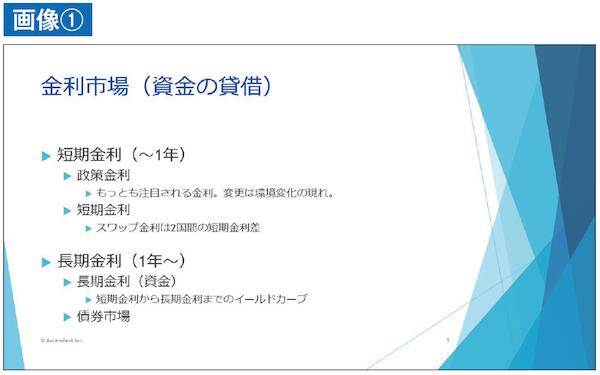
The most representative of the short-term rates is the policy rate. Japan has had negative rates for a long time, while in the U.S. and other countries, policy rates have been tightened compared to a certain past period. The policy rate serves as a target for guiding market interest rates to a certain extent.
Besides policy rates, there are also 1-month, 3-month, and 6-month rates. There are also swap rates.
NonakaSwap rates are familiar even in FX.
YamanakaAnother important aspect is the change from short-term to long-term interest rates. For example, drawing a line through the yields for 1-year, 3-year, 5-year, and 10-year maturities forms the “yield curve.” Usually, when the economy is doing well or is in a normal state, long-term rates are higher than short-term rates.
NonakaWhy do long-term rates become higher when the economy is doing well?
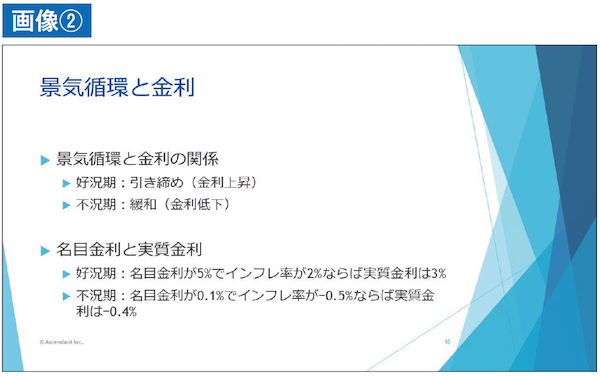
YamanakaThis relates to the business cycle and interest rates. In good times, interest rates are raised to tighten conditions (Figure 2). In other words, raising rates makes it harder to borrow from banks. Conversely, in a recession, rates are eased. When the economy is strong, central banks worry about overheating inflation. Hyperinflation has occurred, for example, in Zimbabwe recently.
NonakaI’ve heard that you need a lot of cash to buy bread.
YamanakaTo prevent such situations, when the economy improves, rates are raised to make funds harder to borrow. Conversely, lowering rates encourages people to borrow when rates are cheap and invest in higher-yield assets. A classic example is land/property.
NonakaIt stimulates investment activity, doesn’t it?
YamanakaYes. For example, if you can borrow money cheaply at 1% interest, more people may buy land thinking its price will rise. Right now, in Australia and China, housing and land prices are surging, but in such cases, the central bank would typically tighten rates.
On the other hand, Europe currently faces concerns about economic slowdown. They were saying they might raise rates after summer 2019, but at the latest ECB meeting they abandoned near-term rate hikes and pushed them to after 2020.
What we must be careful about here is inflation, and what happens when prices keep rising. For example, if the interest rate is 5% and inflation is 2%, the real interest rate is 3%.
NonakaWe are subtracting the portion of inflation from the nominal rate.
YamanakaConversely, in a recession, if the nominal rate is 0.1% and the inflation rate is -0.5%, the real rate is -0.4%. Japan has experienced persistent deflation in the past, with falling prices.
