
Foreign Exchange Online - Masakazu Sato's Practical Trading Techniques | Technical and Fundamental Analysis Forecasting the Future of the 3 Major Currencies [This Month's Theme | The Turkey Shock Strikes! Ultra-long-term View of the Dollar, Yen, Euro, and

Recently there has been no real crisis and the forex market has been in a stalemate, but the "Turkey shock" arrived. The forex market tends to be swayed by President Trump's words, but in such times we should not act with short-sighted haste; instead, we should invest with a long-term big-picture perspective. Therefore, ahead of the volatile year-end trading, let's examine the long-term movements of the dollar, the yen, the euro, and the emerging market currencies in turmoil, such as the South African rand.
This article is a reprint and edit of FX Survival.com’s November 2018 issue. Please note that the market information stated in the text may differ from current market conditions.
Profile of Masakazu Sato

Sato Masakazu. After working at a domestic bank, he joined BNP Paribas (formerly Paribas Bank) in Paris. He has held positions such as Interbank Chief Dealer, Head of Funds, and Senior Manager. Later, he became Senior Analyst at OnlineFX, which boasts the highest annual trading volume. He has been involved in the foreign exchange market for over 20 years. He appears on Radio NIKKEI’s "Stock Live Commentary! Stock Channel" and Stock Voice’s "Market Wide - Foreign Exchange Information," and regularly provides market information on Yahoo! Finance.
If the Turkish crisis prolongs or tariffs are imposed on US-made cars, the dollar-yen could fall below 100 yen!
In the forex market, there is now a situation where the name Trump is almost always present, even on days when crows do not crow. Following the trade war with China and Europe, in late July, President Trump pressured Turkey by demanding the release of detained American pastor and threatening large sanctions. Erdogan, re-elected in June, has a strong authoritarian political stance, and inflation above 15% annually has driven the Turkish lira to multiple record lows.
Trump’s statements have fueled the fire, and against the yen, the lira’s value plunged from the 30-sen-per-lira level to the mid-teens. The ripple effects spread to other emerging market currencies with large current account deficits—Argentina, Russia, Brazil, Indonesia, and others—making the “Turkey shock” a reality.
In early August, the European Central Bank (ECB) reportedly expressed concerns about eurozone banks’ exposure to Turkish assets, causing the euro and the pound to plunge, triggering a broad global stock selloff. Given the ongoing tension between the US and Turkey, the Turkey shock seems likely to smolder into September and beyond.
President Trump has also taken a hard line toward Iran, and this series of assertive diplomacy is expected to continue at least until the November US Congressional midterms. In other words, through November, the dollar and stock prices are likely to remain highly volatile as Trump fans the flames.
Japan is somewhat on the sidelines in trade issues, but Trump has stated that Japan has benefited too much from trade in the past and that it will not be deceived again. Currently, about 1.7 million cars are exported from Japan to the United States, and cars produced in Mexico and Canada are also shipped to the United States. It is unlikely that the Trump administration will leave this unchallenged, and some form of pressure is expected. If President Trump turns his fangs toward Japan's car exports, a rapid yen appreciation toward around 100 yen per dollar is not implausible. Nevertheless, the dollar/yen remains in a range of 110 to 113 yen, in a "strange equilibrium" and "eerie calm."
When faced with short-term uncertainty in FX, the best course is to rise above the fray and cultivate a broad, long-term perspective. So this time, we will examine the long-term movements of each currency pair.
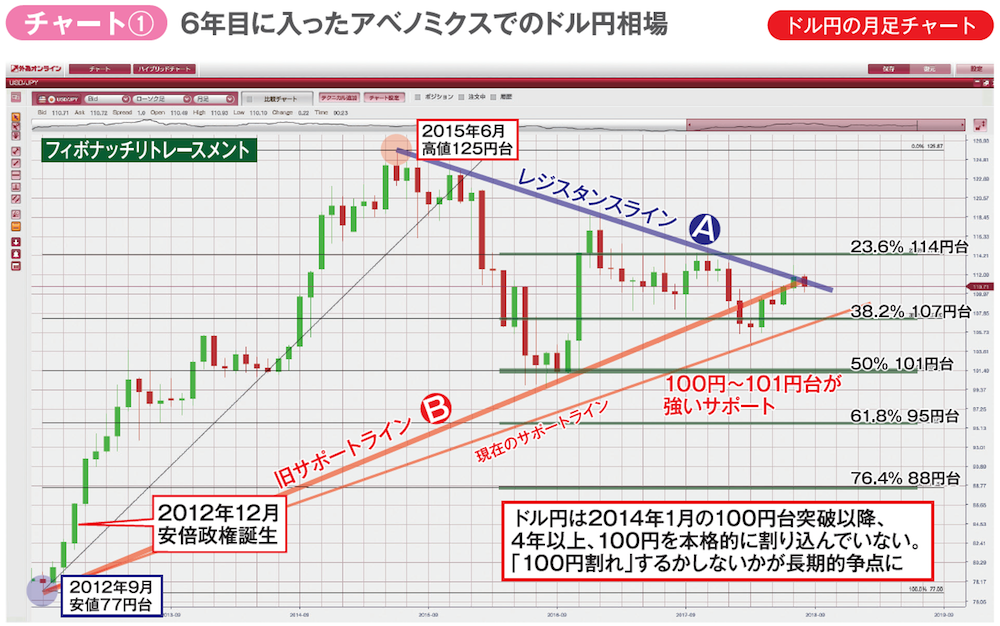
Chart ① shows the monthly USD/JPY chart since December 2012, when the LDP's second Abe administration began and Abenomics started. Since Abe’s economic policies and the Bank of Japan under Governor Kuroda created a megatrend of yen depreciation, nearly six years have passed. The USD/JPY rose straight from the June 2015 high of 125.86 to form a huge triangle consolidation afterwards.
The most important feature on Chart ① is the resistance line A, connecting the June 2015 high with the December 2016 high in the Trump era, which reached the 118 yen range. The current USD/JPY has broken above A and is now, in effect, being pressed by the old support line B which may become a resistance zone going forward.
If we draw a Fibonacci retracement by connecting the September 2012 low in the 77s with the June 2015 high in the 125s, we can see that after the Trump rally stalled in January 2017, price action has hovered within a very narrow band roughly between the 107 yen 38.2% level and the 114 yen 23.6% level.
Overall, the most striking aspect is that since regaining the 100 yen level in January 2014, after some twists and turns, the USD/JPY has never stayed below 100 yen for an extended period. In trend analysis, a rising trend is defined by higher highs, and a falling trend by lower lows. From the current price action, it seems more likely that a new low below 100 yen could occur before a new high above 125 yen.