
Foreign Exchange Online · Masakazu Sato's Practical Trading Techniques | Techno & Fundamental Analysis Forecasting the Future of the 3 Major Currencies [Theme of this month | Intensification of the US-China Trade War! What is the scenario assuming the
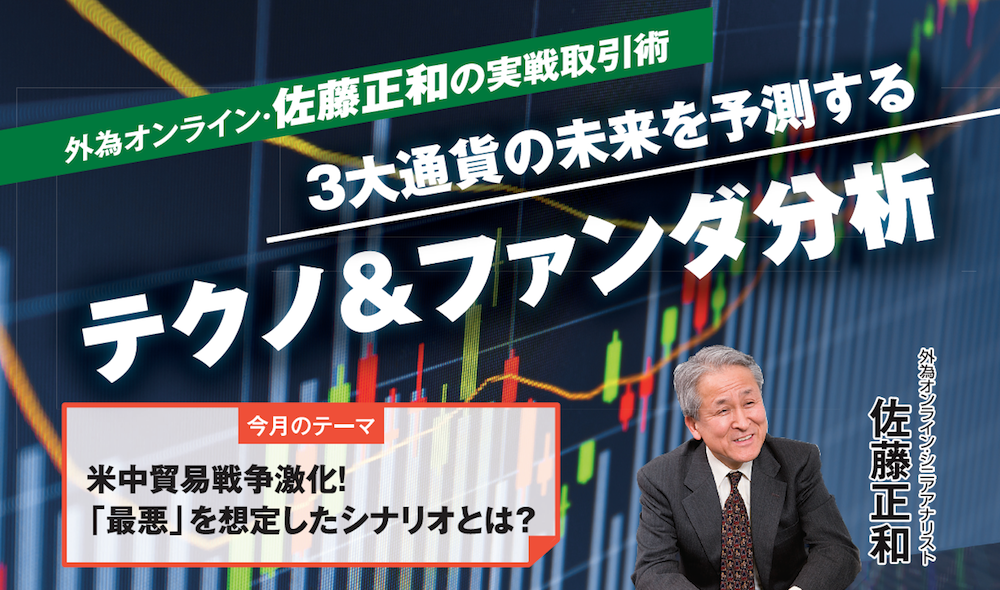
A “storm” has blown into the FX market, which had continued a calm, flat market. The development continues to be driven by President Donald Trump’s aggressive stance to impose 25% tariffs on all imports from China, triggering a high-stakes trade war between the U.S. and China. Although there has not yet been a Lehman-like shock in the exchange rates, it’s prudent to be prepared. This time, we explore the downside targets for each currency pair if the U.S.-China trade war were to enter the worst-case scenario.
*This article is a reprint and rewrite of an article published in FX-Guide.com, August 2019. Please note that the market information in the main text may differ from current market conditions.
Profile of Masakazu Sato

Sato Masakazu. After working at a domestic bank, he joined the French-Banks Baribas (now BNP Paribas) Bank. He held positions such as Interbank Chief Dealer, Head of Funds, and Senior Manager. Later, he became Senior Analyst at the online FX company with a market share of the highest annual trading volume. He has been involved in the foreign exchange world for over 20 years. He appears on Radio NIKKEI’s “Complete Live Commentary on Stocks! Stock Channel,” Stock Voice’s “Market Wide - Foreign Exchange Information,” and consistently provides market information to Yahoo! Finance.
Dollar/Yen Does Not Plunge Even with Trump Tariff Shock. Is 104 Yen a Steel-Plate Floor Even in the Worst Case?
As seen in last month’s column, when the market is range-bound, strategies such as buying USD/JPY, buying AUD/JPY, selling EUR/USD to target high swap points can be effective. However, when the exchange market is struck by a storm, ignoring swap points and riding the sharp price moves can yield substantial profits.
In English, the worst-case scenario is called a “Perfect Storm.” In early May, the intensification of the U.S.-China trade war began with President Trump’s tweets, and it could lead to a future Perfect Storm, eventually called the “Trump Tariff Shock.” Some say that President Trump, who closely watches stock movements, will eventually calm the situation. However, in the U.S. stock market, Nasdaq and the S&P 500 reached record highs in April. It seems he believed some decline in stock prices could be endured.
Additionally, he may have acted early with the presidential election in mind. After all, if tariffs on all imports from China, totaling around 55 trillion yen, were raised from 10% to 25%, more than 10 trillion yen in tax revenue would flow into the United States.
Nevertheless, there are no winners in a trade war. Even if you are an observer, that is the fair conclusion. According to Oxford Economics, a U.S. independent think tank, if the United States imposes a 25% tariff on all Chinese imports and China responds with similar measures, the U.S. GDP would shrink by about 0.5% by 2020, and real growth would fall to near 1%. China’s growth would slow by about 1.3%, dropping to an unprecedented 5% growth. If the trade war escalates into real war and financial instability, a Lehman-like economic crisis would threaten the forex market.
Therefore, this time, we will consider the downside targets for each currency pair under the hypothetical scenario of a complete breakdown in U.S.-China trade negotiations.
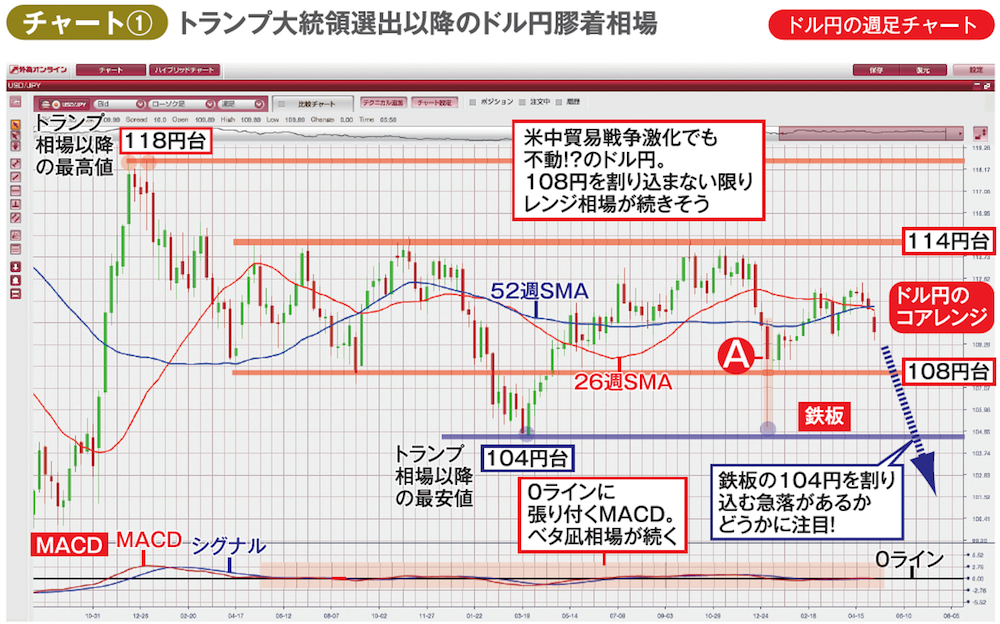
Chart ① is a weekly chart of USD/JPY from the period just before Trump’s election in September 2016. Although we asked, “What if the worst happens?” even as the Trump tariff shock hit in mid-May, USD/JPY has remained in a tight range with core levels around 108–114 yen per dollar.
In the past three years, the highest was in December 2016, right after Trump’s election, at around 118 yen per dollar. The lowest was around April 2017 and at the start of 2019, around 104 yen per dollar. The long lower wick of point A on Chart ① marks the move during the initial drop at year’s start. Technically, the main factor to judge whether the worst-case scenario has truly begun is whether the U.S. dollar breaks below the 104-yen floor that has underpinned the last three years of range-bound prices.
Typically, risk-off would lead to rapid yen appreciation against the dollar, but the recent floor for USD/JPY is firm due to the overwhelming interest rate gap between the U.S. and Japan. If the next move after the trade war is Japan’s large trade surplus against the U.S., one might expect the dollar to fall further and the yen to strengthen. Yet, even as of mid-May when the market was hit by shocks, USD/JPY remains around 109 yen per dollar.
The MACD shown in the lower part of Chart ① has been pinned around the 0 line for three years, and the 52-week moving average has remained nearly flat over the past year. Even when the dollar is hit by a storm, USD/JPY shows a solid bottom that can be regarded as “ironclad.”