
Trade Team: Ancient Ways to Earn Money | Episode 2: Concrete Methods for Economic Indicator Scalping with 90%+ Win Rate [Okachan-man]

Okachanman's Profile

Born in Fukuoka Prefecture in 1980. Hobbies are news searching and going out drinking. Talent is not sleeping. Started FX in 2011, and currently lives a comfortable, full-time trader’s life as a full-time professional. Possesses strong intellectual curiosity and exceptional information gathering and analytical abilities. Recognized for these abilities by “Ancient Trade Team” and became a core member of the team. Skilled in swing trading centered on fundamental analysis.
Ancient FX Blog:Fundamental Trade
*This article is a reprint/edit of an article from FX攻略.com January 2019 issue. Please note that the market information described in the text may differ from the current market.
Learn How Economic Indicator Announcements Work
Price movements are prone to occur at the time of economic indicator releases, and the moves can be predicted with a fairly high probability. When the “expectation” and the “result” of an economic indicator release diverge greatly, I call it a “surprise.” Using a trading method that targets these “surprises,” I earned about 27 million yen in profit over roughly four years.
Economic indicator releases are obtained by each country’s release agencies (Reuters, Bloomberg, etc.) as soon as they occur, and information is publicly distributed. In advance, economists’ forecasts are averaged to form pre-release expectations, and FX brokers’ economic calendars have columns for “Forecast” and “Actual.”
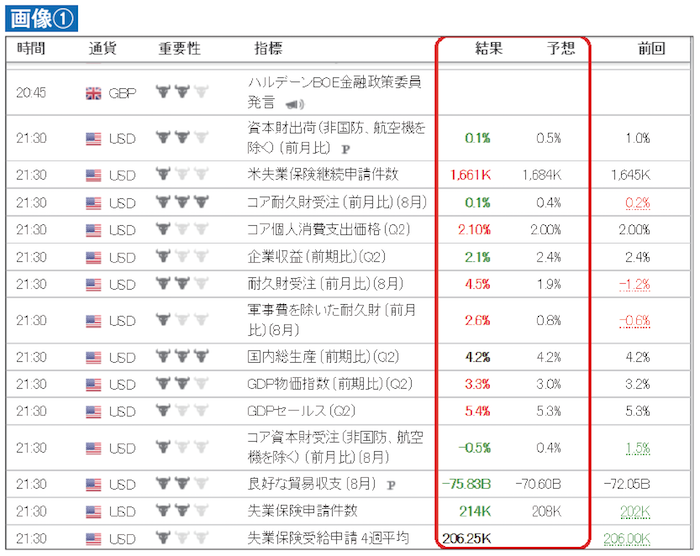
Image ① is the economic calendar from “Investing.com.” The sections circled in red show the “Forecast” and the “Actual.” When the forecast and actual figures diverge, the larger the divergence, the more the price will move in that direction. For example, during the 2018 Canadian CPI (Consumer Price Index) release, the price moves were straightforward as follows.
[Forecast] 0.3
[Actual] 0.6
→ Good result for the Canadian Dollar → CAD rises
[Forecast] 0.3
[Actual] 0.0
→ Bad result for the Canadian Dollar → CAD falls