Did the “intraday trend” that wasn’t in gold exist in the Nikkei 225? Counting Tokyo from 9:00 to 15:00 over 2,135 days.
Verification Notes | Counting the “common sense” of Nikkei 225, Part 1
The author counted in the Gold series first installment whether there is a daytime trend in gold. The answer is thatdays with a trend are in the same proportion as days when minute-by-minute movements are randomly shuffled (real 20.9% · shuffled 21.6%).
So how about the Nikkei 225? Using the same counting method, applied to the Nikkei 225 (futures) during Tokyo daytime, from 9:00 to 15:00. 2011–2019 Tokyo trading days2,135 daysthere are.
First a quiz: Are there more “days with a trend” in Tokyo daytime for the Nikkei?
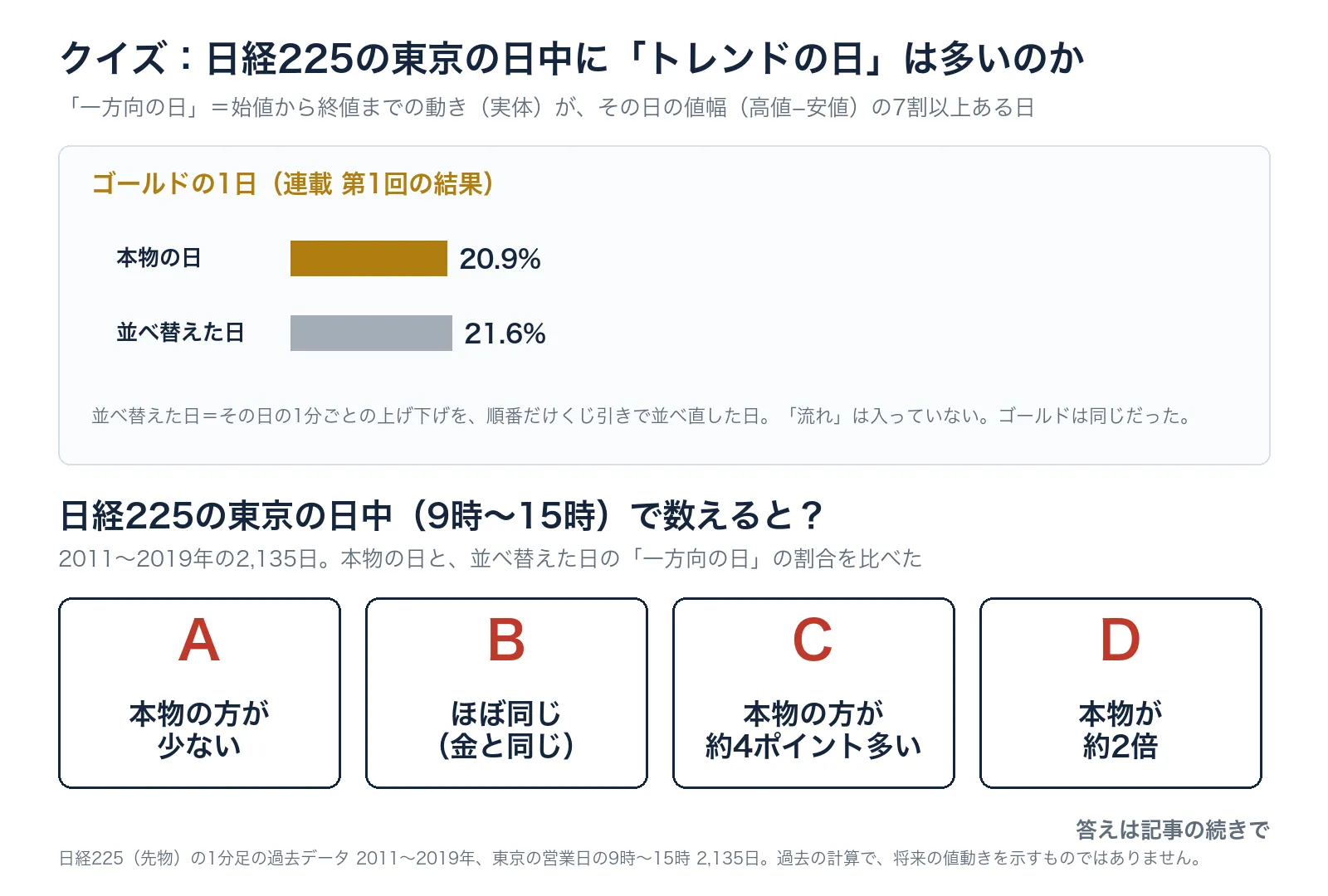
A “one-direction day” is a day when the movement from the opening price to the closing price (the real body of the candlestick) is at least seven-tenths of the range from the day’s high to low. When you look at the chart and feel that “today there was a trend,” that is usually this shape. A “shuffled day” is a day when the minute-by-minute ups and downs of that day are rearranged in order purely by lottery. Both the opening and closing prices, and the size of each rise or fall, are the same, and the “flow” is not present.
How did the real one-direction day compare to the shuffled day?
A: Real was fewer B: About the same (like gold) C: Real was about 4 points more D: Real was about twice as much
Next, we present the answer, and the results of examining nine years as one year each, andthe result of testing whether “if there is a trend, you can take it by getting on in the middle” from 2020 to 2025.
The answer can be read from below under “Continue Reading.”FreeAccess is available with a free GoGoJan member registration (you can sign up with a Google, Yahoo! JAPAN ID, or X account).