
FX Warrior Kurumi-chan Episode 3, 1.3 million yen win and forced settlement are 0.2 yen apart
Key Points of This Article
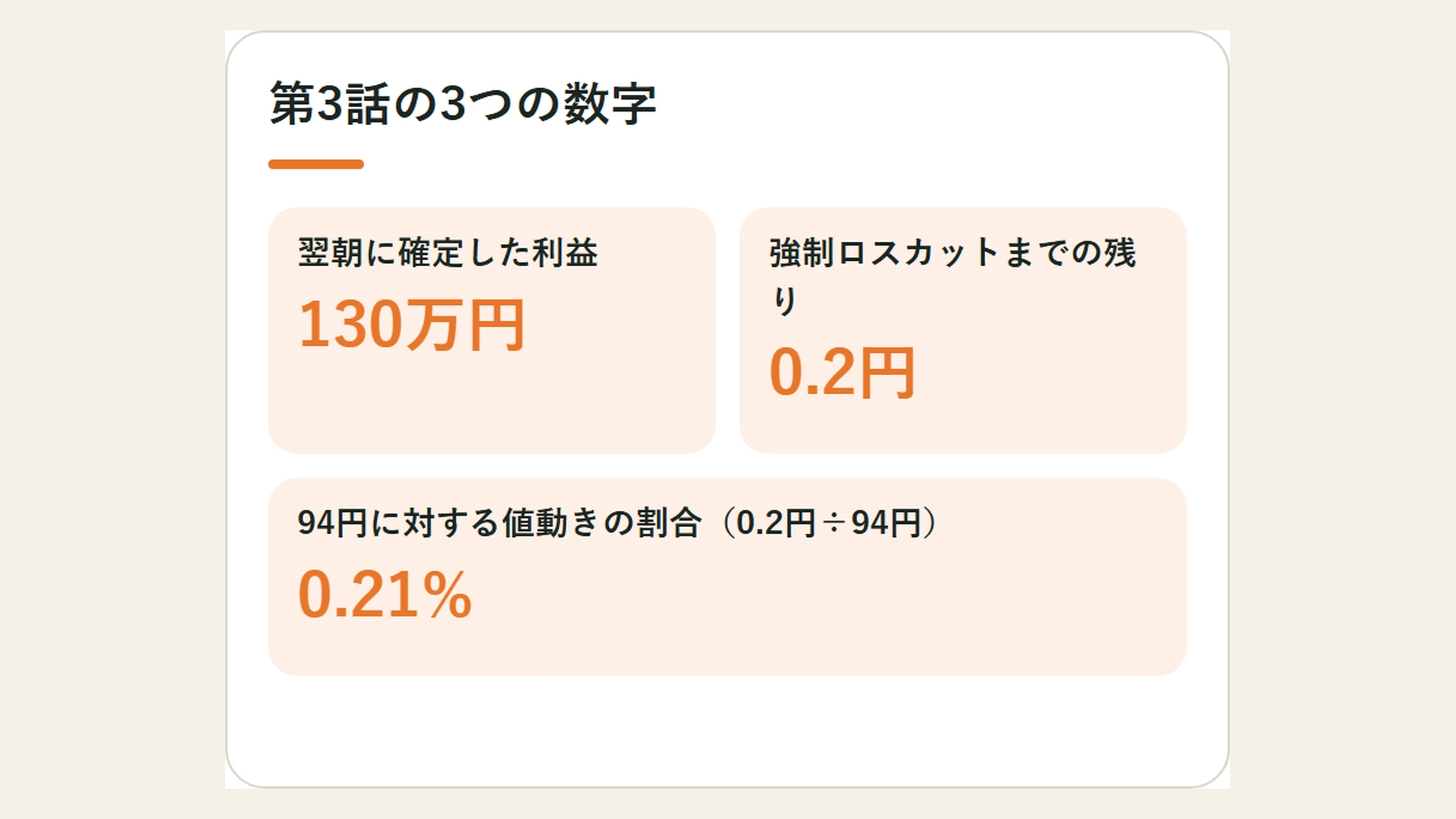
- The 1.3 million yen profit in FX Warrior Kurumi-chan Episode 3 came from buying more after not sticking to the self-imposed rule to cut losses when the 94-yen level was broken—a win that was driven by luck. Mimicking this would be a dangerous trade.
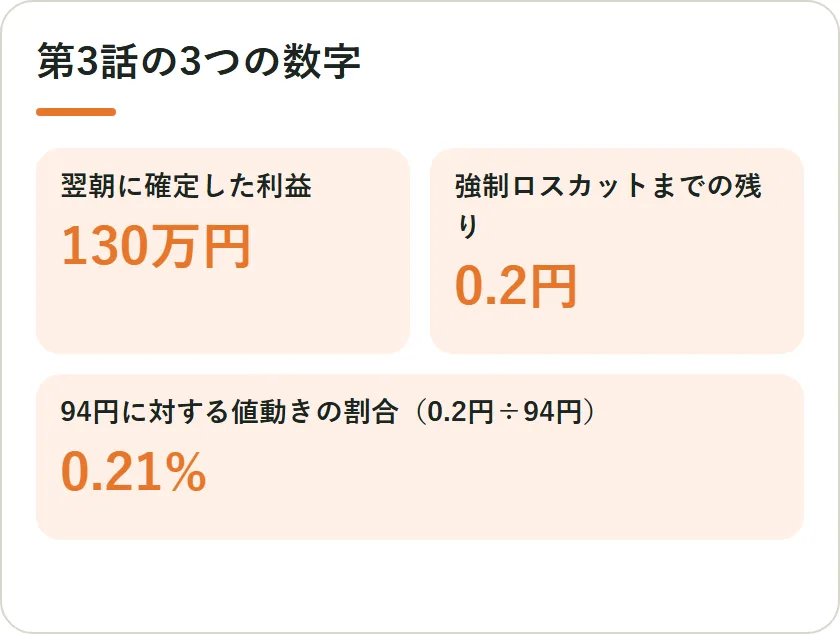
- The difference between profit and forced loss cutting was only about 0.2 yen. It reflects a price movement of just 0.21% from 94 yen.
- If a stop-loss order had been placed just below 94 yen (an order that automatically closes if the price falls to that level), the loss would have largely stopped near the planned point (in sharp moves, execution can occur at less favorable prices than the stop level). The numbers appear in the chapter “What Should Have Been Done.”
What Happened in Episode 3 — The 1.3 Million Yen Profit Came Close to Forced Liquidation, Within 0.2 Yen
The story begins with this scene from the official synopsis: “She deposits her father Ikuo’s 3,000,000 yen in savings, and Kurumi avoids the risk of forced liquidation.” (Official synopsis). Kurumi trades AUDJPY (a currency pair where Australian dollars are bought and sold at a certain rate) and plans to return the funds to her father by the end of the month without being noticed.
A forced liquidation is a mechanism where, when unrealized losses (losses counted only on paper, not settled) inflate to a level decided by the broker, the broker forcibly closes the position.
Kurumi decides to cut losses if AUDJPY falls below 94 yen. However, after seeing a rebound at 94 yen, she increases her long position by 100 lots.
She tells herself that a slight dip is natural, and adds another 150 lots. The price drops to new lows, and the near-forced-liquidation point approaches 0.2 yen away. Kurumi believes she has been liquidated, closes her laptop, and turns away from the market.
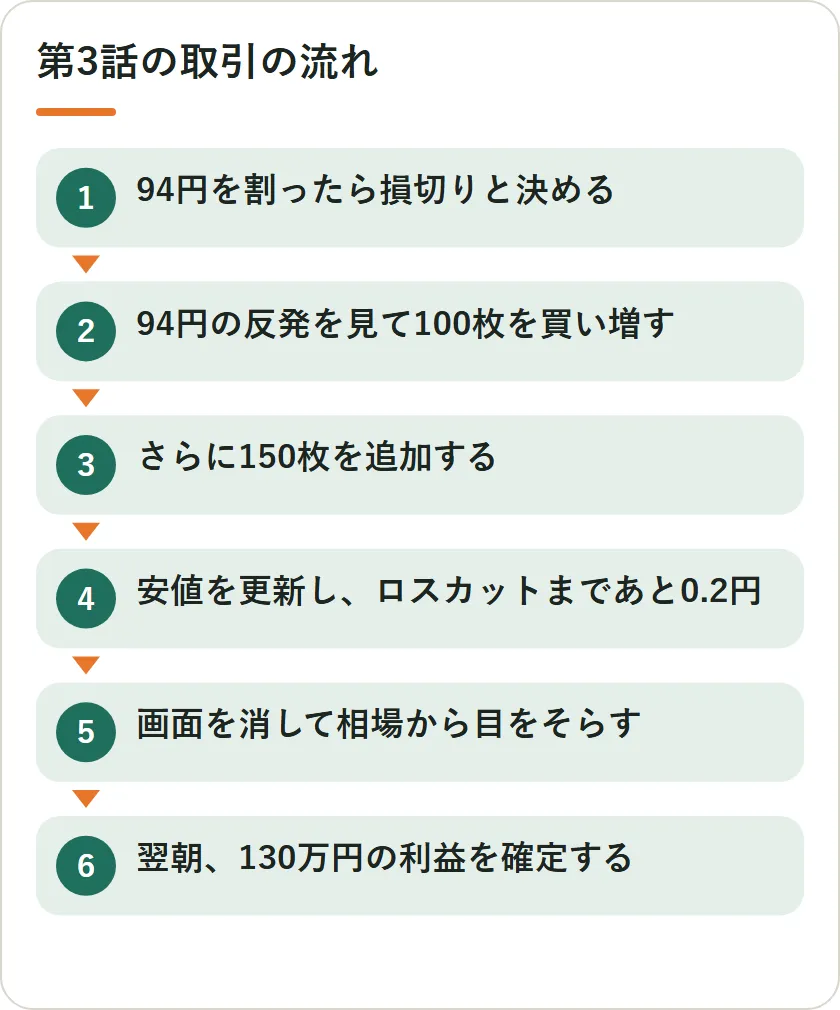
A narration says, “Yet sometimes the market reverses as if to mock human prayers.” The next morning, prompted by a friend Momoko, Kurumi checks her account and finds the position still alive, realizing a profit of 1.3 million yen.
The final narration describes the 1.3 million yen win as being lucky, and paradoxically implies that luck was bad. It notes that getting absorbed in this win is unlucky and is often read that way.
The next part continues with Episode 4: “A Peaceful Life with Zero Unrealized Losses.”
Why Did She Buy More at 94 Yen — A Study of Unrealized Losses and Psychology
The answer is that when you carry unrealized losses, people tend to take more risks. There is research showing that people who still hold unrealized losses are likelier to take risks than those who have realized losses. Kurumi’s flow of buying 100 lots, then 150 lots while still in an unrealized loss fits this pattern.
Kurumi’s 94-yen line was stated as “set in the heart” in the official synopsis, but it was not protected. Instead of taking a loss, Kurumi deferred the loss by depositing more funds to push back the risk of liquidation.
What Could Have Been Done — Numbers If the 94-Yen Line Were Placed as a Stop-Loss
The answer is to place the 94-yen line as a stop-loss order in your mind and as an actual stop order. Then, if the price breaks the line, it would automatically close without emotional interference.
In Japan, for individuals trading FX over the counter, the maximum leverage is 25x. At least 4% of the trade amount must be deposited as margin. 25x and 4% margin are two ways to say the same rule (1/4% = 25).
The next table compares buying at 94 yen and, with a stop at 93.9 yen (0.1 yen below the defined 94 yen), versus not placing a stop, using the maximum limit (25x leverage, 4% margin).
If you buy at 94 yen and close at 93.9 yen, about 2.66% of your deposited funds will be lost. Without a stop, if the price falls 3.76 yen from the purchase price, you lose all deposited funds.
| What to Compare | With Stop-Loss | Without Stop-Loss |
|---|---|---|
| When price breaks below 94 yen | Automatically closes at 93.9 yen | Keeps the position |
| Loss of deposited funds | Generally stops around 2.66% | Falls 3.76 yen from the buy price and all is lost |
| How to calculate | 0.1 yen ÷ 94 yen × 25x | 94 yen × 4% |
The difference is only whether the line is turned into an order or not.
In the United States, after imposing leverage limits on individual FX traders in 2010, the losses of those who previously traded at higher leverage decreased by 40%. This study shows that capping leverage reduces losses for those with higher leverage.
In overseas posts featured on anime no Umi, subtitles and audio were 150, but the screen showed 15, and the second addition quantity isn’t fixed. If we follow the subtitles and audio, Kurumi would have 100 lots plus 150 making 250 lots, and the gains or losses from the added position when the price moved by 1 yen would be 2.5 times what it would be with 100 lots.
Check Before Averaging and Quick Reference Table for Using Your Own Numbers
Before increasing positions or making additional deposits, confirm five things.
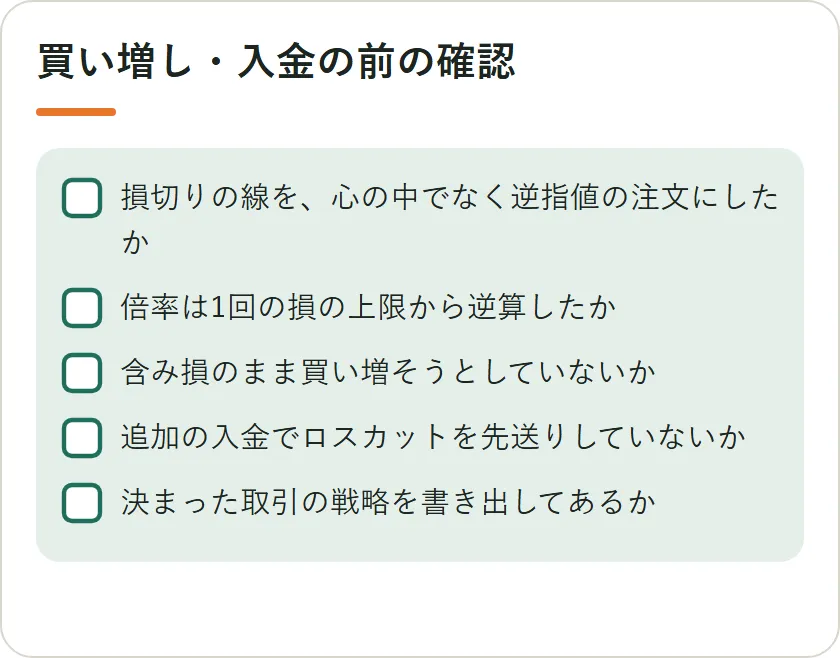
The last item was added because in surveys of individual FX traders in Japan, those without a trading strategy tended to have poorer results.
If you enter your own purchase price, stop-loss width, and leverage, three things appear. The “example answer” in the table is the values derived from the Episode 3 94 yen and the regulatory leverage cap of 25x, with the following assumptions:
- ① Stop-loss width is 0.1 yen (cut at 93.9 yen)
- ② No additional assumptions (only buy price 94 yen and 4% margin)
- ③ Stop-loss width is 1 yen, and the maximum loss per hit is 2% of the account
| What You Want to Know | Example Answer | Formula (Example Numbers) |
|---|---|---|
| ① How much percent of deposited funds are lost with a stop? | 2.66% | Stop width ÷ Buy price × Leverage (0.1 yen ÷ 94 yen × 25x) |
| ② How many yen below the buy price will deplete the funds? | 3.76 yen | Buy price × Margin rate (94 yen × 4%) |
| ③ What leverage is needed to cap a single loss? | 1.88x | Single-loss cap × Buy price ÷ Stop-loss width (2% × 94 yen ÷ 1 yen) |
If You Use a Machine to Enforce the 94-Yen Line — The Rules of Time-Based Settlement and Your Loss Number
Kurumi’s line wasn’t protected because it existed only in her mind. In addition to a stop-loss, there is a method where a machine settles at a fixed time. An EA (an automated trading program).
As an example, when lining up the governance of the EA “LAST ORDER” listed on GogZhan with Kurumi’s movements, the results are as follows.
| Scene | Kurumi (Episode 3) | LAST ORDER’s Rules |
|---|---|---|
| Settlement | Held even after breaking 94 yen | Settles at a fixed time |
| Number of lots | Bought 100 lots, then added 150 lots | Has a cap on the number of lots held at once and the direction is the same |
| Sudden price movements | Pushed liquidation forward by deposits | There is a separate forced liquidation line |
Napping (adding to a position each time the price falls) and martingale (increasing trade size after losses) are not used, according to the sales page.
However, there are times when you can still lose even if rules settle. In past validations on the sales page, the lowest drop was 19.8% of the balance, and it took 374 days to recover (maximum drawdown).
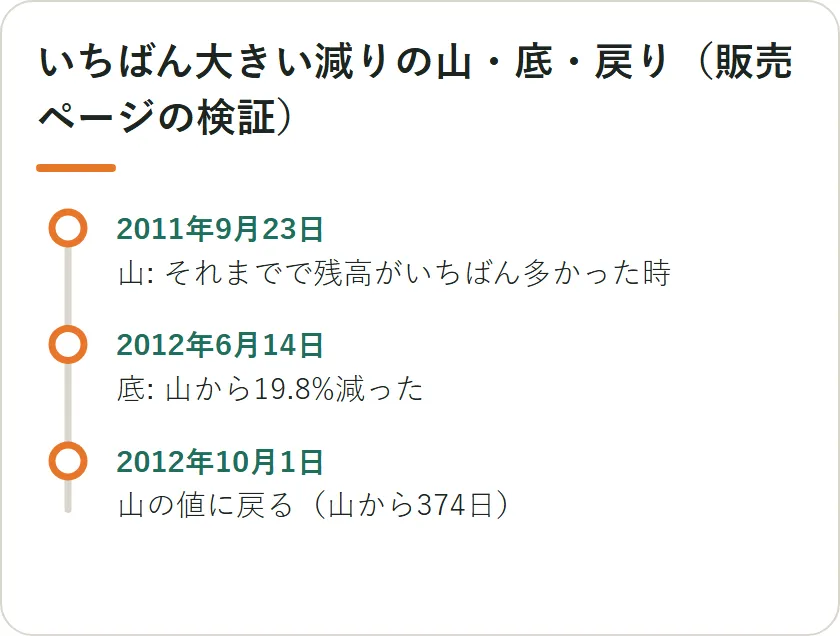
A 19.8% decrease would be 198,000 yen on a 1,000,000 yen account, and 594,000 yen on Kurumi’s 3,000,000 yen deposit.
None of these figures indicate future performance. They are calculations (compounded) based on historical data from May 2003 to December 2025, assuming profits were carried into the next trades without withdrawal.
In the same validation, every year from 2003 to 2025 showed positive returns, with the lowest year being +8.8% in 2012.
The performance can be checked before you buy using a free record.
- All trades’ records (CSV, 86,515 lines) are six columns: date, currency pair, buy/sell, entry price, settlement price, profit/loss pips (units to count exchange rate movements).
- If you sum pips by year in Excel, you can see bias toward wins or losses. Sorting by currency pair shows which currencies tend to underperform.
- Selecting a row and comparing with MT4 charts lets you confirm whether the settlement price lies within that day’s price range.
Frequently Asked Questions
If you cut losses at 94 yen, how much did you lose?
The exact yen amount cannot be shown in this article. Overseas posts on Anime no Umi claim the subtitles and audio are 150 while the screen shows 15, and the second addition quantity isn’t fixed. If expressed as a percentage, the loss of deposited funds when you cut at 93.9 yen is 2.66%.
If you are liquidated, does the loss stop at the deposited funds?
Sometimes not. The Financial Services Agency notes that when the market moves rapidly, even with a liquidation rule, losses can exceed the margin amount.
How many FX troubles are there?
Consultations about FX (foreign exchange margin trading) received by consumer centers nationwide totaled 1,330 in fiscal year 2025, down from 2,408 in fiscal year 2024.
Next to Read
Before you trade a currency pair and with which account you can operate, check on the sales page beforehand. The display on the sales page (as of October 21) is as follows.
| What to Check | Sales Page Display |
|---|---|
| Tools used | MT4-only. Place the same EA on six charts for six currencies |
| Actual tested account | FXTF MT4 |
| Accounts checked by public conditions only | Dukascopy Japan,Rakuten Securities, Gaitamefinest (no performance history) |
| Hedging | Cannot be used on accounts that cannot hold both buy and sell in the same currency |
| Currencies | USDJPY, EURUSD, GBPUSD, AUDUSD, USDCHF, USDCAD — AUDJPY is not included |
| Price | 49,800 yen including tax. One-time purchase with no monthly fee or performance-based reward |
How to view annual and currency-specific performance in the free CSV is explained in the second article. The contents before Episode 3 and the EA that settles by time are on the next page.
- FX Warrior Kurumi-chan Episode 2: 59x equals 1.69% move the other way to zero funds(This is an article that numerically examines the previous episode's trades)
- Procedure to aggregate all trades’ CSV by year and currency in 5 minutes(This is the procedure to verify the EA’s performance using free records before buying)
- Sales page for the EA “LAST ORDER,” which settles at a fixed time (GogZhan)(This is the author’s listed EA. Even if you don’t purchase, you can view how the fixed time, maximum unit count, and forced settlement lines are written)
Next installment in this series: Episode 4 “Zero Unrealized Losses, a Psycho-♡ Life” (for those curious about what a ‘zero unrealized loss’ life after a 1.3 million yen win might lead to)
Sources
The numbers and facts in this article are compiled from the list below.
- Seishun Shogai Otaku Yarou no Nichijou (Ameblo) Episode 3 Commentary
- Kenichi’s Anime Review (Ameblo) Episode 3 Commentary
- ABEMA TIMES (Yahoo! News) Episode 3 Article
- Anime no Umi Episode 3 Commentary
- TV Anime “FX Warrior Kurumi-chan” Official Site Story (Episode 3 “Must Cut Losses, or Not…?”)
- Imas, A. (2016) “The Realization Effect: Risk-Taking After Realized Versus Paper Losses” American Economic Review, 106(8). DOI: 10.1257/aer.20140386
- Hayo, B., & Iwatsubo, K. (2022) “Who Is Successful in Foreign Exchange Margin Trading? New Survey Evidence from Japan” Sustainability, 14(18). DOI: 10.3390/su141811662
- Financial Services Agency “Regarding so-called foreign exchange margin trading”
- Cabinet Office Ordinance on Financial Instrument Business etc. Article 117 (e-Gov Law)
- LAST ORDER Sales Page (GogZhan)
- LAST ORDER All Trades CSV (GogZhan)
- National Consumer Affairs Center “Status of Consumer Affairs in 2025 Nationwide”
- Heimer, R. Z., & Simsek, A. (2019) “Should retail investors' leverage be limited?” Journal of Financial Economics, 132(3). DOI: 10.1016/j.jfineco.2018.10.017
Note: The narration in the reversal scene is translated from English-language posts, and phrasing varies by translation (this article uses the Anime no Umi translation).