
FX Warrior Kurumi-chan Episode 2, 59x is 1.69% If it moves the opposite way, funds are zero
Key Points of this Article
- FX Warrior Kurumi-chan Episode 2 is about Kurumi, who turned 300,000 yen in principal over three months into more than 810,000 yen, by buying AUD/JPY at about 59x leverage. She hesitates to cut losses even when the position becomes a loss, and in the end reaches for her father’s 3,000,000 yen in his dresser savings.
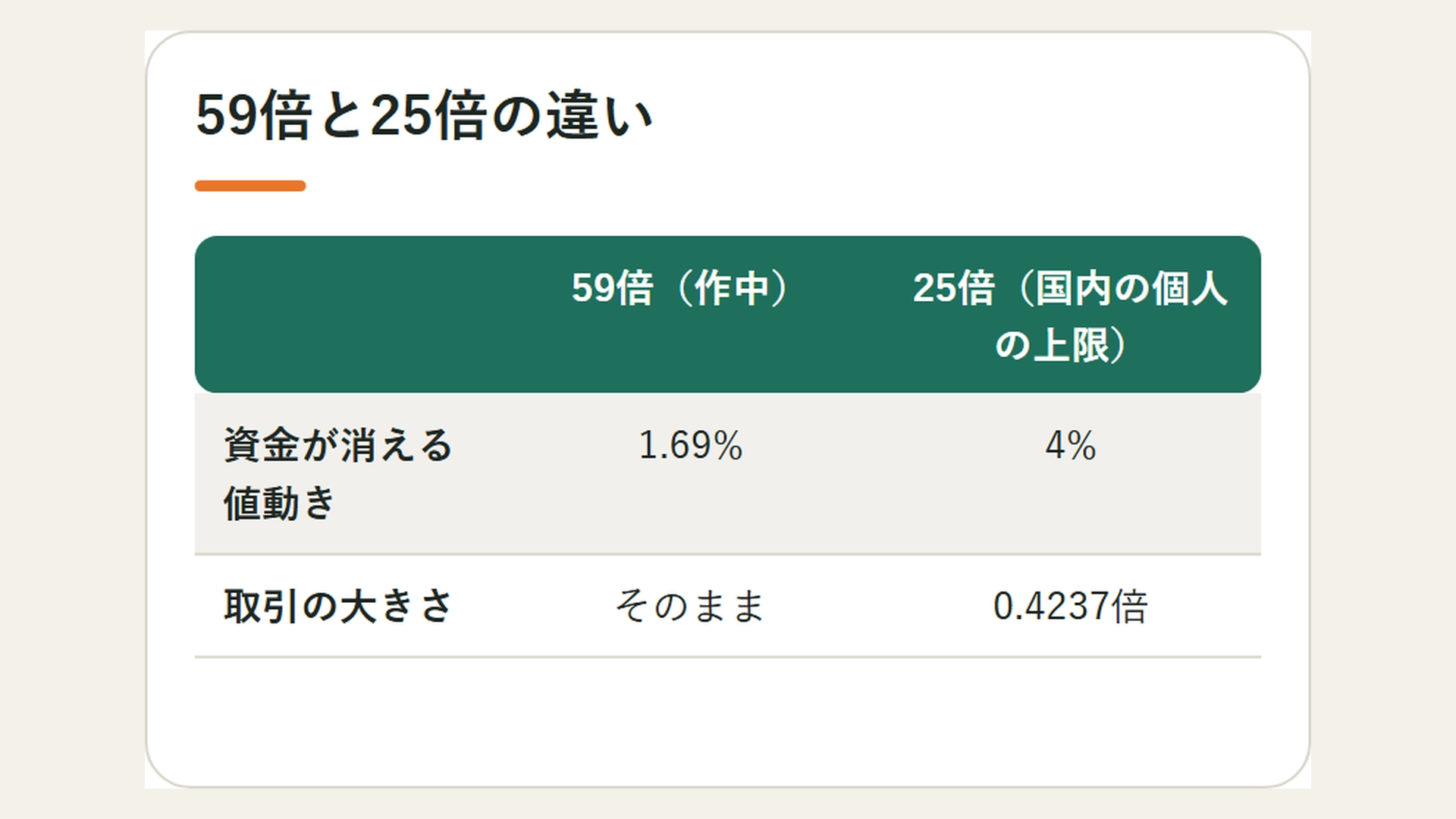
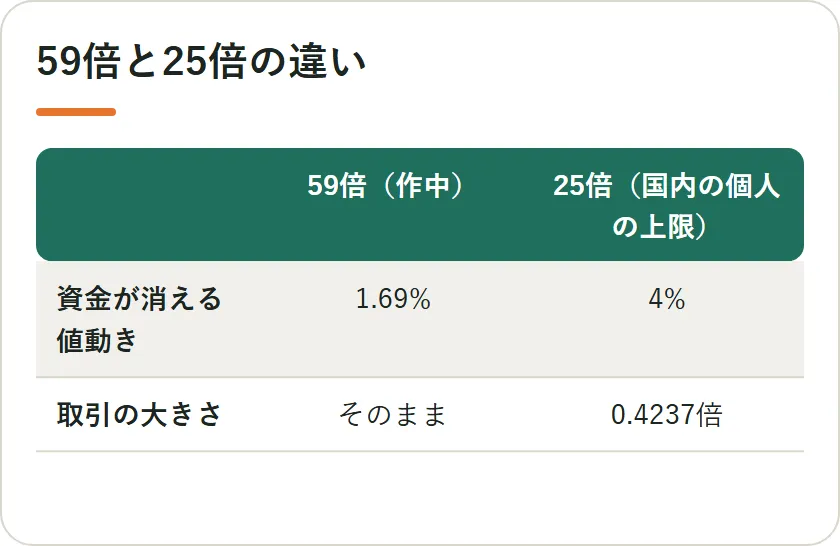
- With 59x, if the exchange rate moves only 1.69% in the opposite direction, all of the funds she holds can vanish. At the domestic individual cap of 25x, the range is about 4% (calculated by the Financial Services Agency).
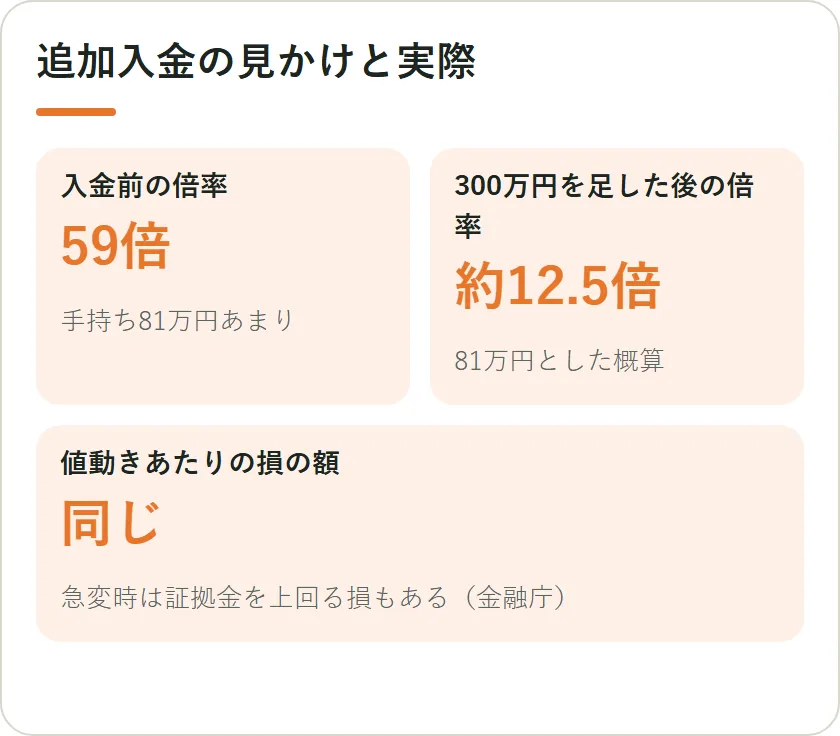
- Even after adding 3,000,000 yen, the leverage drops to about 12.5x, and the amount of loss does not decrease (calculation). In the United States, after a leverage cap was introduced, people who had been trading at high leverage saw their losses shrink by 40%.
The mechanism of an EA that settles at the decision time even with unrealized losses: EA “LAST ORDER” sales page (GogoJungle)
What Happened in Episode 2——A 59x AUD/JPY is a trade where funds vanish if the market moves 1.69% in the opposite direction
Episode 2 “Because there’s leverage, it’s okay♪” is a story that happened within a 59x leveraged trade where funds vanish if the exchange rate moves 1.69% in the opposite direction.
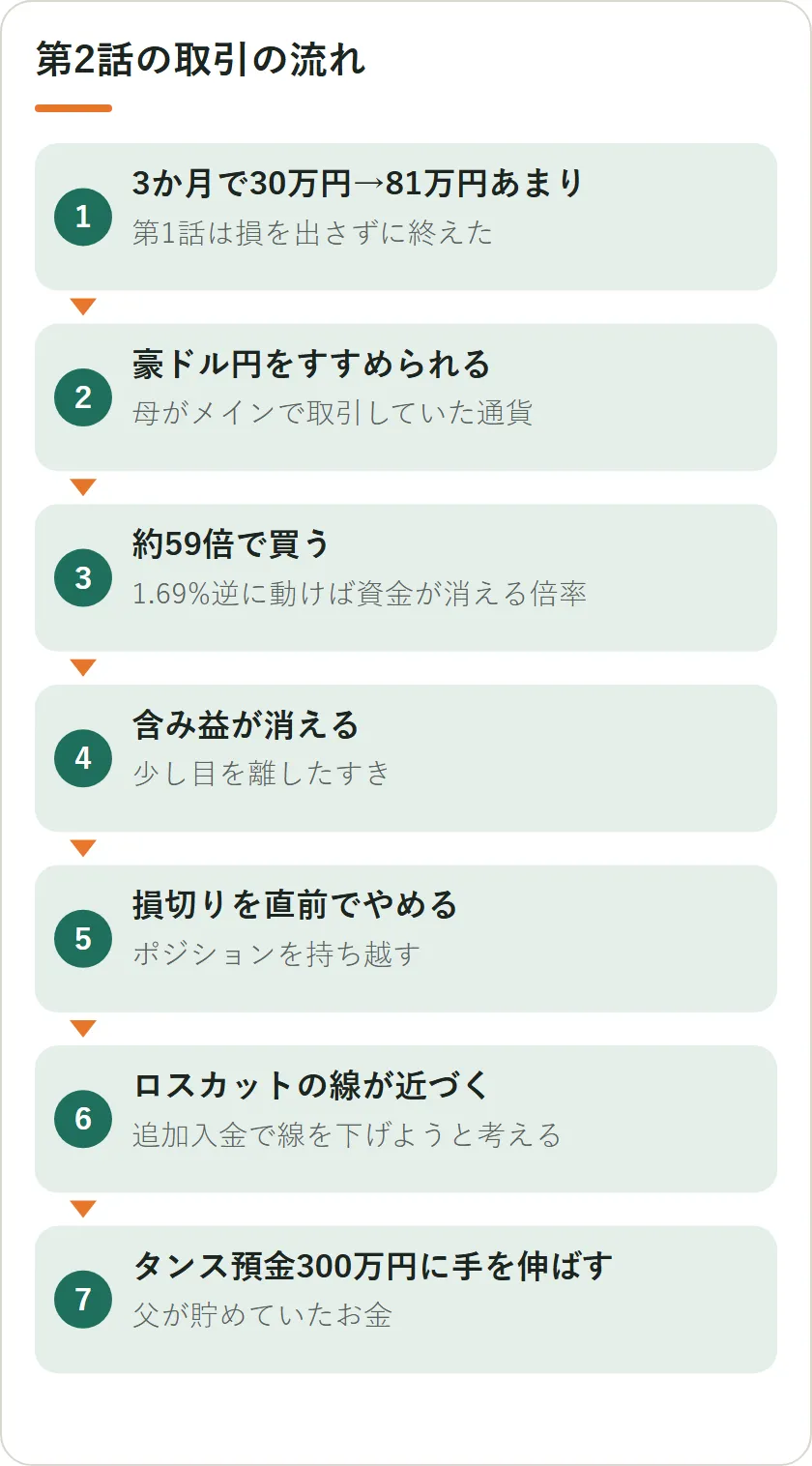
Leverage is a number that represents how many times the account funds the amount being traded. The Episode 1 trade ended without a loss. In the following three months, Kurumi increased her principal from 300,000 yen to more than 810,000 yen.
Next, her investing friend Moe-chi-ko (Mo-mo-chi-ko) recommends AUD/JPY. AUD/JPY was the currency pair Kurumi’s mother mainly traded when she lost 20,000,000 yen. Moe-chi-ko offers to lend 3,000,000 yen, but Kurumi declines.
Nevertheless, Kurumi tries to grow funds with high leverage. The official synopsis states that Kurumi “despite wavering, enters into ultra-high-leverage trading.” Kurumi’s leverage is about 59x.
The foreign brokers Kurumi uses are introduced as having no upper limit on leverage. The trades initially went well, but when she looked away for a moment, the market fell, and unrealized gains disappeared. Unrealized gains are the gains on trades that have not yet been settled.
Kurumi exclaims, “I failed... I was completely greedy... I was giddy...” and feels defeated. She tries to set a stop with “I’ll settle at the next move,” but stops just before, and carries the position over. The diary describes this as being tempted by “the possibility that it will rise further.”
Soon, the line for a forced liquidation approaches. A forced liquidation is when, once losses hit a preset level, the broker forcibly ends the trade. Kurumi considers adding more money to lower the line and reaches for her father’s 3,000,000 yen in dresser savings.
Moe-chi-ko, who recommended it, quietly believed that AUD/JPY was currently in a wait-and-see phase.
Why Couldn’t She Cut Losses and Why Did She Reach for Her Father’s Money—a Psychological Look at Unrealized Losses
People feel losses more heavily than gains of the same amount. Kurumi’s four situations each involve a common trap for people.
| Episode 2 Scene | What Tends to Happen |
|---|---|
| After accumulating profits for three months, buy at about 59x | The increased money looks like “profit” and becomes easier to bet bigger (house money effect) |
| Moe-chi-ko suggests AUD/JPY | Being exposed to a friend’s trades makes wins come faster and losses harder to bear (temperament effect) |
| Stops cutting losses and reaches for her father’s money | If unrealized losses remain unconfirmed, it becomes easier to take bigger risks |
| Adds funds to push the stop loss line farther away | Deferring losses becomes easier, leading to longer postponement of stop losses |
The row-by-row study of the table is as follows.
- Line 1: In Thaler & Johnson (1990) experiments with real money, people became more willing to take risks after previously gaining.
- Line 2: In Heimer (2016), when a social network of trading peers becomes usable, the magnitude of the temperament effect nearly doubles. The temperament effect refers to the tendency to settle winning trades early and hold losing trades longer. This is not a study of a single friend’s suggestion.
- Line 3: In Imas (2016), after losses are realized, people avoid risk, but while unrealized losses remain, they take bigger risks.
- Line 4: In Heimer & Imas (2022), when leverage restrictions delay losses, the temperament effect reduces. The data from trading and both experiments showed the same result. Additional deposits move in the opposite direction, but there is no study on deposits themselves.
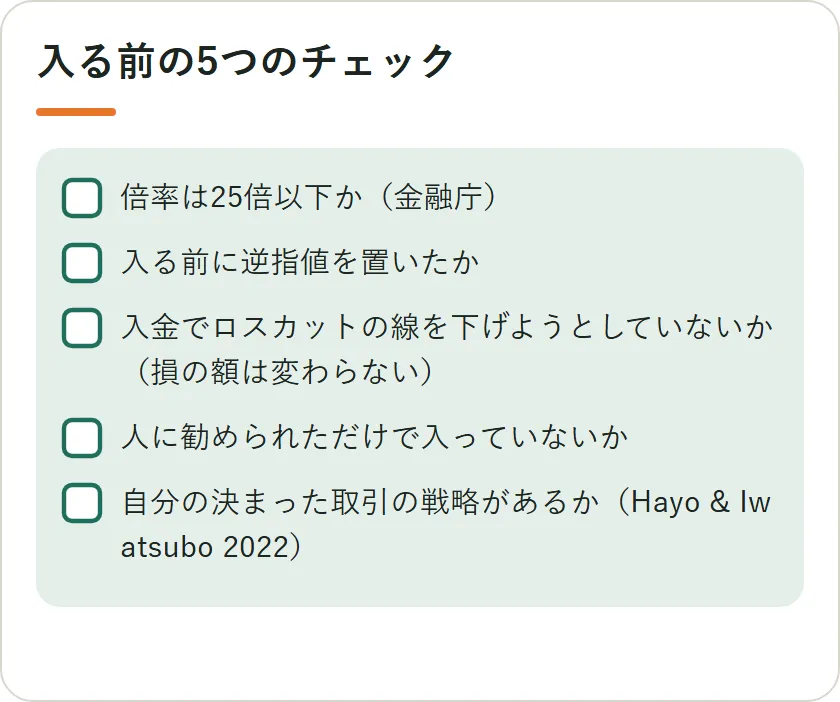
Leverage caps and whether there are fixed strategies were related to actual losses and performance. In U.S. retail FX, after the leverage cap was introduced in 2010, trading volume dropped 23% and those who had traded at high leverage saw losses decrease by 40%. Among Japanese individuals trading FX margin, those without a fixed trading strategy tended to have poorer performance.
What Could Have Been Done—Looking at Leverage, Stop-Loss, and Additional Deposits in Numbers
The calculations in this chapter do not include commissions or spreads.
First, leverage. In Japan, individuals trading over-the-counter FX must post collateral of at least 4% of the trading amount, limiting leverage to 25x or less. If a 59x trade is scaled to 25x, the trade size becomes 25/59 = 0.4237x, about 40% of the original size.
The range in which funds can vanish is calculated as 1/leverage × 100. At 59x, 1/59 × 100 = 1.69%; at 25x, 1/25 × 100 = 4%. Even at 25x, the range is only 4%, but it is wider than 1.69% at 59x.
Next, the stop-loss line. In this article, the pre-set order for stopping losses is called a stop order (reverse limit). For example, if you decide to limit a single loss to 2% of your account (2% is just an example), then 810,000 × 2% = 16,200 yen is the upper limit.
If you keep 59x while following this rule, the stop order would be moved at 2% ÷ 59 = 0.03% movement. It becomes clear that with 59x, setting a loss cap itself is difficult because only a tiny move can trigger it.
Finally, additional deposits. Adding 3,000,000 yen lowers the leverage to 59 × 810,000 ÷ (810,000 + 3,000,000) ≈ 12.5x (approximate, treating 810,000 as 810,000). However, the stop-loss line just moves farther away, and the trade size remains the same, so the loss per price move does not change.
Even though the leverage appears lower with the added money, the amount of loss does not decrease by one yen, and exposing your father’s money to losses is a pitfall revealed by the calculation. The Financial Services Agency notes that when the market moves abruptly, even with a stop loss, “losses may occur that exceed the amount of margin.”
Answer—If you bind by rules, you cannot postpone (in EA that settles at a fixed time)
The answer is to lower leverage and to pre-establish rules that prevent postponing losses. Kurumi decided within unrealized losses and attempted to postpone via additional deposits; Heimer & Imas (2022) showed the opposite: increasing the cost of postponement through constraints reduces the temperament effect.
To align the LAST ORDER mechanism described on the sales page with Kurumi’s behavior in reverse, it would be as follows:
- Entry and settlement times are fixed. Whether unrealized gains or losses, all settlements occur at the predetermined times, so positions cannot be held to expiration.
- There are limits on the number of positions held simultaneously and on positions in the same direction. Averaging down (doubling down as prices fall) or martingale (increasing the size after losses) are not used.
- In addition to normal settlement rules, there is a forced settlement line to prepare for unexpected rapid moves. The safety line is guarded by machines, not people.
The currencies traded are USDJPY, EURUSD, GBPUSD, AUDUSD, USDCHF, USDCAD — AUD/JPY is not included. Even with binding rules, losses can occur.
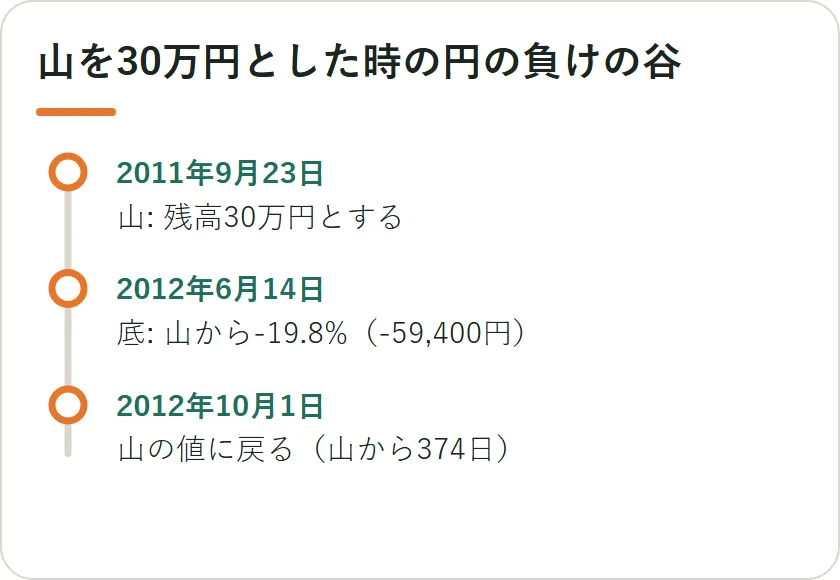
In past validation of LAST ORDER, the worst period saw the balance drop 19.8% from its peak, and it took 374 days to recover to that peak.
If the peak balance was 300,000 yen, the deepest drawdown would be about 58,962 yen (300,000 × 19.8% = 59,400 yen). As with the seller’s validation, this is based on adjusting trade size to the balance (compounded), not a separate scenario.
Reference: Asset curves and annual performance seen in a free CSV of pips
When applying to your own account, the 19.8% decrease corresponds to yen, while pips 1,291.6 (the peak value returning to the baseline after 502 days) is a reference value for a different method of counting that does not include trade size or compounding. The two figures below are calculated from a free CSV of all trades (product number 86515, 11,489 trades, 6 currencies) distributed by the seller on GogoJungle.
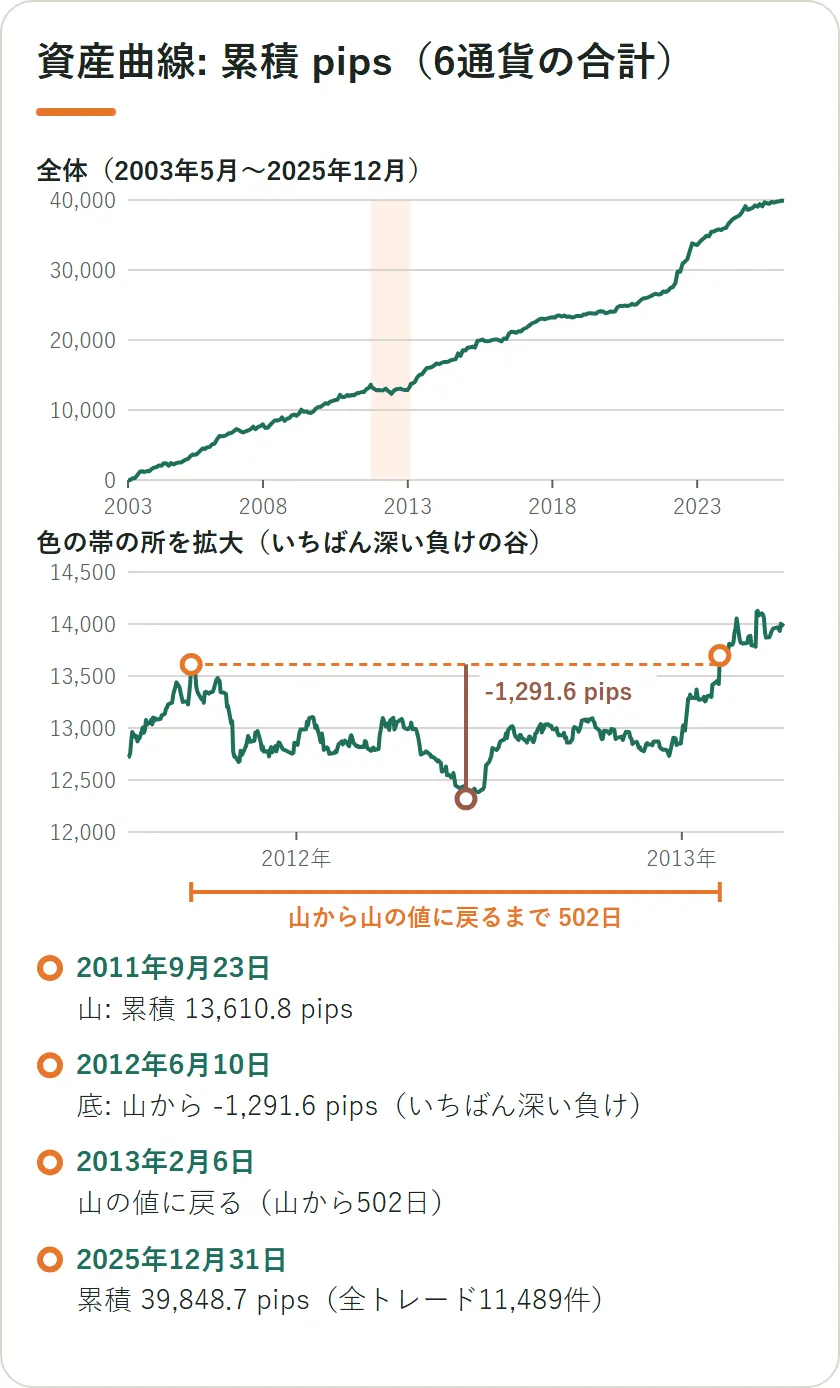
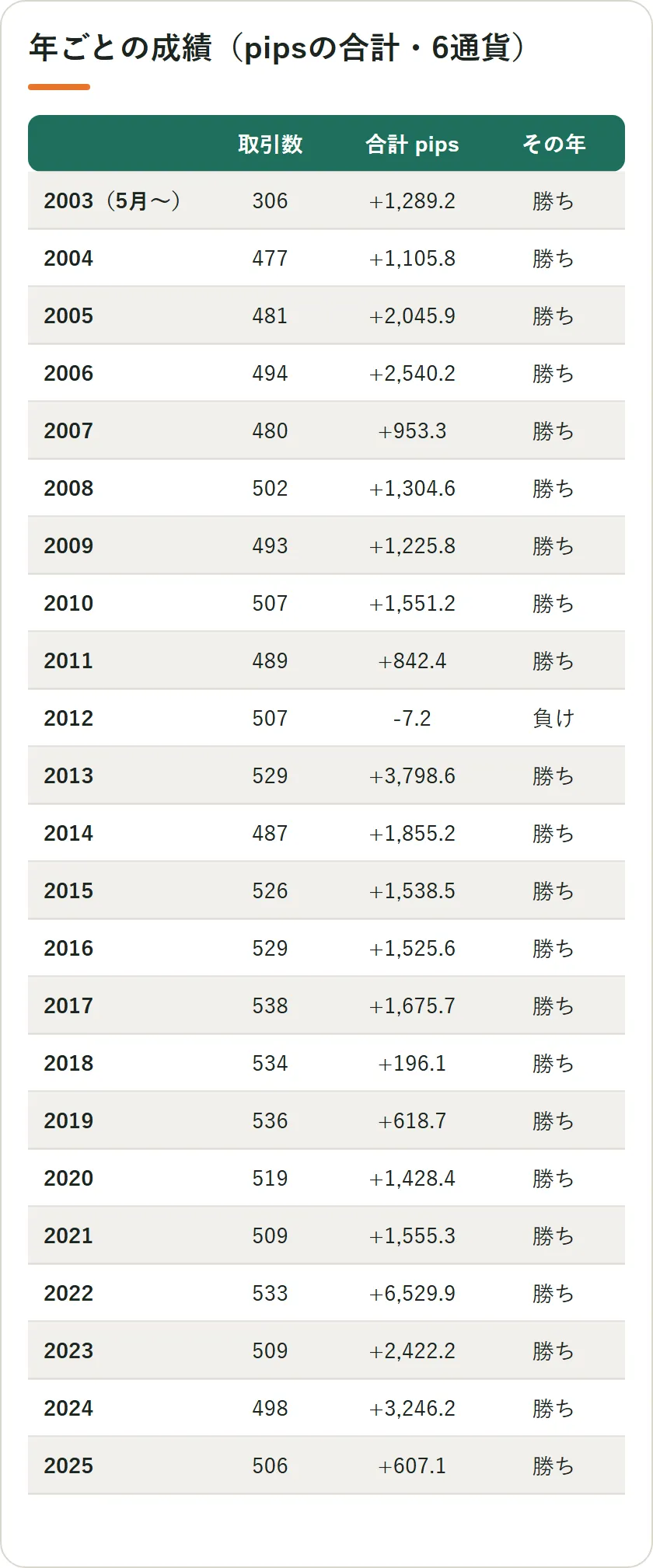
In pips, only 2012 was negative (-7.2 pips) among 23 years. In the calendar-year performance of yen (compounded), 2012 was +8.8%, and all 23 years were positive.
Both are historical validation values and do not guarantee future results.
A Table to Check Your Leverage and Stop-Loss Width
How to use: In the right column, input your account funds, the amount you will stake, and the loss limit per trade (in %), and calculate from top to bottom. The example column lists numbers derived from the figures in the work and domestic limits.
| What to check | Formula | Example (figures from the work and domestic limits) | Your numbers |
|---|---|---|---|
| ① Leverage | Stake ÷ account funds | In the work, about 59x | |
| ② How much funds can vanish | 1 ÷ Leverage × 100 | 59x → 1.69%, 25x → 4% | |
| ③ Loss per single trade | Account funds × decided % | 810,000 × 2% = 16,200 yen | |
| ④ Movement to the stop order | Decided % ÷ Leverage | 2% ÷ 59x = 0.03% | |
| ⑤ Leverage after deposit | Leverage × funds ÷ (funds + deposit) | 59 × 810 ÷ 381 ≈ 12.5x (loss amount unchanged) |
The smaller the value in ②, the more quickly funds can diminish with small price moves. If the value in ④ is too small to place, it is a sign to lower leverage.
Frequently Asked Questions
Is FX Warrior Kurumi-chan’s FX scary?
At about 59x in the work, funds can vanish if the exchange rate moves 1.69% in the opposite direction. Even at 25x, the range is 4%. The Financial Services Agency notes that during sudden movements, losses may occur that exceed the amount of margin.
Can you trade 59x domestically?
Domestically, retail FX is limited to 25x or less. The broker Kurumi uses in the work is introduced as overseas broker with no leverage cap.
Can adding funds avoid a stop-out?
Deposits reduce leverage; adding 3,000,000 yen to 810,000 yen makes about 12.5x (rough). However, trade size remains the same, so losses do not decrease, and in abrupt moves you can lose more than the money you deposited.
How many FX consultations are there?
National Consumer Affairs Centers accept inquiries; FX consultations registered on PIO-NET were 1,330 in 2025 and 2,408 in 2024.
When was Episode 2 broadcast?
It aired on TOKYO MX on October 8, 2026, at 22:30.
Next to Read
- The EA “LAST ORDER” that settles at the predetermined time regardless of unrealized losses (GogoJungle)(This is the EA the author offers for sale.)
- Before buying the EA, a 5-minute procedure to aggregate all trades by year and currency from the CSV
Next installment in this series: Episode 3 “If I don’t cut losses, then…?” (For those curious about the psychology and numbers when you can’t cut losses while holding unrealized losses)
References
The numbers and sources for this article are summarized in the list below.
- Anime Kai “Kaizoku no Umi” (Overseas Reactions) Episode 2
- Futanman+ (Yahoo! News) Episode 2
- Zawa Soku (Overseas Reactions) Episode 2
- Kenichi’s Anime Review (Ameblo) Episode 2
- Nincho Nichiki Episode 2
- ABEMA TIMES (Infoseek News) Episode 2
- Official site of TV anime “FX Warrior Kurumi-chan” Story Episode 2
- Bandai Channel “FX Warrior Kurumi-chan” Episode 2
- Financial Services Agency “Regarding so-called foreign exchange margin trading”
- Cabinet Order on Financial Instruments and Exchange etc., Article 117 (e-Gov Law Search)
- National Consumer Affairs Center “Status of Consumer Complaints Nationwide 2025 – From PIO-NET” 2025
- Kahneman, D., & Tversky, A. (1979) “Prospect Theory: An Analysis of Decision under Risk” Econometrica. DOI: 10.2307/1914185
- Shefrin, H., & Statman, M. (1985) “The Disposition to Sell Winners Too Early and Ride Losers Too Long: Theory and Evidence” The Journal of Finance. DOI: 10.1111/j.1540-6261.1985.tb05002.x
- Thaler, R. H., & Johnson, E. J. (1990) “Gambling with the House Money and Trying to Break Even: The Effects of Prior Outcomes on Risky Choice” Management Science. DOI: 10.1287/mnsc.36.6.643
- Imas, A. (2016) “The Realization Effect: Risk-Taking After Realized Versus Paper Losses” American Economic Review. DOI: 10.1257/aer.20140386
- Heimer, R. Z. (2016) “Peer Pressure: Social Interaction and the Disposition Effect” The Review of Financial Studies. DOI: 10.1093/rfs/hhw063
- Heimer, R. Z., & Simsek, A. (2019) “Should retail investors' leverage be limited?” Journal of Financial Economics. DOI: 10.1016/j.jfineco.2018.10.017
- Heimer, R. Z., & Imas, A. (2022) “Biased by Choice: How Financial Constraints Can Reduce Financial Mistakes” The Review of Financial Studies. DOI: 10.1093/rfs/hhab073
- Hayo, B., & Iwatsubo, K. (2022) “Who Is Successful in Foreign Exchange Margin Trading? New Survey Evidence from Japan” Sustainability. DOI: 10.3390/su141811662
- LAST ORDER Sales Page (GogoJungle)
- LAST ORDER All Trades CSV (GogoJungle)
How to Read the Research
- Kahneman & Tversky (1979): Theory based on patterns of human choice.
- Thaler & Johnson (1990): Experiments with real money. Subjects were not foreign exchange trading.
- Shefrin & Statman (1985): The temperament effect and evidence for it.
- Heimer (2016): Individual traders’ trading records and SNS data. A comparison using the timing of broker SNS partnerships.
- Imas (2016): New data and existing data.
- Heimer & Imas (2022): Individual trader trading data and two experiments.
- Heimer & Simsek (2019): An observational study (difference-in-differences) comparing three sets of U.S. individual FX data before and after regulation.
- Hayo & Iwatsubo (2022): 2018 survey of individuals trading Japanese FX margin; overconfidence and underconfidence did not show a noticeable effect on performance.