
Investors Actor Shun Hirose's Oshi! Chart Club | Chapter 2: Are Multiple Moving Averages Beneficial?
Characters in This Story
Gakushuin Chaato (Gakushuin Chaatto)

A new member of the private Wachii Plus Academy Chart Club. In the past, she was known in class as the “Master of Multiplication,” but the moment the name changed from “Arithmetic” to “Mathematics,” she heard something within her crumble, so the story says.
Hirose Shun

Captain of the Chart Club. The school’s strong subject is “Language Arts.” When she was little, she studied voraciously to win library-book-reading awards. But after entering middle school, she rose to the top in Home Economics, neglecting studies and developing exceptional feminine charm.
*This article is a reprint and remix of an article from FX攻略.com, February 2019 issue. Please note that the market information written here may differ from current market conditions.
Hello everyone, well, actually ossu! In this case, yes. I’m Hirose Shun, a yokai-actor in the “Investor.” Thank you to everyone who read Episode 1. This time is Episode 2. To you reading this, you’re already a fine member of the “Chart Club,” so let’s become friends with the chart as much as possible! The chart is really interesting and like a living thing, something to be cherished, isn’t it!
Part 1: Investment Is a Probability Business
Gakushuin Chaato (hereafter “Gaku”) senpai…
Hirose Shun (hereafter “Shun”)Wha-What’s wrong!? You don’t seem energetic. Or rather, you seem quite down...
Gaku: The other class members are whispering that I joined the investment club, saying, “They’re dangerous…” It seems like that.
Shun!? Dangerous, you say?
Gaku: There’s a vibe like, “That person might be dabbling in gambling…?” Ugh…
ShunHuh, investment isn’t gambling at all. It’s true that some people try to make money like gambling without studying, taking risky trades, and some noisy people who fail declare “Investment is all luck!” which is troublesome.
Gaku: Right…
ShunInvesting is a “business of probabilities.” Professional investors understand this and act with caution and boldness; traders, like other professionals, should be respected and are cool. So Gaku-kun, hold your head up!
Gaku: I’ll first study properly and become a winning trader, and dispel that image from people around me! Investing is not gambling!
ShunExactly, not luck or fate...! Murmur murmur...
Gaku: Hmm, senpai... are you aiming to turn this into a manga or anime…?
Shun(……。)
2nd Part: The Two Major Crosses
ShunTo master “Ido-dai,” last time we first learned what the “Moving Average” is at its core.
Gaku: (He’s continuing as if nothing happened… amazing mental fortitude.)
ShunToday we’ll learn from famous buy/sell signals of the moving average, and the significance of using multiple moving averages in Ido-dai.
Gaku: Oh, ossu!
ShunThe moving average represents, as taught last time, the average price at which people bought or sold the stock over the past ◯ days.
Gaku: So, for example, if the current price is above the moving average during a “buy,” it means, on average, people who bought in those past ◯ days are in the plus.
ShunRight. Therefore, when the price transitions from below the moving average to above, buyers who were in the negative gradually become positive. Conversely, if you were selling while the price was rising and you were in profit, you’ll see losses gradually increase as the price moves down).
Gaku: If you’re a buyer, that’s cause for “Yay!” and if you’re a seller, “Ah… what a waste….”
ShunExactly. Crossing the line can increase the momentum for buyers, and sellers exiting with opposite trades can further increase buying pressure.
Gaku: It’s a relief when profit turns to loss, and it’s unsettling when profit starts to shrink...
ShunUnderstanding this investor psychology, thinking about the famous buy/sell signals “Golden Cross” and “Dead Cross” becomes a bit different (Figure 1).
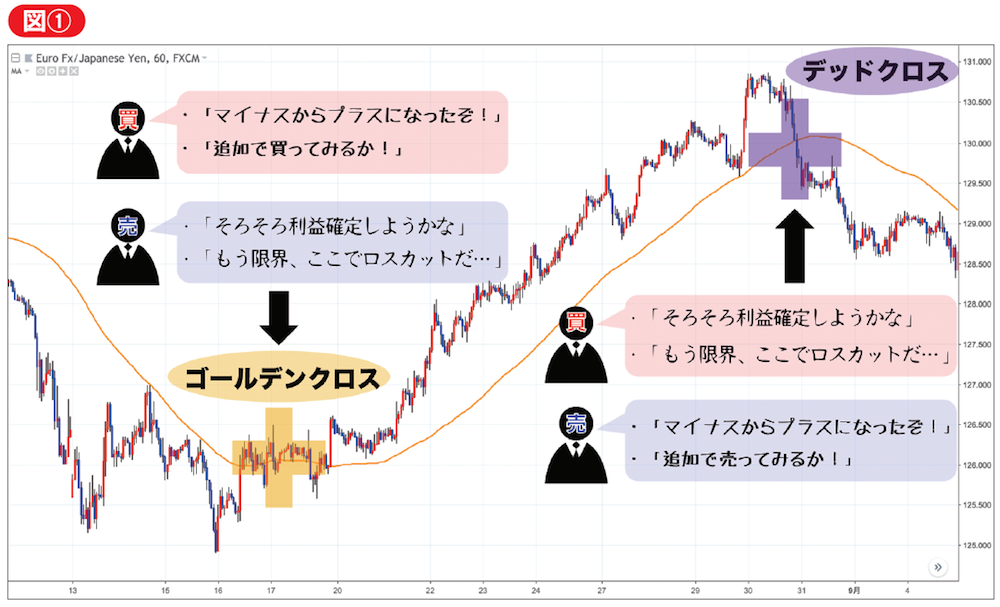
Source:EURJPY chart by TradingView
Gaku: Wow! The crosses sound like cool names for techniques; my inner teen is fired up!!
ShunIndeed… I get that feeling too... (laugh). Anyway, what’s important is, as I taught before, the “meaning.” If you think about why that buy/sell signal is valid, many things will become clear.
Gaku: It’s no use just memorizing signals because books say so, right?
ShunA Dead Cross is the opposite: the point where profits from previously profitable buying positions are taken or where a position that entered at a loss is forced to exit with a sell order, and where previously losing selling positions gradually move into profits, causing losses to lessen and prices to drop.
Gaku: And because it’s a famous signal, many traders enter from it.
ShunYes. Because it’s a major signal, there are new entries as well as additions from traders who already hold positions.