

Are you cutting losses with a solid basis? [Capital management and position management Part 3]
Hello! This is SAKU.
Last time we talked about money management, but from this post onward I’d like to touch on position management methods and how to implement them in detail!
(The previous article is here→ Do you really need to know?! 2% rule and bankruptcy probability )
Position management is as crucial as fund management!
To prevent letting losses swell and to avoid losing precious funds, and to protect the profits you’ve earned, let’s learn position management!
In this first step of position management, we’ll delve into the basis for stop-losses in depth.
Approach to Stop-Losses
First, let’s review the approach to stop-losses!
There is no single correct timing for taking profit or stopping losses; act when the underlying basis has been broken.
In particular,for stop-losses, be sure to place a stop-loss order immediately after entry and do it without fail.
Rather, before entering, look at the stop-loss range and take-profit target, consider the risk-reward, and then enter.
Fundamental stop-loss orders should not be moved without reason.
Wanting to move your stop-loss means you don’t have a solid basis or you shouldn’t have entered in the first place. Think carefully before entering ahead of time.
If you hit a stop-loss, admit the loss gracefully and use the lesson for the next trade.
“Losing and resting is the best of the best” is another saying.
Stop-losses are a legitimate strategy.
Even when stopped out, don’t get depressed or angry; treat it as a necessary expense and move on.
Whether you end a loss as a loss or use it as a learning cost is up to you.
For the concept of stop-losses, also refer to the earlier article (Are you stopping losses properly? – About extremely important stop-losses –) as well!
On What Stop-Losses Are Based
When you say stop-loss, the basis for stopping can vary depending on the situation.
Below are some examples to examine the bases for stop-losses!
・Example of a pullback buying
I’ve summarized the basis for a stop-loss after entry using a pullback buy as an example in the diagram below.
Let’s look at them one by one.
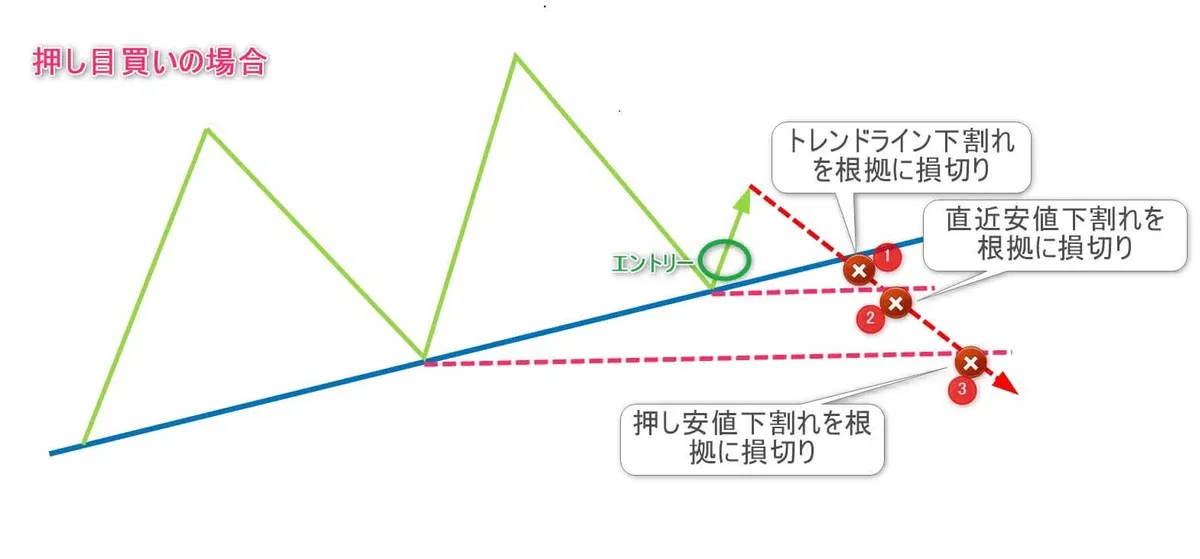
①is a pattern where you stop out when the price breaks below the trendline after entering.
A trendline represents the flow and direction of the trend, so breaking below that trendline means the trend’s direction may be changing.Therefore, when you entered with the anticipation of the trend continuing upward, you would consider stopping out out of concern for the change in the prior trend
.
This stop is disadvantageous in that it’s hard to set a stop-loss just below, but the advantage is you can exit faster than a player watching horizontal levels.
②is a pattern where, after breaking the trendline in case ①, you wait to see if the most recent low is broken.
③is a pattern where you stop out if the price breaks below the swing low
Breaking the swing low means, according to Dow Theory, that the uptrend may have ended, so the assumption of an upward continuation for a pullback buy is completely invalidated. Therefore stop out is the pattern.
Stop losses in case ① or ② are deeper, but you gain the benefit of having time to wait and observe.
Also,a break of the trendline does not necessarily mean the Dow Theory’s trend has ended, so you can respond if price rebounds after not breaking the swing low and then rises again.
・Entry after a return move following a trendline break
Even when you enter on a return move after breaking the trendline, there are multiple stop-out patterns to consider.
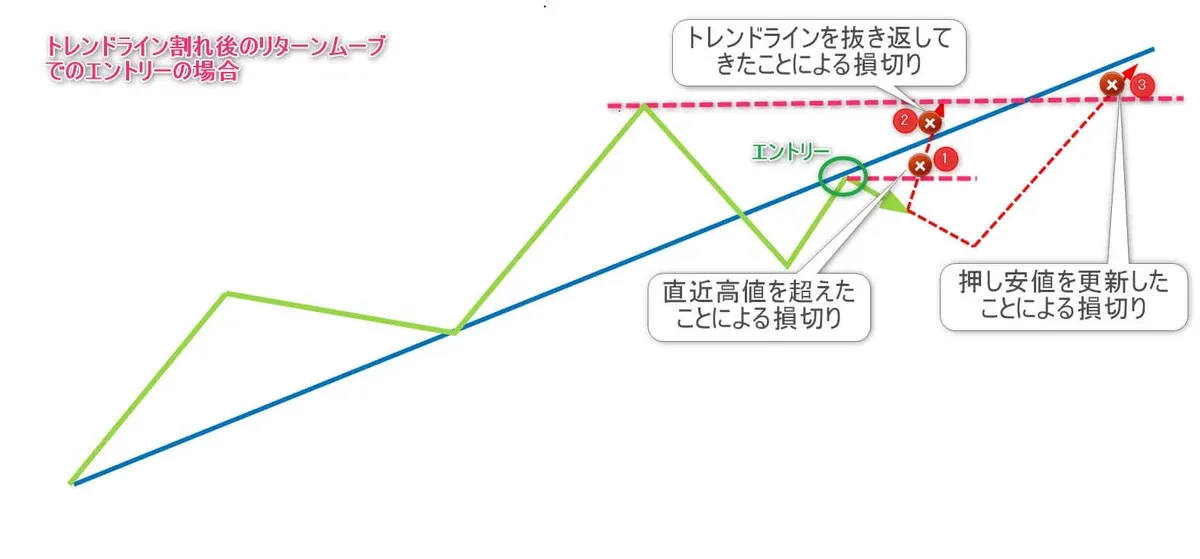
①is a pattern where, after a return move, price doesn’t immediately fall and instead exceeds the recent high (the high tied to the return move against the trendline), causing a stop-out.
Since you use a horizontal line as a reference, it’s easier to place a stop-loss order, allowing for a shallower stop-out, but personally I feel this justification is weak.
Price often consolidates around the trendline after a return move.
②is a pattern where, after a return move, price re-enters the trendline and you stop out.
Re-entry into the trendline area suggests the previous trend’s flow might resume, so you should stop out.
The advantage is that you can respond if price consolidates near the trendline and then drops.
In such cases, you might watch and, if your allowable loss threshold is reached, stop out temporarily.
③is a pattern where you stop out if the price exceeds the most recent high and updates the swing low.
In such cases,you determine the justification to be invalid and stop out.
In case ②, I mentioned price rising while consolidating near the trendline, but you could also endure until case ③’s swing-low update occurs.
Which Stop-Loss Is Best?
If you’re a reader of my serial articles, you probably already know, but
any of them is fine!
In short,it depends on what basis and scenario you used to enter and what would cause your assumption to break.
Each stop-loss has its own merits and demerits.
Wherever you choose to stop, it should be where you can accept the decision and stop out calmly.
A small technique is to stop out in stages, gradually.
By doing so, if the price moves in your predicted direction after a stop-out, you may be able to retrace with break-even or ride the profits on the remaining positions.
However, in this case, make sure to follow your ownfund management rules so that even the total of all positions does not exceed your allowable loss, and split the stop-out strategically
Never use stopping out as a reason to delay!
That’s all for now!
I was planning to write about profit-taking as well, but the stop-loss section grew longer than expected, so I’ll leave profit-taking for next time!
In addition to the examples above, various patterns can be considered depending on the scenario, but you should be able tostop out with a solid basis.

【First-come, first-served Public Campaign!】→ MMS Trade EncyclopediaThe true nature of the “structural traps” that individual investors fall into and market microstructure analysis that foresees the footprints of big players (There is also a free sample)

→The Secrets of MTF Multitimeframe Analysis (There is also a free sample)