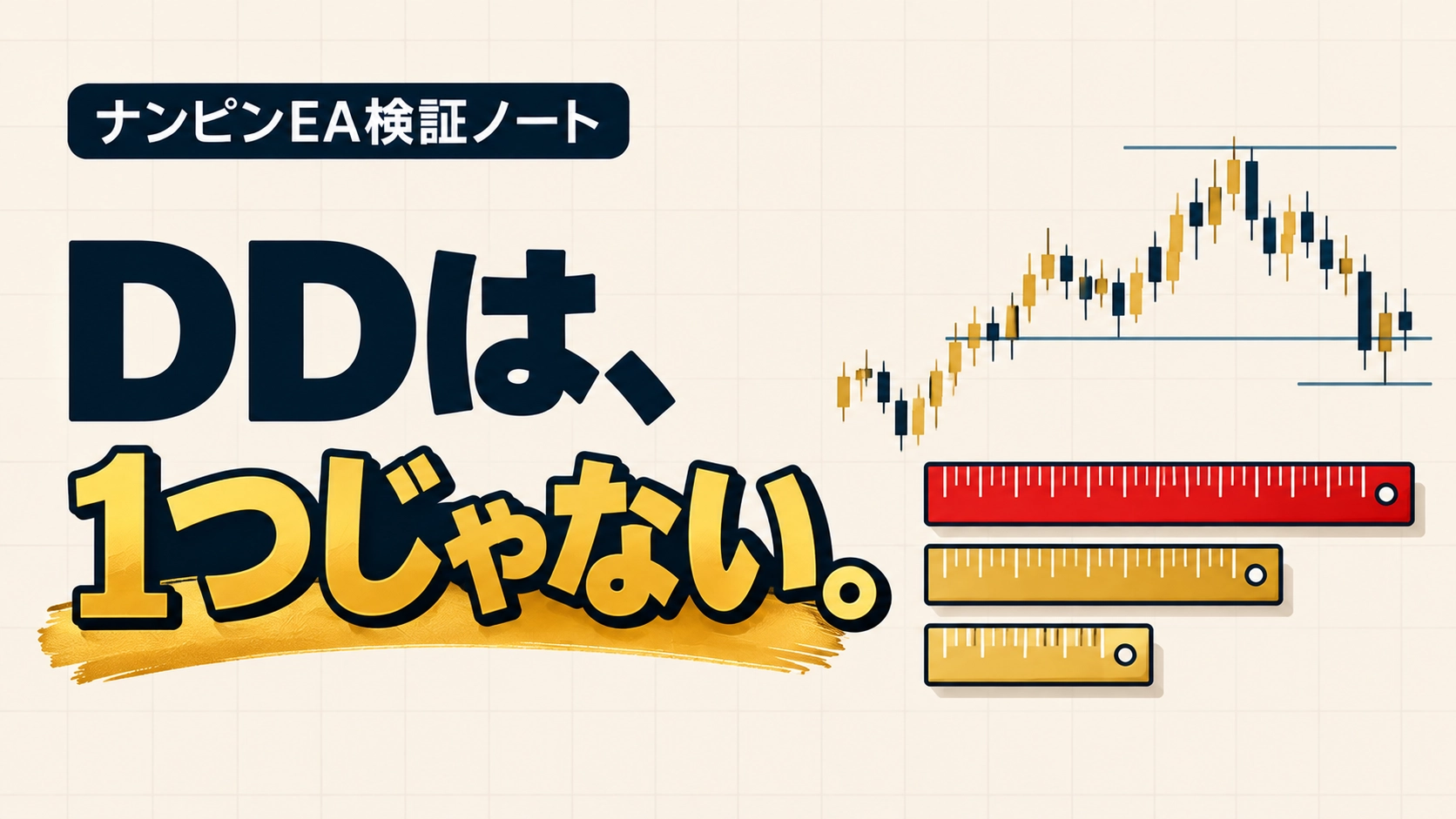

Is it okay to believe the "Maximum DD 10%"—the reason DD can take many forms in the same backtest
Namping EA Verification Notes: Gold's Counter-Trend Averaged Entry EA“Senju -SENJU-” development and verification series.
Product page is here
Backtest for 10 years, max DD 10%. Have you ever been attracted by such EA sales pages?
In reality, there are several kinds of what is called “maximum DD.”
It’s appealing. However, from what I’ve seen, when you look at forward performance later,it often either gets stopped out in a short period or already exceeds 30% DD, which contradicts the backtest numbers.
Readers, perhaps you’ve had similar experiences.
Why do such inconsistencies occur? There isn’t a single cause, but in this article I’ll discuss one area where Nanpin EAs show especially large differences: “How to measure DD.”
“Maximum DD” is not a single number
In MT5 backtest reports, there are multiple DD figures.
Balance-based:DD viewed as only realized P/L (drawdown excludes unrealized losses)
Equity-based:DD including unrealized losses
For Nanpin EA,these two are very different.
In fact, I lined up both numbers for the same backtest of Senju.
This article covers four points:
In the same backtest,the DD for “Balance-based” vs “Equity-based”(actual MT5 report numbers)
For Nanpin EA,the reasons these two differ greatly
Why it’s hard to trust “Backtest 10 years, DD 10%”, and two more reasons
A checklist you want to confirm on the sales pagechecklist
In the same backtest, DD can have many forms
From Senju’s backtest (1,000,000 yen, 0.01 lot, run continuously, realistic), the DD portions are lined up from the MT5 report.
| Indicator | Amount | Ratio | What is measured |
|---|---|---|---|
| Maximum drawdown based on Balance | 128,752 yen | 10% | DD viewed from only realized P/L (unrealized losses not included) |
| Maximum drawdown based on Equity | 478,042 yen | 47% | DD including unrealized losses |
In the same backtest, Balance-based DD is 10%, Equity-based is 47%.Even in monetary terms, there’s about a 3.7x difference.
The product page for “Senju -SENJU-”displays DD using the equity-based measure that includes unrealized losses.
Product page is here
Besides, the Balance-based maximum DD of 128,752 yen matches the report’s “Maximum consecutive losing trades (10 losses)” figure. In other words, Balance-based DD only looks at drawdown caused by a streak of losing trades that have been settled.
Why these two differ so much in Nanpin EA
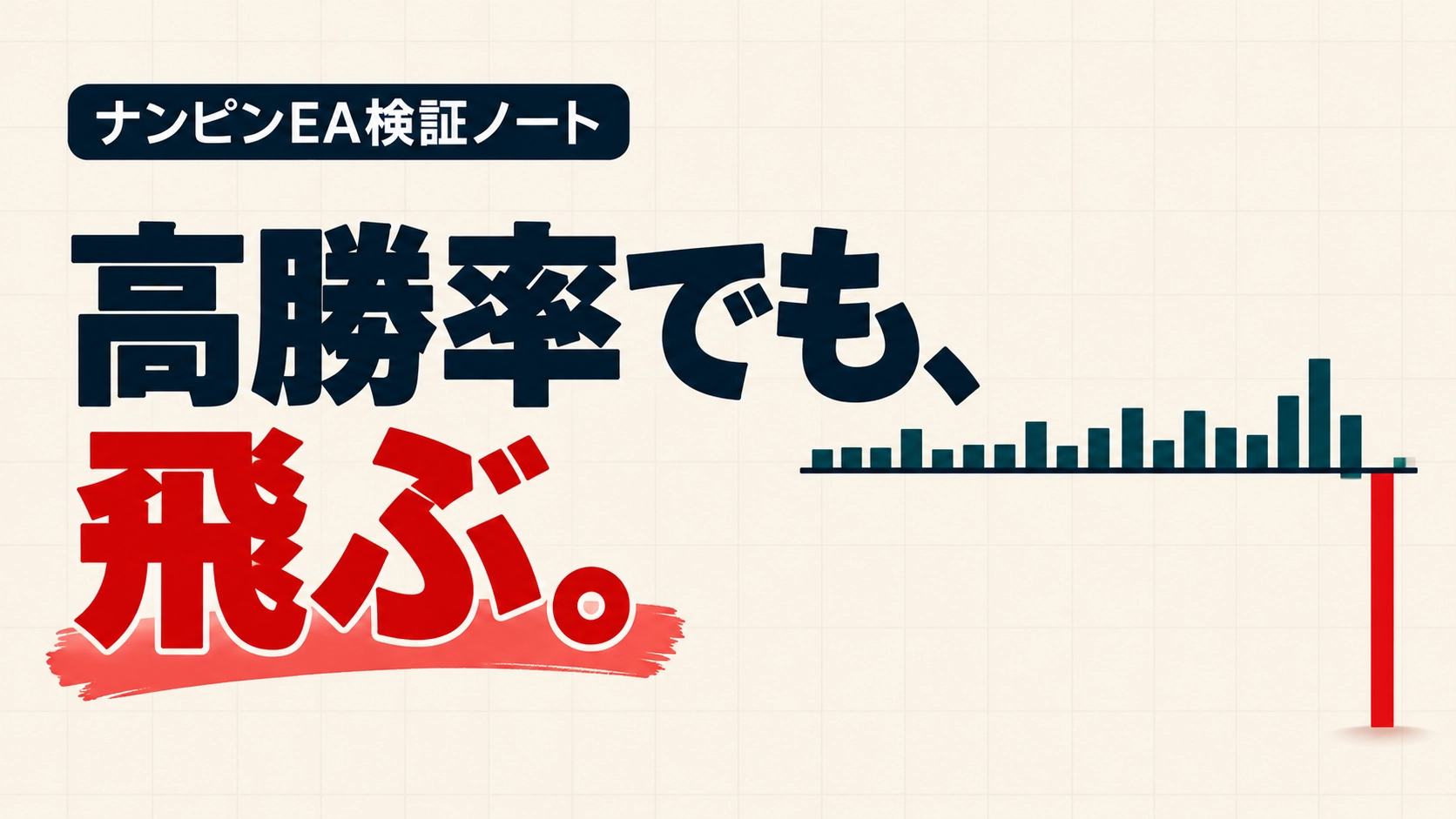
Nanpin EAs do not exit positions while in drawdown. Even as unrealized losses expand, Balance remains unchanged, and only when positions are settled do profits and losses finalize.
Therefore, Balance-based DD cannot reveal the size of unrealized losses. Even if unrealized losses are large, if they rebound and take profits, the balance increases.
The danger of approaching a stop-out is only visible in the equity-based DD, including unrealized losses.
Personally, with Nanpin-type EAs,I look at it on an unrealized loss basis.
Two more reasons to distrust “Backtest 10 years, DD 10%”
① Even with a long period, a low DD can indicate a lot of room for adjustment
It’s possible to tune so that you don’t enter during scenes that produce large DD. If a long-term test shows an unnaturally low DD, I question those adjustments.
② Factors that appear only in forward testing
Spread, slippage, swap, brokers’ differences, and network conditions; elements that are hard to reproduce in backtests but affect forward performance.
Checklist to verify on the sales page
Whether DD is clearly stated as Balance-based or Equity (unrealized losses included) based
Whether maximum unrealized loss is shown as both the monetary amount and the percentage of the account
Whether the backtest period and whether there was over-optimization (filters) explained
Whether forward testing duration, capital, lot size, and broker are shown separately from backtest
Whether forward DD does not contradict backtest DD
Summary
“Maximum DD 10%” means you should confirmwhat DD it measures.
Nanpin-type is viewed on aunrealized-loss-inclusive Equity-basedbasis
Even with the same backtest, it can be 10% or 47% (Senju’s example).
Long periods with low DD look attractive, butwatch the forward results
The more attractive the numbersthe more you should verify with forward performance. Forward results help confirm whether they align with backtest figures.
Senju’s DD is viewed as unrealized-loss-inclusive,
the Senju product page shows DD on an unrealized-loss-inclusive “Equity-based” basis.
・Equity-based maximum drawdown:amount and percentage
・Distribution of maximum unrealized loss by basket
・Annual maximum drawdown and account maximum unrealized loss
Next time
From next time, I’ll discuss Senju’s design.
I will write about the reason I decided not to increase lot size.