
How to read board information, how to read and use it — Aim to become a one-rank higher investor by remembering board readings! | Episode 2: How to enter at favorable prices [Yohei Onishi]

Profile of Yohei Onishi

Financial journalist. After working at a publishing company, he became independent in 1995 and has contributed articles mainly on finance and economics to money magazines, business magazines, and weekly magazines. He has interviewed numerous analysts and strategists active at the forefront of the market, as well as top executives of listed companies. He is well versed in FX and financial trading in general.
*This article is a republished and edited version of an article from FX攻略.com February 2019 issue. Please note that the market information in the text may differ from current market conditions.
Judging entry points from the quantity of market orders
Order book information is something you can use to realistically grasp the back-and-forth between buyers and sellers happening right before your eyes. This time, from the buyer’s standpoint, let's consider how to read the order book information to enter at a favorable price.
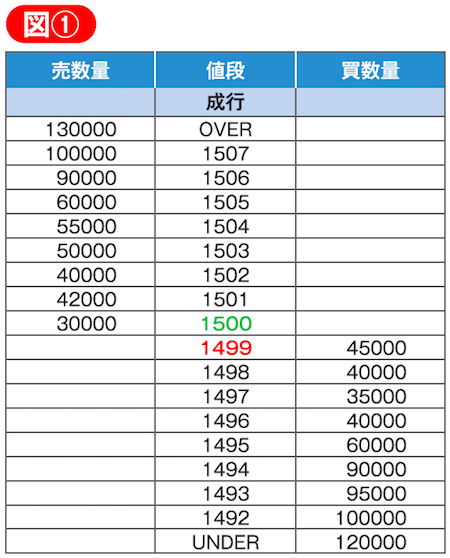
First, please pay attention to Figure ①. If you were thinking of buying this stock, at what price would you place a limit order? While you want to buy as cheaply as possible, you also want a high chance of execution, so you would ideally place a buy order at 1499 yen. However, at present there are no sell orders at that price. Unless a seller places a 1499 yen bid, you cannot buy this stock.
Of course, if you were to place a market order here, the situation would be different. If the number of shares you order is within 30,000, it would execute at 1500 yen. Even if your buy limit was 1499 yen, if there are market sell orders that match your desired purchase quantity, it would execute at that price.
For example, suppose a market sell order reaches 47,000 shares in this moment. Then all buy orders at 1499 yen (45,000 shares), including yours, would be filled and that row of the order book would become blank. Next, the market buy orders at 1498 yen would also be filled in a first-come, first-served basis for the remaining market sell orders of 2,000 shares, and that row would be revised from 40,000 shares to 38,000 shares.
Because market orders are filled quickly, their quantities appear in the order book only before the morning and afternoon session. If you check the number of market orders before trading begins, it helps you decide what limit price to place. If the quantity of limit buy orders at a favorable price is exceeded by market sell orders, you can consider it a bullish signal to enter a buy position confidently.
Additionally, at the top of the order book there is a section labeled OVER and at the bottom a section labeled UNDER, each showing quantities. OVER represents the quantity of sell limit orders placed at higher prices, and UNDER represents the quantity of buy limit orders placed at lower prices.
If OVER is significantly larger than UNDER, it indicates that investors who want to sell at higher prices are dominant, suggesting a bullish market. Conversely, if UNDER is more prominent, buyers may want prices to be lower, indicating a weak market.