

Trade AI Forecast: How will the dollar, interest rates, and stock markets move after the October 2 US employment report?
?This article was posted on October 2, 2026=>Latest related articles?
On October 2, the most anticipated material in the market is the US September employment statistics to be released tonight.

?FX New Generation: One-Click FX Training
Previous Answer Check
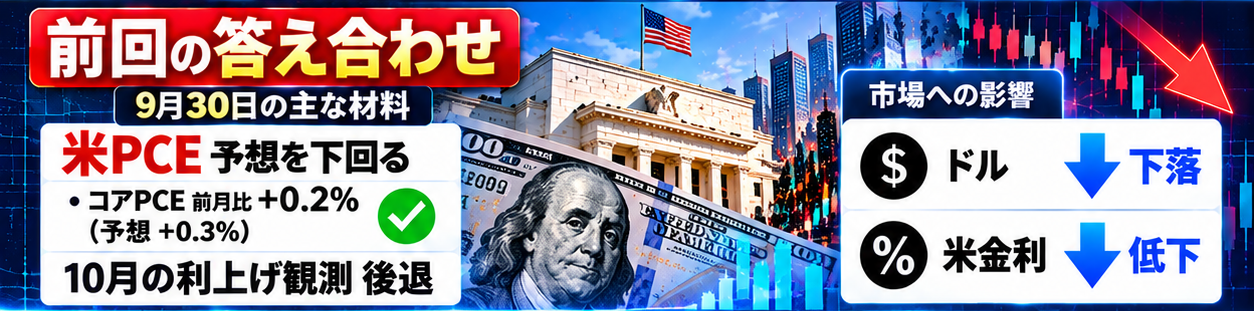
Last time, the US August PCE price index was released.
PCE price index rose 0.3% month over month, core PCE excluding food and energy rose 0.2%. Year-over-year, PCE is up 3.4% and core PCE is up 3.0%.
The core month-over-month increase was below market expectations of 0.3%, and expectations for a October rate hike by the Federal Reserve (FRB) receded.
However, caution is needed that the year-over-year figures came in below forecasts (PCE 3.7%, core 3.3%). An annual revision of the calculation has revised July to 3.4% and 3.0%, making July and August the same after the revision. It is not that “inflation suddenly cooled in August.”
Meanwhile, personal consumption rose 0.6% in real terms in August, the strongest growth in about a year and a half. The economy remains solid at the bottom.
Tonight's US Employment Data
The US September employment statistics will be released at 21:30 Japan time.
Market expectations are for nonfarm payrolls to rise by about 90,000 (8.4k-90k range), unemployment rate at 4.1% holding steady. Average hourly earnings are expected to be around 3.1% year over year.
Although August payrolls rose by 162,000, well above expectations, July rose by only 21,000, indicating large monthly swings. The focus is whether August’s strength continues or was temporary.
If employment greatly surpasses expectations, expectations for additional rate hikes will intensify, becoming a driver for the dollar and U.S. interest rates. It could pressure tech stocks sensitive to rates.
Conversely, if employment is weak, rate hike expectations may retreat and become supportive for the stock market.
However, the focus is not solely on the number of jobs. In a scenario with strong inflation vigilance, average hourly earnings, the unemployment rate, and revisions to past figures are considered more influential for monetary policy outlook. If results are as expected, market reaction may be limited.

Persistently High U.S. Rates and Crude Oil
Another key focus is the bond market and crude oil prices.
The U.S. 10-year Treasury yield rose to as high as 5.34% on October 1, a multi-year high since early 2000s. It then eased slightly and trades in the 5.2% range in Asia on the 2nd.
Behind this are sticky inflation, heavy government borrowing, and solid growth, with OIS (overnight index swap) pricing in further rate hikes by year-end. Higher long-term yields increase corporate funding costs and overvaluation concerns in equities, acting as a market headwind.
Crude prices remain elevated. In trading on the 2nd, North Sea Brent trades around $102 per barrel, and WTI around $93.
Saudi Arabia is increasing exports via ship-to-ship transfers and other indirect routes, but pipeline damage and Strait of Hormuz constraints persist, so the oil market moves by watching supply and geopolitics.
If crude remains high, inflationary pressure is prolonged, keeping expectations for further rate hikes alive.
In short, the current market is a balance between US employment data, US rates, and oil prices influencing each other.

Market Environment on October 2
In the current market, inflation indicators seen through the PCE (including effects of methodological revisions) and still-high U.S. rates and oil prices are wrestling for dominance.
If tonight's employment data is strong, expectations for rate hikes and a stronger dollar are likely to emerge, potentially weighing on the stock market. Conversely, if weak, rate hike expectations may retreat and provide support for stocks.
If the results deviate significantly from expectations, market direction may change.
Completely no-risk trade simulator for free practice and verification!
Details page for One-Click FX Training