
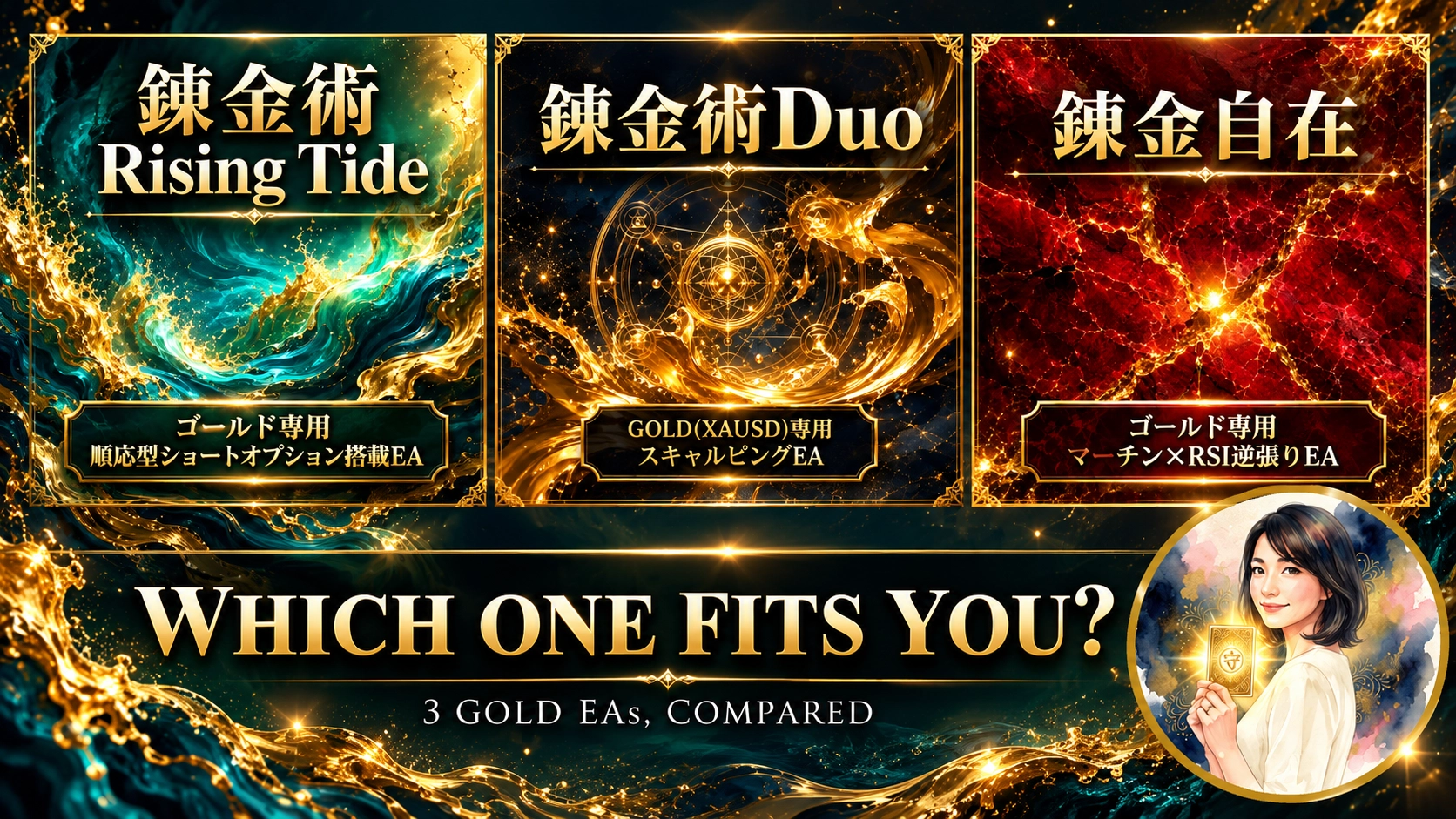
Alchemist Series: Which of the three suits me?
Serial Yoko and Kenji's GOLD EA Mastery Notes Part 3
Hello, this is Yoko.
In Part 1 and Part 2, we talked about why we create grid EA, why we choose modest multipliers. This time, finally, we answer the most common question: “Which of the three should we choose?”
In short, the three at a glance

|
Alchemy Rising Tide Primarily a buy-focused, with selling linked only when buys have piled up, a cautious option-type. Riding the rising tide of gold, it quietly captures profit even in a down market. |

|
Alchemy Duo Buy-only and very simple. Averaging down is at parity (does not increase lot size). The settings the user decides are effectively only two. |
|
Alchemy Flex RSI reversal×martingale, with three risk levels: stable, aggressive, and ultra-aggressive from which you can choose. It uniquely supports both directions (buy and sell). |
Comparison table
| Rising Tide | Duo (M15) |
Duo (M5) |
Alchemy Flex (Stability type) |
|
|---|---|---|---|---|
| Direction | Buy-dominant + Sell-linked |
Buy-only | Buy-only | Both directions |
| Averaging down multiplier | 1.1x | Same as entry | Same as entry | 1.06x |
| Testing period | 12 years | 12 years | 12 years | 7 years |
| Leverage 20x Minimum margin maintenance |
50.76% | 196.33% | 38.95%※ | 20.13% |
| Ease of setup | Standard | Very easy | Very easy | Choose from 3 levels |
※Duo(M5) is calculated with the braking amount raised from the standard 800,000 to 900,000. For details, see the concluding addendum.
Suitable for whom
First-time EA users who want to start safely
→Alchemy Duo (M15 mode). With few settings, you can operate comfortably even with low leverage.
Those who want a balance of profit and stability
→Alchemy Rising Tide. A buy-dominant structure with a little selling added as a bonus.
Looking at the three side by side this time, Rising Tide maintained margin maintenance in the 50% range even with 20x leverage, and although small adjustments occur due to crash-rescue, there was never a moment when the brakes activated. From the developer’s perspective, this robustness is genuinely reassuring, and it clearly explains why it is the best-selling product.
For those who want to choose risk level themselves and aim in both directions
→Alchemy Flex. We offer three levels, from stable to ultra-aggressive.
Yoko's note
There is not always one correct answer. Depending on your account leverage, funds, and how much price movement you’re comfortable watching, please choose one that suits you.
Of course, some people run multiple strategies in combination. I hope to discuss how to combine them in a future opportunity.
Next time teaser
Next time,dive deeper into Alchemy Duo. We’ll discuss which mode, M5 or M15, suits you best and provide details on the braking amount settings introduced this time.
Thank you for reading until the end.
Yoko
Addendum: To users of Alchemy Duo (M5 mode)
Duo has been introduced assuming high-leverage accounts with roughly 1000x leverage. GoGoJiang’s official forward tests run at leverage 20–25x, so we redid the backtest at 20x to confirm. With the standard braking amount (800,000), in November 2014 and March 2026 the account experienced deeper-than-expected DD, triggering the loss-cut brake (automatic settlement within expectations). In November 2014, the balance briefly dropped to as low as 230,000. We apologize for not fully verifying low-leverage behavior for a software designed at 1000x leverage.
If you use M5 mode on a low-leverage account, we recommend raising the braking amount to 950,000. If you raise to 950,000, a single activation in March 2026 brings it up to the same level as high-leverage accounts. We will update the manual soon.
※This article presents past verification results and does not guarantee future profits. Please make investment decisions at your own responsibility.