
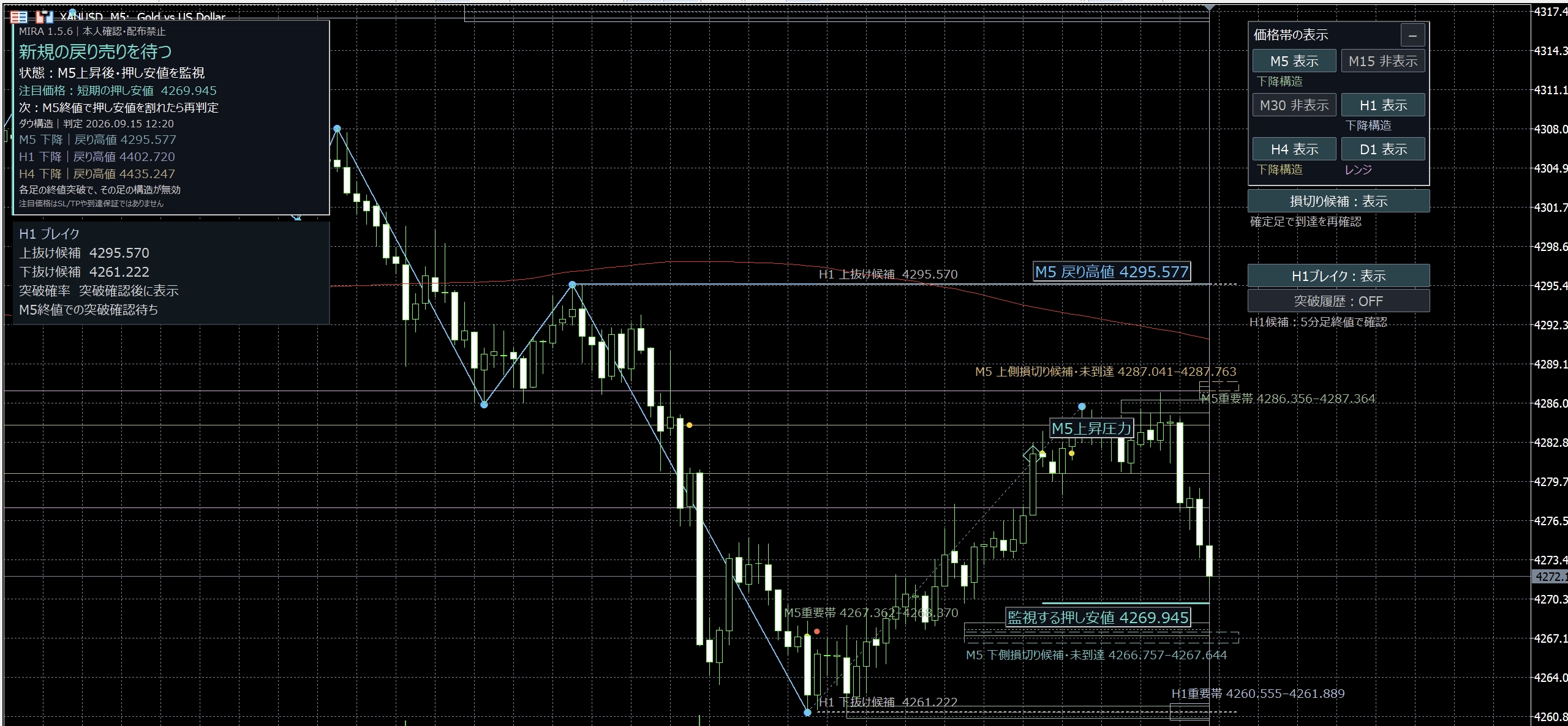
【MIRA】To win, look at the destination of the ascent. GOLD stalls at an important price zone on the 4-hour chart
“I want to win in the market. Therefore, I want to improve the accuracy of my entries.”
I think the reason for using indicators is not to display a chart neatly, but to connect daily judgments to profits.
Nevertheless, you buy after a strong rise only to see a pullback. You sell when you see a decline, only to be pulled back the next moment.
If you’re repeating such trades, before entering“where is the price currently reaching”consider adding this to your thinking.
What we’ll introduce this time is a scene where GOLD is bounced at an important four-hour price zone and turns to decline. Through MIRA, we’ll think about a “new way of viewing the market” to build judgments for winning.
GOLD Pulls back. The 4-hour important price zone acts as resistance
In GOLD this time, the price was blocked by an important four-hour price zone ahead of the rise, and subsequently turned down.
This is a scene where the important price zone functioned as resistance obstructing the rise.
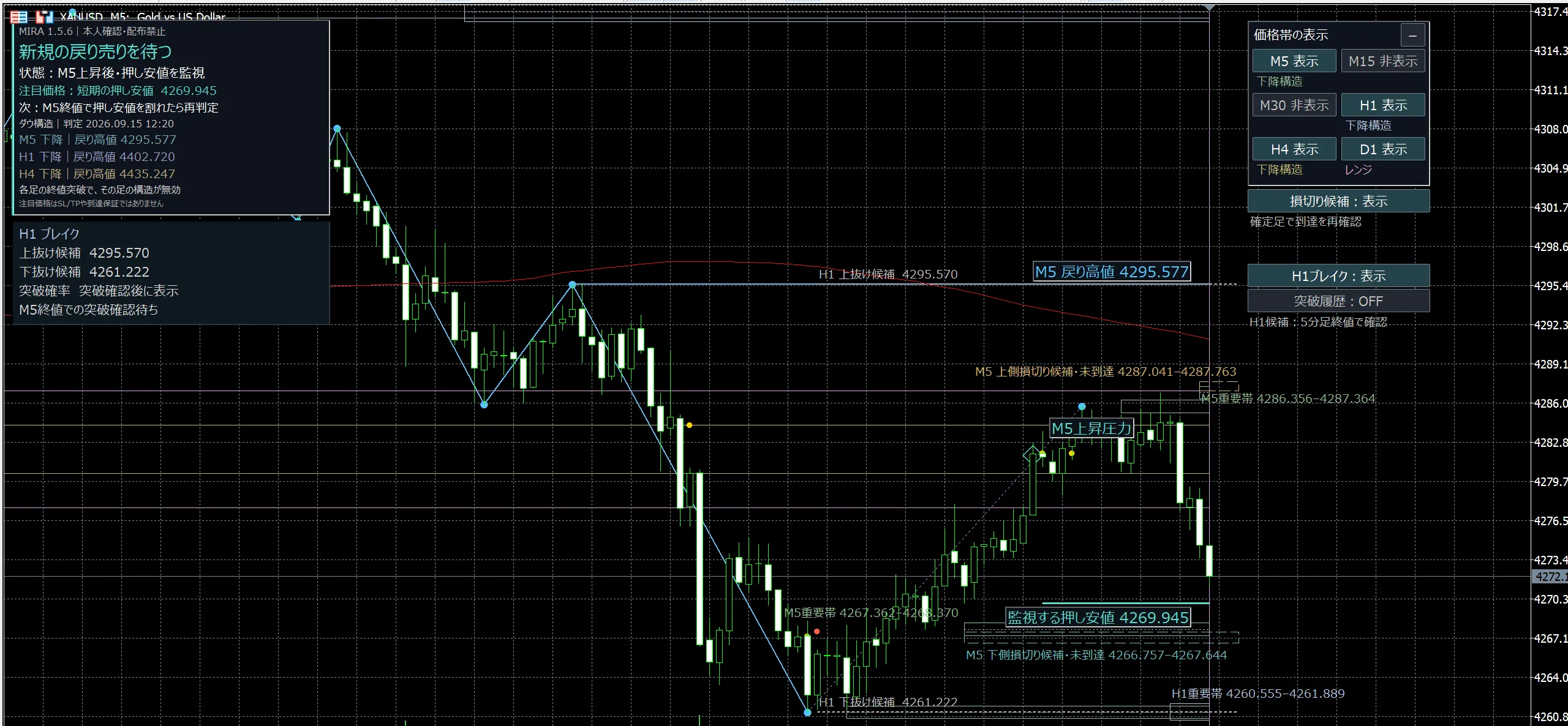
If you only look at the short-term upward movement, you may feel “it might go higher.”
However, if you understand that the rise is approaching a four-hour important price zone, your thinking before entry changes.
“If I buy here, will it immediately hit the nearby resistance?”
“Can this price range be surpassed? Let’s first see how it reacts.”
If you aim to win, you should examine the place to enter as carefully as you look for momentum.
A new perspective is to go one step beyond “rising”
The new perspective we want to adopt this time is simple.
“In addition to rising,
look at what it is rising toward.”
Even if a 5-minute chart shows a strong ascent, if there is a four-hour important price zone ahead, there is also a scenario where the price is held down at that level.
With this viewpoint, you can organize not only why to buy but also why to wait to buy. Furthermore, if a pullback is confirmed, you can reevaluate the market as a new opportunity to consider selling on a rebound.
However, simply reaching a price range does not guarantee a pullback. There is also a possibility of breaking through, so it is important to confirm price movement after reaching and the candle confirmations.
After a decline, how to wait for the next opportunity
It’s easy to think, after the chart has moved down, “I should have sold.”
The difficult part is not hastily selling out of frustration, but waiting for the next condition.
The MIRA screen displays,“Wait for a new rebound sell”as well.
It also suggests monitoring the short-term swing lows and re-evaluating if the five-minute close breaks that swing low.
This does not mean selling the moment the decline is seen.
“What to wait for now,”
“Which price to confirm,”
“What would trigger a reassessment?”
Organize your next actions first and then compare them with your entry conditions. You can use MIRA as the basis for your judgment.
Turn the desire to win into concrete judgments
The stronger the desire to win, the more you don’t want to miss the price movement in front of you.
That’s why, rather than saying “enter immediately,”“clarify the entry conditions”is what I want to aim for.
MIRA is an analysis-support indicator that organizes important prices and market scenarios.
Before using your own entry method, check the important price bands on the higher timeframes. Then look at the price reaction and the confirming candle to decide whether to consider or pass.
Regarding the worry of “jumping in at the momentum and getting caught in the pullback,” see if this verification procedure can be a new solution by comparing it with your own trades.
This time, GOLD pulled back at the four-hour important price zone.
When a similar scene occurs next time, can you judge not only by the momentum of the rise but also by the destination it is heading to?
Why not take that step into daily analysis with MIRA together?
Check MIRA product description and screen
※This article revisits past price movements as an example. The displayed chart does not indicate actual trading results, nor does it guarantee similar pullbacks or future profits.