

Even in Orca, if you lose to inflation, there is a blind spot in investing that is "effectively negative"
“If you buy Orcan and invest for the long term, you’ll be safe”. With the spread of NISA, opportunities to encounter such words have increased. Indeed, Orcan, which can be diversified across stocks worldwide, is a product that tends to reduce risk compared with concentrating on individual stocks.
Now, let’s think a little here.If stock prices rise, does that truly mean wealth is increasing?
In fact, “how many percent it rose” alone does not reveal the true achievement of an investment.

?FX New Generation: One-Click FX Training
? If stock prices rise by 5%, what if prices rise by 5% due to inflation?
For example, in a country with 5% inflation, stock prices rise by 5%.
100万円 becomes 105万円. You’d think, “It increased by 50,000 yen!”
However, if prices rose by 5% in the meantime, the things you can buy with 1,050,000 yen are almost the same as with 1,000,000 yen before.
In other words,nominally it has increased by 5%, but in real terms it has hardly increased.

Conversely, if stock prices rise by only 3%, you are losing to inflation. By the numbers it looks positive, but in purchasing power terms it is a negative.
Being in Orcan does not let you escape this problem.
Investing in companies around the world reduces the risk of choosing the wrong companies or countries. However,the global stock market as a whole cannot avoid the impact of inflation and high stock prices.
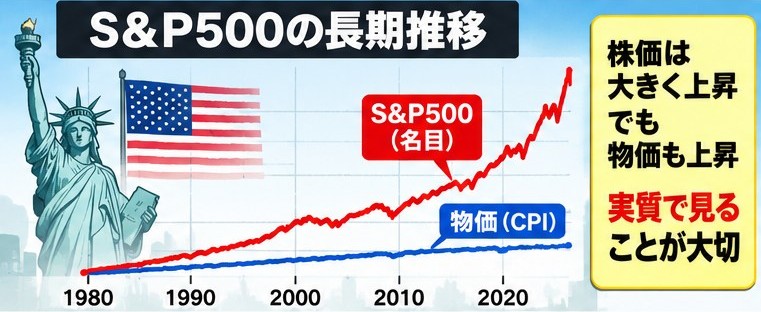
? The flip side of “S&P 500 would have been highly profitable if held since old times”
There is a story that if you held the S&P 500 since 1980, it would have grown enormously. This is true. However, U.S. prices have risen substantially since 1980 as well.
What becomes important then is to consider the stock price rise rate and the price rise rate separately.
The S&P 500 has grown well above inflation. In other words, it isn’t simply that “the value of money fell, so stock prices rose.” Corporate earnings growth, dividends, and productivity improvements have also increased real value.
That is why long-term investment in the S&P 500 and global equities is meaningful.

However, if you bring past successes into the present without adjustment, the story changes.
What rose sharply in the past and what will rise in the same way in the future are separate issues.
If stock prices rise to high levels, future returns may be lower.
“Orcan is safe because of global diversification” is not wrong, but“Global diversification = guaranteed profit” is not.
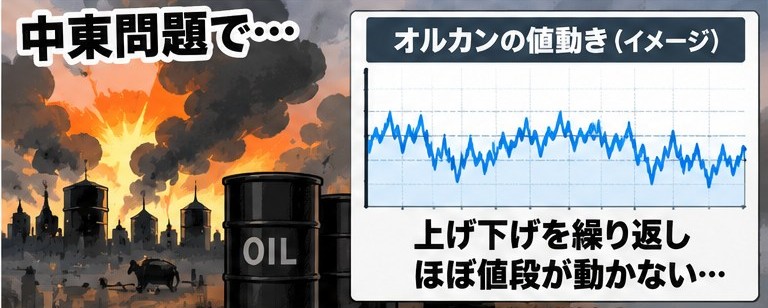
? Summary: Don’t rely too much on Orcan for safety
Orcan is an excellent investment product that can diversify across global stocks, but thinking that “just by buying it it will steadily rise” is a bit off.
Since the Middle East issues began, Orcan has oscillated, and prices have hardly moved. If this persists long-term, there is a risk of real wealth shrinking due to inflation.
What matters is not nominal gains but real returns after subtracting inflation.
As an investor, you should look at more than just “what percent it rose” — you should ask whether it is beating inflation. Past stock market successes don’t automatically guarantee future gains, and many traders may have learned that this isn’t always easy.
Fully risk-free trading simulator for free practice and validation!
Details page for One-Click FX Training MAX