
Foreign Exchange Online: Masakazu Sato's Practical Trading Techniques — Techno & Fundamentals Analysis Predicting the Future of the 3 Major Currencies [This Month's Theme | Buy on Dips! Trading method of yen carry trade aiming at interest rate differe
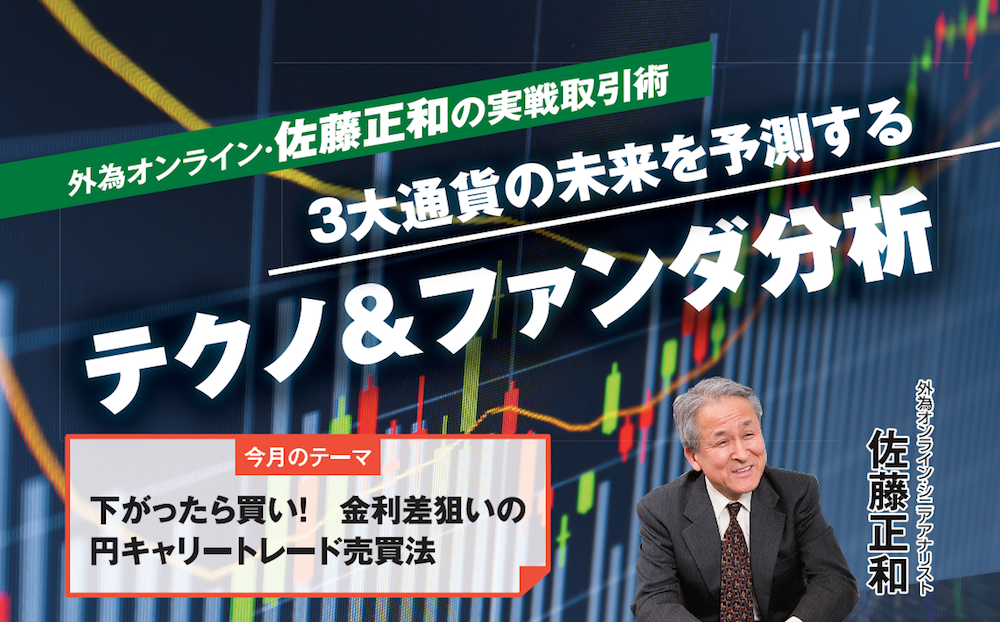
Sato Masakazu Profile

Sato Masakazu. After working at a domestic bank, he joined France-based Paribas Bank (now BNP Paribas). He has served as Interbank Chief Dealer, Head of Funding, Senior Manager, and other positions. Subsequently, he became a senior analyst at FX Online, which boasted the highest annual trading volume. He has over 20 years of experience in the currency market. He appears on Radio Nikkei’s “Complete Live Commentary on Stocks! Stock Channel” and Stock Voices’ “Market Wide - Foreign Exchange Information,” and regularly provides market information on Yahoo! Finance.
In 2019, the FX market continued in a rangebound, non-trend environment. Although there are uncertainties such as economic slowdown from the US-China trade war, the US economy is not in a full-blown recession, and the current “flat calm” market is the result of a mixed situation. When currency rate movements are sparse, the only path is to pursue investments targeting swap points. What are the trading methods and optimal targets?
*This article is a reprint and revision of FX攻略.com’s July 2019 issue. Please note that the market information written in the main text may differ from the current market.
Dollar/Yen: A contrarian-bottom and sudden drop buying strategy that targets both exchange gains and swap points is effective
As the Heisei era ends and the Reiwa era begins, thinking about “What will the FX market look like in the Reiwa era?” is a sobering thought. Even if the era name changes to Reiwa, the one objective in FX trading remains the same: to make profits. This will never change. FX profits include not only gains from exchange rate movements but also income from swaps, earned when selling low-interest currencies and buying high-interest currencies.
In 2019, following 2017 and 2018, the currency market has continued in a three-year streak of a “flat calm range.” In a market without strong trends or sharp surges or crashes, it becomes difficult to profit from currency fluctuations whether you go long or short. On the other hand, as long as the range persists, you can hold currency pairs with interest rate differentials for a long time and steadily accumulate swap points with little concern about losses from exchange rate movements. A range market is, in a sense, an ideal environment for swap-point-focused investing.
Therefore, this time let’s consider another FX profit method: invest with a focus on swap points. Of course, no matter how diligently you earn swap points daily, if there is a large loss from exchange rate movements, it defeats the purpose. For swap-point-targeted investing, buying in places where the exchange rate is unlikely to fall further serves as a hedge against sudden exchange-rate shifts. When selling the ultra-low-interest yen and buying high-interest currencies, the basic strategy is “don’t fear a plunge, buy if it goes down.”
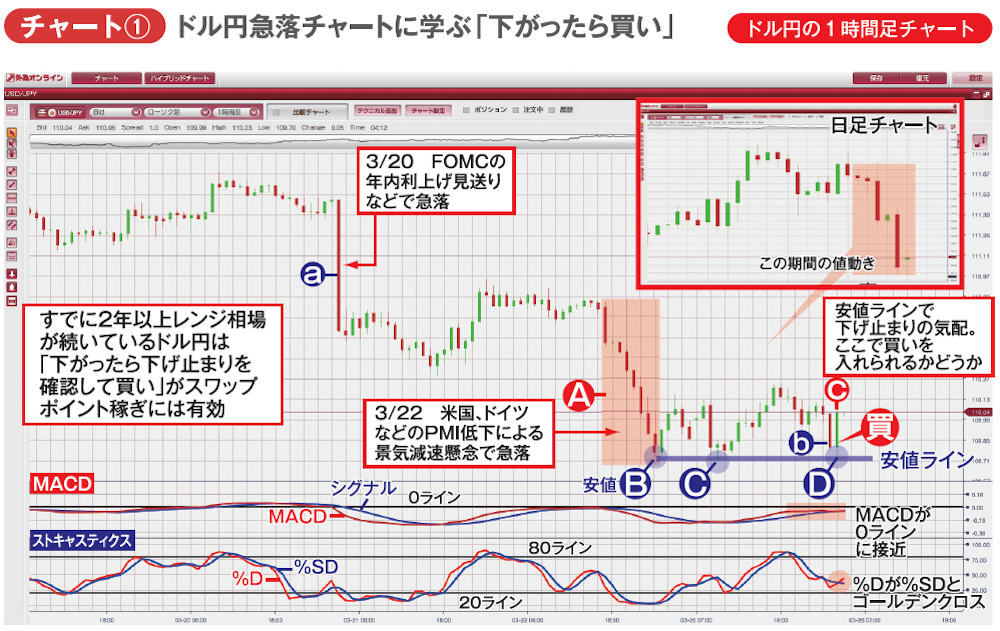
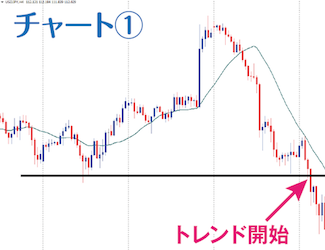
To illustrate the trading method necessary to target exchange-rate declines, let’s look at a recent example. Chart ① is the 1-hour chart of USD/JPY immediately after a sharp drop on March 22. In the upper-right frame, we also show a longer-term daily chart leading up to the drop.
There are two sharp drop moments on the chart. The large bearish candle a on the night of March 20 (Japan time) reflected market disappointment over the US Federal Open Market Committee (FOMC)’s decision to postpone rate hikes for the year and the Federal Reserve’s asset shrinkage plan ending in September.
By the evening of March 22, the US manufacturing PMI for March fell short of expectations, and PMI in the Eurozone and Germany also hit a six-year-to-six-and-a-half-year low, raising global growth concerns. Stocks, including risk assets, fell, and the safe-haven yen was bought, sending USD/JPY down to about 109.75 in zone A of Chart ①, a drop of just over 1 yen.
Nevertheless, Japan-U.S. interest rate differentials remained above 2%, and FX Online’s USD/JPY swap points for buying 10,000 units were around 65 yen per day (late April 2019). The two sharp drops in Chart ① were, in a sense, opportunities to “buy when it goes down.”
So, how do you confirm the bottom and place a buy order? Looking at Chart ①, after mid-day on the 22nd, Zone A’s candlestick declines persisted, and after hitting the lowest point B, a reversal occurred. The subsequent low C also held around the 109.70 area, and at point D in the late night of the 26th, the price briefly fell to a support line before a bullish candle c emerged, offsetting the bearish candle b. This combination of candles b and c is known in Sakata Kaisen as a “bullish engulfing” and in price action as a “bullish reversal,” signaling a bottom and potential upward move.
On the lower MACD, the signal line crossed, and the MACD rose toward the zero line. The Stochastic indicator remained above the oversold 20 line, with %D crossing above %SD, signaling a potential bottom. Whether you can buy when it has fallen, as in the bottoming phase after Chart ①’s D, hinges on this moment of courage to buy after a drop.