
The Future Path of Foreign Exchange Markets, Episode 111 [Tomotaro Tajima]

Tomotaro Tajima profile

Economic analyst. Alfinaunts president and representative director. Born in 1964 in Tokyo. After graduating from Keio University, he transitioned from Mitsubishi UFJ Securities where he worked to his current position. He analyzes and researches a wide range from finance and the economy to strategic corporate management, and even personal asset formation and fund management. He serves as a lecturer for lectures, seminars, and training hosted by private companies, financial institutions, newspapers, local governments, and various business associations, with about 150 talks per year. He has written numerous serialized columns and commentary in print media, including Weekly Gendai “The Rules of Net Trading,” Examina “Money Maestro Training Course.” He has also worked on many websites writing columns on stocks, foreign exchange, etc., and is highly regarded as a stock and FX strategist. He is also responsible for the Home Economics section of Kodansha’s “The Fundamentals of Modern Language” (Gendai Yōgo no Kiso Chishiki). After regular appearances on television (TV Asahi “Yajū-ma Plus,” BS Asahi “Sunday Online”) and radio (MBS “Tsuchan no Asaichi Radio”), he currently serves as a regular commentator on Nikkei CNBC “Market Wrap” and Daiwa Securities Information TV “Economy Marche.” His main DVDs include “Ultra Easy. Tomotaro Tajima’s FX Introduction” and “Ultra Easy. Tomotaro Tajima’s FX Practical Technical Analysis.” His major books include “Wealth Revision Manual” (Pār Publishing), “FX Chart ‘Profit’ Equation” (Alchemix), “Why Can FX Make You Asset Rich?” (Texts), and many others. His latest publication is “How to Profit by Riding the Rising U.S. Economy.”
※This article is a reprint and revision of an article from FX攻略.com July 2019 issue. Please note that the market information written in the text may differ from current markets.
The widespread rise in U.S. stocks and the sustained high dollar index
As is known, the dollar/yen briefly touched the 112 yen level in early March, and while testing below 110 yen toward the end of March, once April began it moved back to the 112 yen range, and has generally remained firm.
Meanwhile, the dollar has continued to trend strong against the euro and the pound, and at the time of writing the Dollar Index is approximately 10% higher than the lows reached last December. The strength of the dollar is underpinned by one key factor: an exceptionally strong trend in U.S. stock prices. Among several U.S. stock indices, the surge in the Philadelphia Semiconductor Index (SOX) is particularly striking. As shown in Chart ①, the SOX index updated its all-time high of 1,464 points in early April, continuing to show no signs of waning at the time of writing.
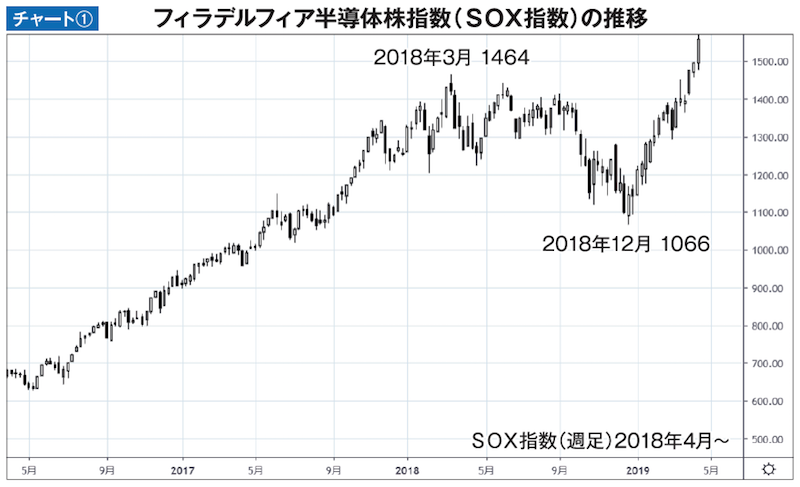
Similarly, the so-called “U.S. FinTech Index,” the KBW Nasdaq Financial Technology Index (KFTX), also updated its all-time high soon after April began and continues to reach new highs almost daily. This is truly a quintessential U.S. stock rally. Like the indices mentioned above, the Dow Jones Industrial Average, the S&P 500, and the Nasdaq Composite are also expected to reach new all-time highs in due course. Some market participants may see this as mere overshoot or a temporary phenomenon, but can we really afford to dismiss the situation? At the very least, given that U.S. stock indices are all hitting record highs, it would be incorrect to conclude that there are signs of a recession in the U.S. economy.