

It's not too late! With NISA pension from age 50, a plan of 1,880,000 yen per year until age 80
Don’t you feel your retirement fund might not be in time?
Actually, when you look at the estimates introduced by financial planner Noboru Urakami on PRESIDENT Online, there is a surprisingly interesting plan.
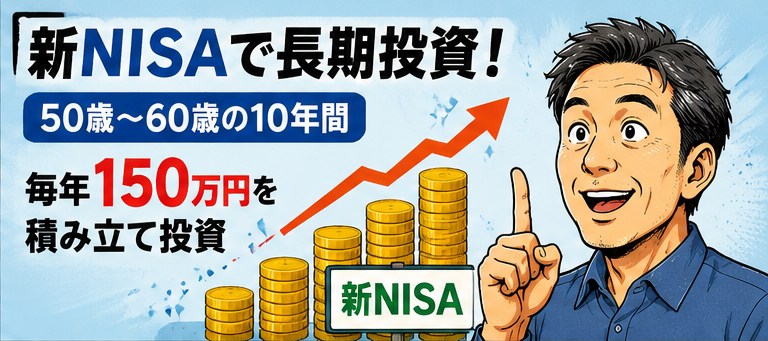
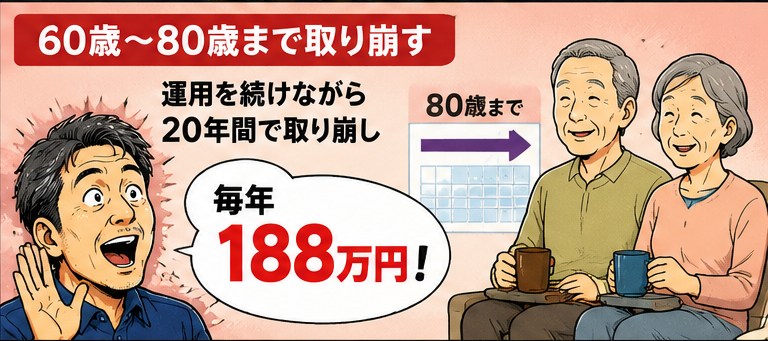
From age 50 for ten years, invest 1.5 million yen per year in the new NISA into the S&P 500, and then gradually draw down for 20 years from age 60. Assuming a 7% annual return, you would have about 21.38 million yen at age 60, and you could receive roughly 1.88 million yen per year thereafter.
If you think “it’s too late because I’m already 50,” that may be a bit premature to give up.
?FX New Generation: One-Click FX Training MAX
?Convert 1.5 million yen bonus to NISA over 10 years
The mechanism is fairly simple. From age 50 to 60, invest 125,000 yen every month, 1.5 million yen per year. The principal over 10 years is 15 million yen. With a 7% annual return, the amount at age 60 would be about 21.38 million yen.
And what’s important after that. Rather than spending the 21.38 million yen all at once, by continuing to invest and drawing down over 20 years, you would receive about 1.88 million yen per year, totaling about 37.72 million yen.
During the withdrawal period, since you are still growing the assets, it won’t be simply 21.38 million yen ÷ 20 years.
1.5 million yen per year is not a small amount, but the annual investment limit for the new NISA is up to 3.6 million yen, and the tax-exempt limit is 18 million yen, so this 15 million yen over 10 years fits within the rules.
?If you consider 7% per year “normal,” the numbers change a lot
Here, let’s look at it in numbers rather than feel.
Urakami’s estimate is based on 7% per year, a long-term plan to accumulate 125,000 yen monthly, 1.5 million yen annually, from age 50 to 60.Even a difference of 1% or 2% in the yield makes a big difference in assets at age 60.
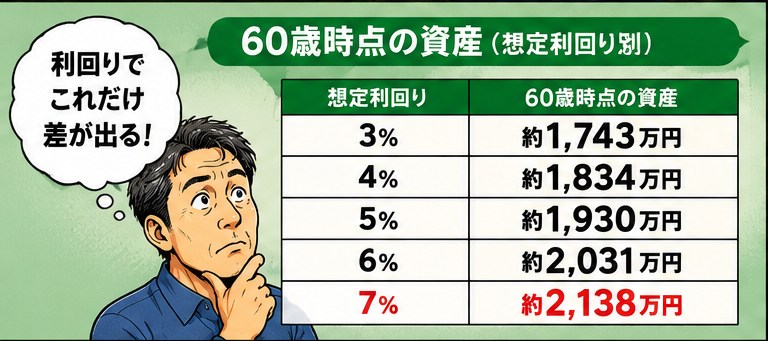
Similarly, with the same condition of saving 125,000 yen per month for ten years, varying the assumed yields yields roughly the following results.
| Assumed yield | Assets at age 60 |
|---|---|
| 3% per year | About 17.43 million yen |
| 4% per year | About 18.34 million yen |
| 5% per year | About 19.30 million yen |
| 6% per year | About 20.31 million yen |
| 7% per year | About 21.38 million yen |
In other words, there is about a 3.95 million yen gap at age 60 between 3% and 7% yields.
Of course, in reality results will vary depending on monthly investment timing and market fluctuations. Still, planning retirement funds assuming you can achieve 7% annually is somewhat risky.
The Financial Services Agency also states that long-term, regular, and diversified investing is the basis for asset formation, while investments carry the possibility of principal loss. Past performance cannot be used as a guaranteed future yield.
?Inflation is another essential factor not to overlook
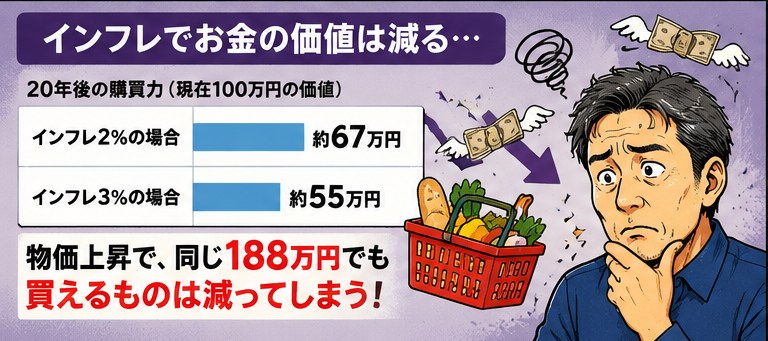
If prices rise by 2% per year, the purchasing power of 1,000,000 yen in 20 years would be about 670,000 yen today. At 3%, it would be about 550,000 yen.
In other words, even if you receive 1.88 million yen per year from age 60, by the time you reach 80, the value of that 1.88 million could be less than today’s 1.88 million. Looking at the numbers alone, the purchasing power may be reduced.
Public pensions are revised annually based on price levels and wages, but the basic pension for fiscal year 2026 is only up 1.9%. It’s important to remember that it does not fully track inflation.
Therefore, in retirement simulations, you should examine multiple scenarios, such as “what if it’s 7%?” and “what if it’s 3%?” and “what is the real value if inflation is 2%?”
Treat 7% not as a target but as a best-case outcome, and center your plan around around 4–5% to be more realistic. In investing, it may be more important that your plan doesn’t fail when returns fall short than to try to maximize returns.
?Summary: From 50, time is your ally with NISA
This plan involves investing 1.5 million yen per year from age 50 for ten years and drawing down for 20 years from age 60 to create about 1.88 million yen per year as your “personal pension.” If you achieve 7% annual return, you reach about 21.38 million yen at age 60, but at 3% it’s about 17.43 million yen. The difference in yield creates about 3.95 million yen in assets.
Additionally, you cannot avoid the risks of asset erosion in yen due to market fluctuations and currency exchange rates, and inflation eroding real purchasing power. You cannot assume that future 1.88 million yen will have the same value as today.
Therefore, rather than hoping for a single 7% figure, it’s important to verify that retirement funds can be sustained under cases around 3–5% as well.
It’s not that being 50 means it’s too late; it’s about how you use the next ten years. From an investor or trader’s perspective, the key is not maximizing gains but creating a funding plan that won’t break even if returns don’t exceed expectations.
Both markets and retirement funds benefit from strategies that can be sustained over time rather than a single high-stakes move.
Practice and verify freely with a complete no-risk trading simulator!
Details page for One-Click FX Training MAX