
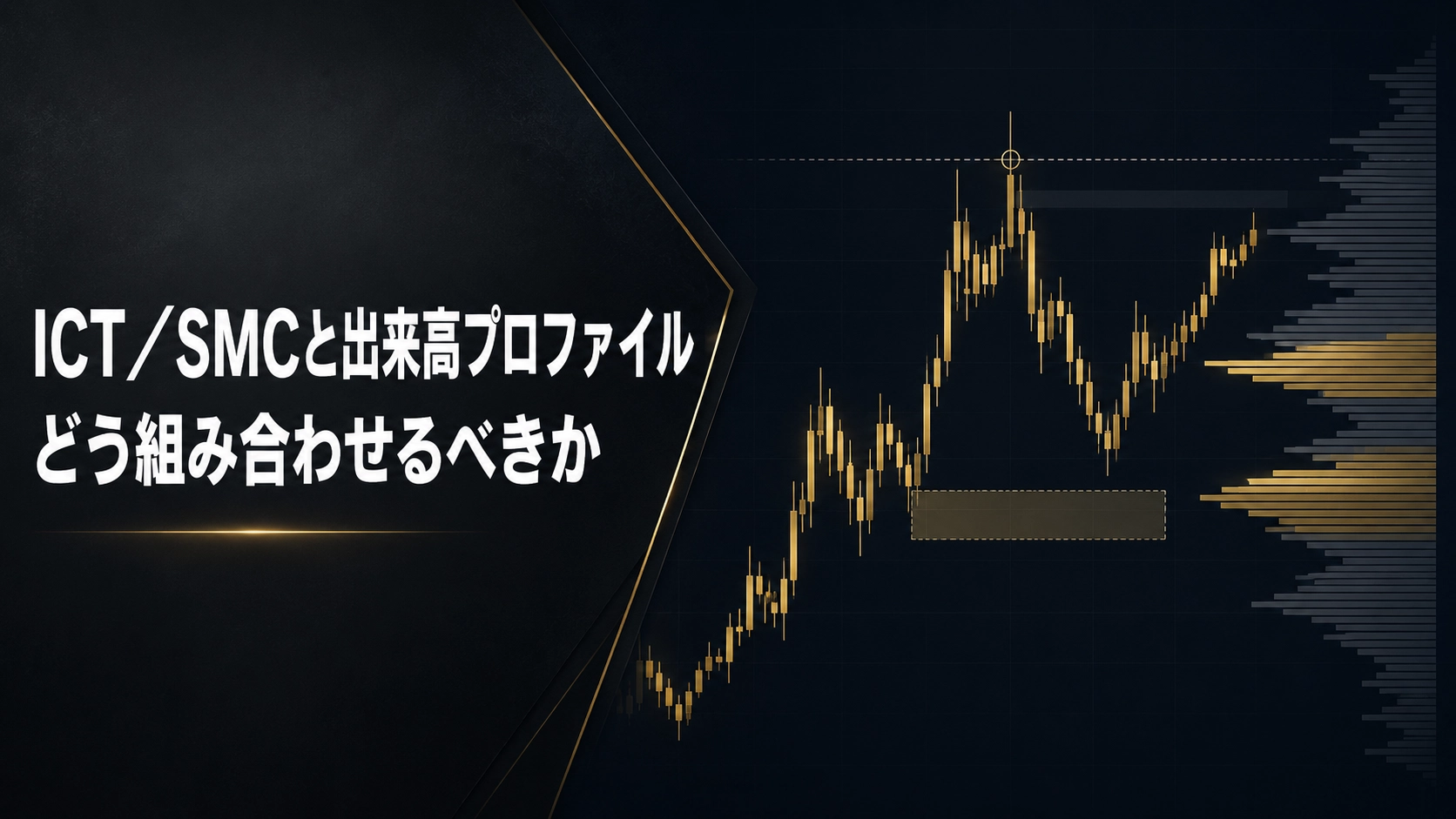
How should ICT/SMC and volume/profit profiles be combined
Do not hastily label it as the "institutional footprint"
In the ICT community, there are discussions about overlaying liquidity, MSS, and FVG with volume profiles to narrow entry opportunities. However,it is premature to declare HVN and LVN as "areas where institutional orders remain."
A volume profile is a tool that visualizes, over a specified period, where at what price ranges there was trading activity. POC is the price with the highest traded volume, and VAH/VAL indicate the upper and lower bounds of the chosen value area.
On the other hand, in FX profiles, what is used is often tick volume rather than the consolidated trading volume of concentrated venues. This information is based on the number of price updates, andit does not reveal participants' characteristics or order intent.
Therefore, HVN and LVN are best treated as: HVN = "price ranges where trading concentrated in the past," LVN = "price ranges that price moved through quickly." Returning to the same price does not necessarily mean a reversal. Volume profiles are not signals that predict the future; they are a supplementary guide to read past trading biases.
Separating roles cleans up the chart
In practice, with ICT/SMC,"where to look for a reaction"is assigned to the volume profile"whether the market accepted or rejected that price range"to make interpretation clearer.
For example, if the higher-timeframe structure is bullish, first consider the nearby low-side liquidity and discount zones as candidates. Check whether VAL or HVN overlap in that vicinity for the day or previous day. If, after sweeping liquidity on lower timeframes, a clear displacement and MSS appear there, consider a move back to FVG.
It is important to set orders not only by profile levels but also on the condition that a structural change occurred on the SMC side.
Conversely, entering LVN does not require chasing a breakout. Only after observing whether the price accelerates through or quickly re-enters a range can you decide on execution viability. In the forex market, studies show that price action can accelerate when reaching levels where stop orders tend to concentrate. However, you cannot determine the location of stops or the intentions of large players from individual charts.
Verifications should record the results of using them together
If you use profiles, you should fix the target period, number of bars, and time of day in advance. If you later select convenient HVN or LVN, verification easily overfits.
Separate the SMC standalone setup from the setup with added profile conditions, and record at least about 30 occurrences. It is important to compare not only win rate but alsoaverage P/L, maximum consecutive losses, and R including spreads and fees.
In particular, in prop trading evaluation accounts, it is easy to overlook the share of trading costs at tight stop levels. If you cannot place stops up to a structural inhibition point, reduce position size or skip. The purpose of adding volume profiles is not to increase the number of trades by strengthening the case.Exclude ambiguous situations and keep only the scenarios where execution is acceptable given the risk tolerance.
Organizing XAUUSD analysis with "MIRA"
MIRA is an MT5 indicator that organizes, on one screen, the items verified in SMC/ICT for XAUUSD: higher-timeframe structure, sessions, liquidity sweeps, displacement, MSS, FVG, and so on.
It does not automatically decide buy/sell; before making a discretionary final judgment,it serves as a supplementary tool to check for missed evidence or inconsistencies with the market environment.
Whether to enter, how much to trade, and stop loss levels must be determined by the trader based on market conditions and their own loss tolerance. The purpose of using MIRA is not to increase the amount of evidence, but to create a process that can be recorded and tested under the same conditions.
https://www.gogojungle.co.jp/tools/indicators/84267
Reference information
TradingView Volume Profile Indicators: Basic Concepts
Federal Reserve Bank of New York: Stop-loss orders and price cascades in currency markets