
[Fibonacci Practice Notes] Episode 5: Which market to target and at what level
The starting point is decided and the meaning of levels is understood. Now, where to buy
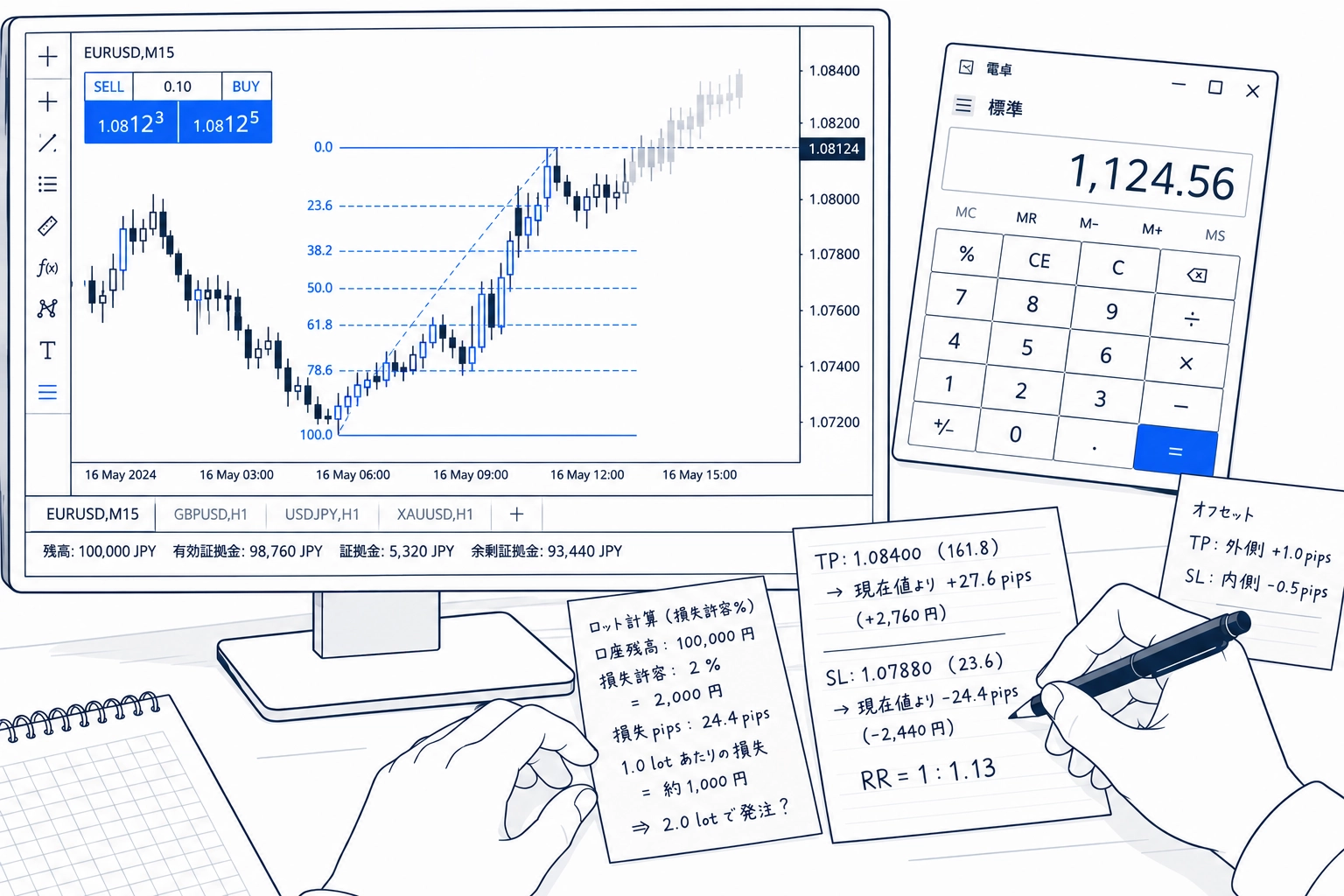
Last time, I wrote about how to choose the starting point. This time, it’s about what comes after.What level to actually trade atis the topic.
In the third installment, I explained the meaning of levels. 23.6% and 38.2% were shallow retracements, while 61.8% and 78.6% were deep retracements. However, “knowing the meaning” and “how to use it” are two different things, right? This time, I’ll focus on the “how to use it.”
Judging by the strength of the trend
To get to the conclusion,in a strong trend wait around 38.2%, and in a weak trend wait around 61.8%is the basic idea.
As explained in the third installment, if there are many people who want to buy, it will be picked up before a deep pullback. In other words, the trend is considered strong when it stops at a shallow retracement. If you are pursuing a strong trend, deep chasing is forbidden. Many of you have probably experienced losing track of the entry timing while aiming for a deep pullback.
A shallow phase requires courage, but when a strong trend is in place, waiting around 38.2% makes sense.
Conversely, if momentum feels doubtful, waiting up to 61.8% becomes an option. You might be able to buy at a favorable price. Of course, you must accept the possibility that it may not reach that far.
At this point, the question is“How to determine whether the current trend is strong or weak?”, right?
The option not to focus on a single point
Honestly, it’s difficult to say in advance how strong the trend is. Therefore,the idea of dividing into multiple levelsexists. In other words, diversifying the positions.
For example, split the lot into three parts. Place reservations at 38.2%, 50%, and 61.8% respectively. If it rebounds shallowly, only part of it gets filled. If it reaches deep, the rest gets filled. I, too, have missed entries by focusing on a single point. It should increase the probability of hitting than concentrating on one point.
The FT S I use allows you to register multiple pending orders at once. You can also send them all at once. There’s no need to manually place one order for each level. This split-entry method is also very easy.
Still, Fibonacci alone cannot decide everything
Up to here, I’ve listed the criteria. To be honest,relying on Fibonacci numbers alone to declare “the current trend is strong” is not reliable.
As written last time, Fibonacci works because many people are looking at the same line. The strength of the trend itself is more reliably assessed when combined with other factors, such as horizontal lines, support/resistance, moving averages, etc.
When multiple reasons align, that’s a good trading opportunity.
Does not apply in range-bound markets
One more important caution.If there is no clear trend to begin with, Fibonacci-based judgments do not hold.
In the fourth installment, I cited whether a continuous wave can be seen as a criterion. A range market does not satisfy this. It’s just up and down repeatedly. It’s hard to decide where exactly the “pullback” is defined.
Even if Fibonacci seems effective, remember that you are in a range market. There is also a possibility that a trend could begin.
In a range market, it’s better not to force a judgment and to keep the option of watching and waiting.
Details of the tools introduced earlier are as follows.
→Fibonacci Trade System (Product Page)
Next time
In the sixth installment,how to combine Fibonacci with other indicatorswill be written.
This time I wrote that Fibonacci alone cannot determine everything. Then, what exactly should be combined with what and how? Next time I’ll dive into that.