
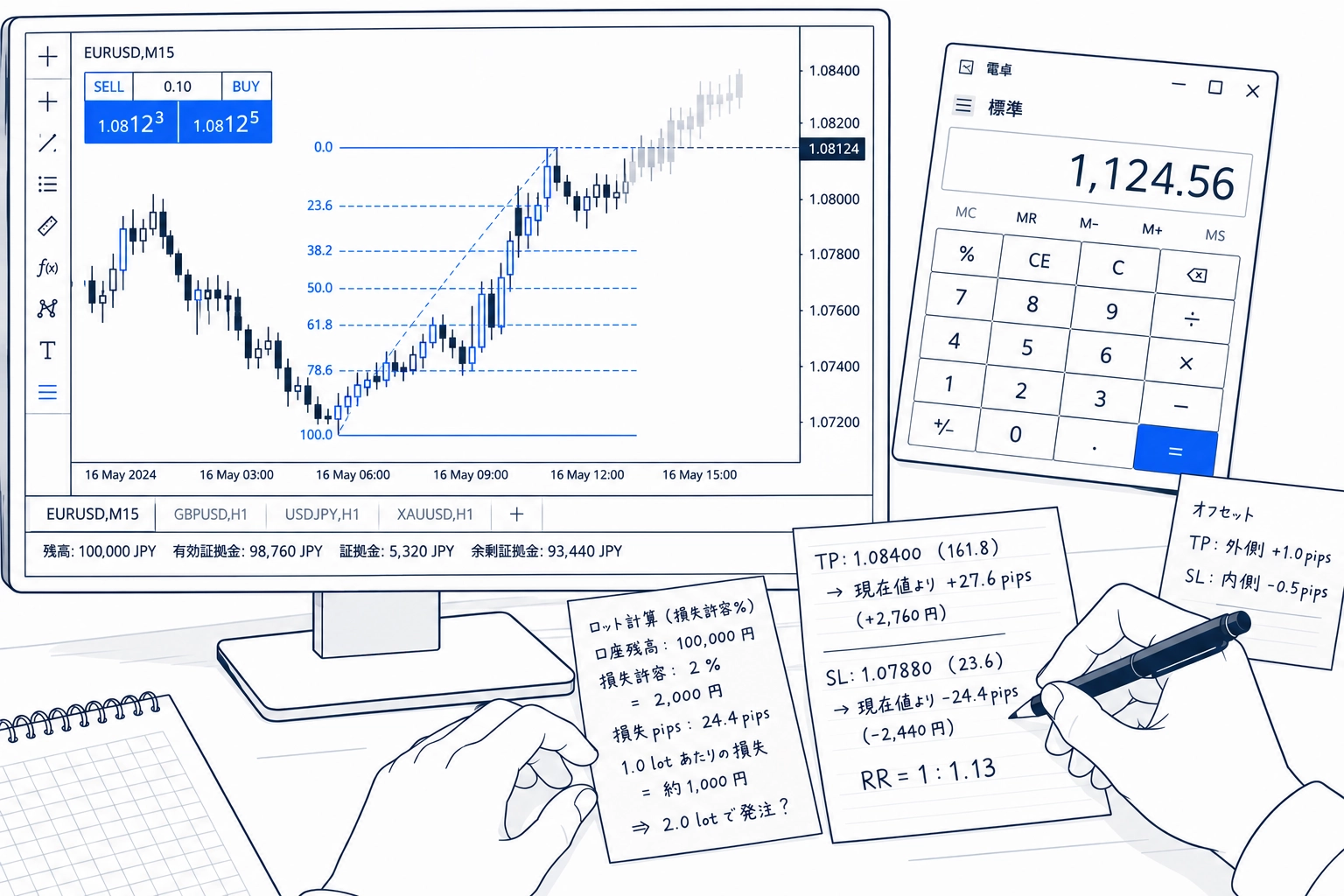
[Fibonacci Practice Notes] Episode 1: "It retraced to 61.8%", five things to decide before placing an order
Where the Recoil Happens and Beyond
There are many explanations of Fibonacci retracements. 23.6%, 38.2%, 50%, 61.8%, 78.6%. The idea is that these areas are prone to rebound.
However, many explanations seem to end there.
To actually place an order, you must decide what comes after, where to place take profit, where to place stop loss, how many lots, and whether the trade is worthwhile in the first place.
This time, I’ll talk about what happens “after you pull it.” This was the most troublesome part for me in trades using Fibonacci.
① First, decide the target level
Let’s start from basics.
When aiming for a pullback in an uptrend, draw Fibonacci with the most recent low as 0% and the high as 100%, and wait for prices to return.
Commonly watched are the 38.2% to 61.8% range. It’s sometimes called the golden zone.
Why is this area watched? The reason is simple:because many people are looking at the same lines. 61.8% is the golden ratio and is included in MT5’s default settings. In other words, it’s not that the justification is so strong, but that “everyone is looking at it,” which makes it effective.
So, rather than adding minor values yourself, it may be safer to focus on standard levels.
② Where to place the stop loss
This is where the main discussion begins.
Prices have retraced to 61.8%. They look like they might rebound. I want to buy. …So where do you place the stop loss?
What is commonly advised is,a little outside the next level. If you enter at 61.8%, place the stop a bit outside 78.6% or outside 100%. Some people prefer a cushion of about 10 pips.
Why outside a little? If you place it exactly at the level, there’s a high risk of being stopped out by wicks. Those who have experience with this likely know the pain.
However, placing it further outside widens the stop loss distance.Widening reduces being stopped out but requires lowering the lot size to keep risk in check.This trade-off is unavoidable.
③ Where to take profit
Take profit can also use Fibonacci levels directly.
- 0.0%(Recent high) … the simplest target
- 23.6%… take partial profit early
- 161.8%… extension if price breaks the high and continues
There is also a method to split: take half at 38.2% or 50% and hold the rest to 0.0%. It’s about balancing win rate and profit size.
④ Now, put some numbers to it
Now, this is the part I most want to convey this time.
Let’s convert the previous combination into actual numbers.
For example, if you buy at 61.8% and place SL at 100% and TP at 0.0%. If the Fibonacci overall width is 100 pips, it would look like this.
- From entry to stop loss:38.2 pips
- From entry to take profit:61.8 pips
- Risk-reward ratio:about 1 to 1.6
I think these numbers aren’t bad.
Then what if you wait until 78.6% to enter?
- To stop loss:21.4 pips
- To take profit:78.6 pips
- Risk-reward ratio:about 1 to 3.7
Note that these numbers do not include spread. In reality, it would be slightly worse.
Looking at the numbers alone, waiting longer appears more advantageous.
However, it often doesn’t retrace that far. It may rebound at 38.2% and then continue.The longer you wait, the better the conditions, but the fewer times you can enter.I believe it’s worth keeping this relationship in mind.
It’s not that one method is right or wrong. I adjust depending on market conditions.
However, if you start thinking on the spot, you’ll be late. So I decide on a few preset templates and pick the one that fits. That alone makes judgment faster.
⑤ Decide the lot size
Finally, the lot size.
Once the stop loss width is decided, the lot can be calculated. Simply divide the acceptable loss by the stop loss width.
For example, with 5,000,000 yen capital, and a single-transaction acceptable loss of 2% (10,000 yen). If the stop-loss width is 38.2 pips, you can endure about 262 yen per pip.
…This is calculated every time.
It's quite challenging in practice
Let’s lay out the flow again.
- Draw Fibonacci
- Decide where to enter
- Read the SL price
- Read the TP price
- Convert the distance from current price to pips
- Calculate the lot from acceptable loss
- Open the order screen and input price and lot
Seven steps. And they areto be done while the market is movingas you do them.
After confirming the rebound, open the order screen, input the price, recalculate the lot... and as that happens, the price can run. I’ve had this happen many times.
However, what’s more troublesome is another matter.If you’re preoccupied with calculations, you’ll lose the ability to monitor the market.
Even though prices move in front of you, you’re busy with calculations and order entry. You end up placing orders without staying calm and focused on the market. It’s a common situation.
With practice, it becomes faster. But when you try to go faster, you become sloppy. In my case, I tended to postpone lot verification. I’d place orders first and check later. A bad habit, I think.
I delegate these calculations to tools
I use a tool called Fibonacci Trade System (FTS), an MT5 add-on.
This tool automates steps 3–6 above.
When you draw Fibonacci, badges appear at the preset levels (for example, TP=0.0, SL=100.0). There you’ll seethe price, the distance in pips from the current price, and the risk-reward ratio for that lot. Then you just press a button.
In other words,you make the decision, and the calculations are delegated. It isn’t a tool that automates market reading. But I find that aspect convenient.
What changed most for me wasn’t speed.It was that the time to look at the market returned.
Because I’m not drawn into calculations, I can watch price movements more calmly.
If you register a preset like “Enter at 61.8%, SL at 100%, TP at 0.0%” beforehand, you can call the same setup with the press of a button thereafter.
Details of the actual screen and functions are on the product page.
→Fibonacci Trade System (Product Page)
Next time
In the second installment,“Where did the number 61.8% originate in the first place”I will write about it.
This time was about how to place TP and SL, a practical topic. Next, we’ll go back a little. How the 23.6% and 61.8% that come with MT5 from the start are calculated, and why they work in the market.
By the way,there is exactly one number among that list that cannot be derived from the Fibonacci sequence.Do you know which one it is?
Answer next time!