
Understanding Max Iwamoto's "Parabolic" Part 1 [Max Iwamoto]
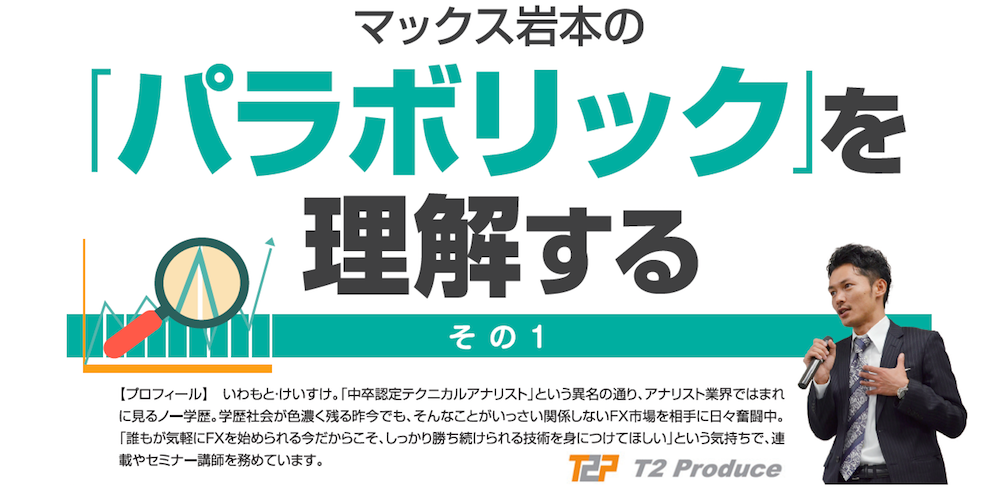
Max Iwamoto Profile

Keisuke Iwamoto. As the nickname “Self-taught Technical Analyst with a Junior High School Diploma” suggests, he is an extraordinarily uneducated person in the analyst industry. Even in an era where educational background heavily matters, he fights daily against the FX market, which is unrelated to such things. With the feeling of “now is the time when anyone can easily start FX, so I want you to acquire the skills to continuously win,” he serves as a serial author and seminar lecturer.
*This article is a reprint/edited version of an article from FX攻略.com, March 2019 issue. Note that the market information stated in the text may differ from the current market.
Trend-strong Do-Ten (reversal) trading tool
Parabolic is a technical indicator conceived by J. W. Wilder, and its name comes from the shape of the formed graph resembling a parabola (parabola).
Parabolic has two main characteristics. First, it is a do-ten trading tool that always holds either a buy or a sell position. However, considering that the market can move up, down, or consolidate, there are pros and cons to always maintaining a position, but when a trend persists over a certain period, Parabolic can yield large profits—that is its hallmark and appeal. Therefore, Parabolic is classified as a trend indicator.
Secondly, it has the concept of both “price” and “time.” Parabolic makes buy/sell decisions around SAR (Stop And Reverse) drawn in dots, and this SAR has a trailing stop function that gradually approaches the price distance independently of price movements. Therefore, it not only follows the trend but also helps reduce missed profit opportunities, making it a versatile tool.