

I understand strong currencies. But the real reason why the currency strength trade doesn’t continue is “Which pair should I buy?”

“USD is strong” and then you stop at the next step
Many of you may have added a currency strength meter to your chart. It ranks eight currencies by strength at a glance and shows which currency is currently being bought. When you first introduced it, you feel like you can read the market.
However, at the actual order form, you freeze. Even if you know “USD is the strongest,” what should you buy? Should you buy USDJPY, sell EURUSD, or sell GBPUSD? You know which currency is strong, but you can’t decide which pair to take and in which direction to position it.
From here, many people pick one pair with the most obvious price movement and enter. Then they get stopped out due to the other currency’s conditions. “The strength was right, but the pair choice caused a loss”—and after several such losses, they quit using currency strength, which is a common point of failure.
The problem isn’t the method. It’s the gap between “judging strength” and “executing the order.” In this article, we call thisthe execution barrier. Most of the reasons for not continuing lie in this execution part, not in market judgment.
Currency-Strength Trading is about buying and selling currencies, not pairs
In the first place, currency-strength trading is about buying and selling the currency itself, not a specific pair.
This is where the idea of choosing only one pair diverges. For example, if you judge USD is strong and only buy USDJPY, the profit and loss depend not only on USD’s strength but also on JPY’s conditions. If JPY happens to be bought that day, USDJPY may not rise even though USD is strong. One pair simply picks up the noise of the counter currency.
To avoid this, the idea is to diversify across multiple pairs involving the base currency. If you want USD, you would enter USD-buy positions across seven USD-pairs such as USDJPY, EURUSD (sell), GBPUSD (sell), … so that USD-buy positions are created simultaneously. Because the counter currencies vary (JPY, EUR, GBP, etc.), the noise of any particular counter currency averages out, leaving the portion closer to “USD strength.” This isbasket tradingbasic logic.
By spreading across currencies rather than risking a single pair, the noise of the counter currencies is dampened, shifting the focus from “picking the right pair” to “selecting the currency.” The currency-strength signal and basket execution method should naturally be considered together.
We understand the theory. Can you execute it by hand?
So, let’s do this seven-pair basket manually. Here, the execution barrier becomes evident as a concrete workload.
FirstOrder placementfor each of the seven USD-related pairs, decide buy or sell and place the order. If you get the direction wrong in one pair, that pair becomes a contrarian trade.
NextLot sizingPutting the same lot on all seven pairs does not align risk. Each pair has different pip values, spreads, and volatility, so you need to allocate by pair.
And thenMonitoringAfter holding seven positions, some pairs will be in profit, others in loss. You can’t decide exits by looking at individual pips; you must look at total P/L and adjust manually while watching the market.
Judgment of strength can be done in seconds. Yet the reason it often doesn’t persist is that the workload of placing orders, calculating lots, and monitoring totals is too heavy for discretionary trading. The root cause of frustration is not the method but the workload. This is the essence we emphasize.
Case study: holding seven pairs in one go after the London open
A brief, practical flow: during European time, 30 minutes to an hour after the London open, check the currency strength of the top currencies from the session start. If USD is among the top, build USD-centered positions in the seven related pairs in the same direction (USD buy) simultaneously. Then close based on the total P/L—this is one cycle of basket trading.

The method of measuring strength at session start and the exact entry/exit numbers will be covered in the next article. For now, please grasp the skeleton of “check the top currencies and hold the seven pairs for those currencies.”
Putting this entire process into one click
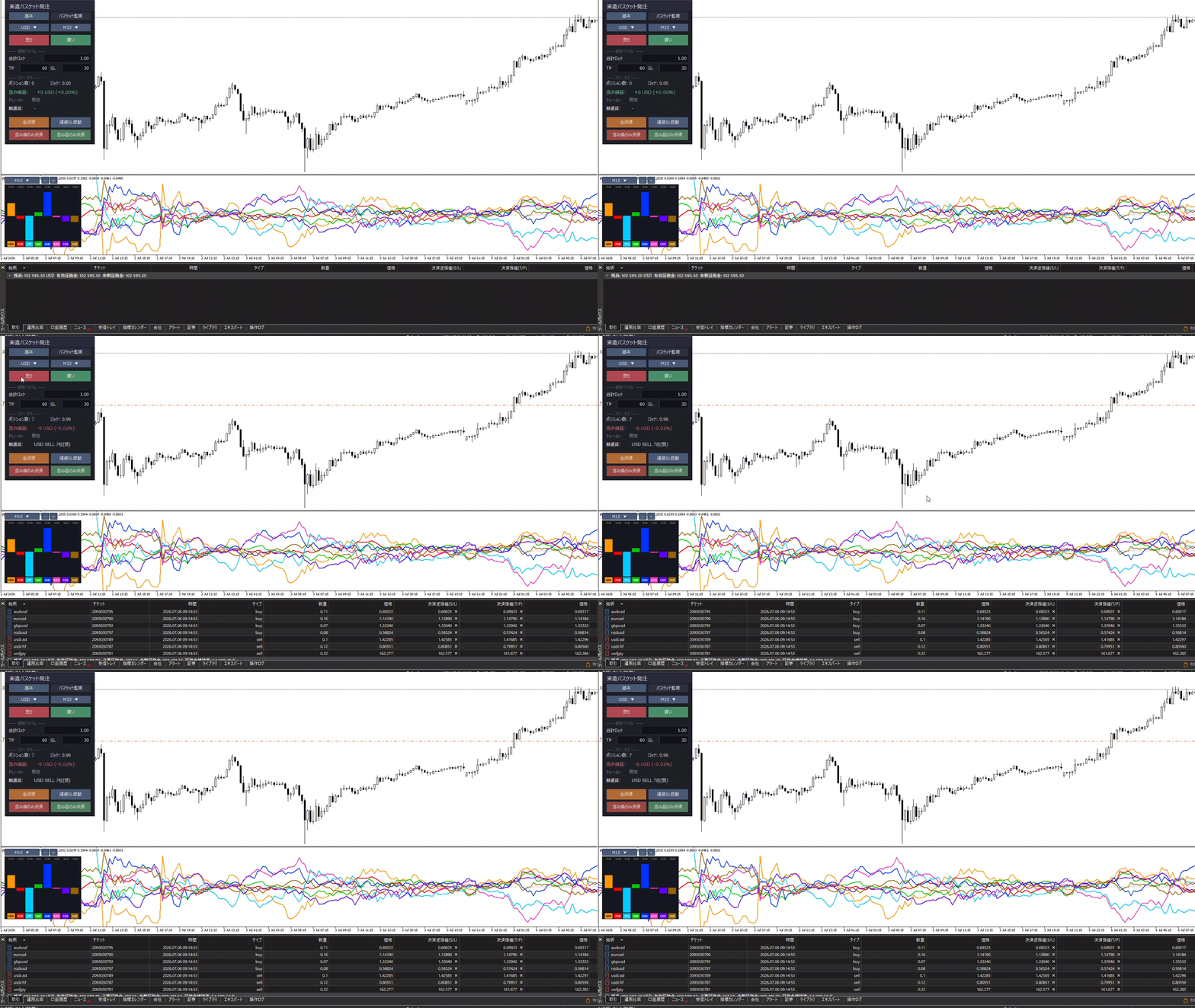
All of the steps—order placement, lot allocation, and total monitoring—are consolidated so that you can execute by choosing a single base currency in what we callHonest Basket.
This is a tool for MT5 that supports eight currencies (USD/EUR/JPY/GBP/AUD/NZD/CAD/CHF). After selecting the base currency and executing, it automatically determines the buy/sell directions for the related seven pairs and places the orders in bulk. Lot sizing is computed automatically using either a proportional strength difference with a spread correction, or equal risk (ATR × pip value) methods. After placing orders, it monitors total P/L at 2-second intervals and handles exit triggers such as basket-level TP%, SL%, trailing, and withdrawals based on strength ranking. It is not automated trading but a tool to support discretionary order placement and management.
The judgment of strength is done by humans; only the tedious execution is handed to the machine. This is a tool to overcome the execution barrier.
Early-release price 19,800 yen (tax included) available until July 31.
Thereafter the regular price will be 24,800 yen (tax included).
View product page (Honest Basket)
The method described in this article does not guarantee profits. Please verify on a demo account and use at your own risk.