
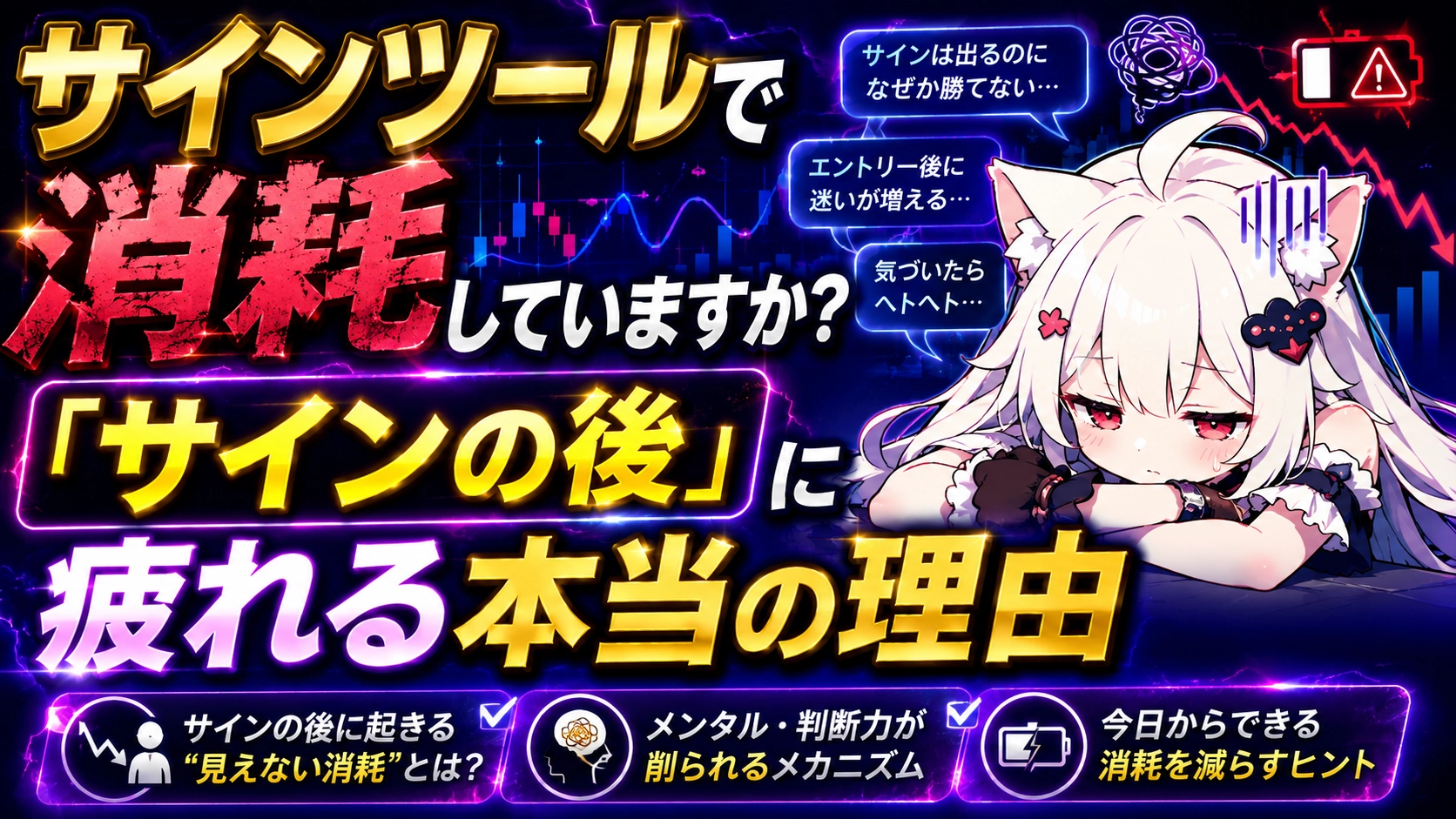
Are you exhausted by sign tools? The real reason you feel tired after signing
Every time a signal lights up, you rush to the chart, there’s a flicker of excitement and doubt as to whether to enter or not, and by the time you decide, the signal disappears—aren’t you a little tired of such days? Sign tools are useful devices. But many people tire not from the signals themselves,but from what happens after the signal. Today, I’ll talk about this, including my own mistakes.
Let me make it clear from the start. Sign tools aren’t bad. They are wonderful tools that indicate the “entry trigger” conditions. You don’t have to stare at the chart all day; they tell you when the conditions align. This has great value in itself.
The problem is that the signal only tells youthe entrance candidate. How much to enter at, where to place stop loss, where to take profit, and what lot size to use—these trade decisions occupy most of the judgment, and ultimately,they remain in your own hands.
From the moment the signal lights up, the mental burden begins. Specifically, this cascade occurs:
- Doubting whether you should really enterhesitate. While hesitating, prices run away and you get left behind
- Wondering if the signal will repaint laterdoubt repaint. You can’t fully trust the signal
- Even after you enter,when to cut is unclear, and you worry about unrealized gains and losses
- Staring at the chartstaring at the screen. You can’t put the phone down
- When it fails,blaming yourself. Even if it works, you fear it will fail next time
Before you know it, more than winning or losing, yourwillpower is worn down. This is the most common form of exhaustion with sign tools. The tools sit there calmly, yet you’re controlled by your own emotions.
※The judgments remaining after the signal are the real exhaustion.
I’m saying this with authority, but I went through the same path. Doubting signals, cutting too early with a gut decision, letting trades sit without justification, breaking my rules. The scenes I remember most are the times I broke the rules more than when I got a signal right. Back then, the drain wasn’t money as much as willpower. That’s why now I try to limit the space for emotions as I trade.
You don’t need to throw away sign tools. The idea is to lighten the judgments that remain after the signal. There are three broad approaches.
| Direction | What it entails | What gets lighter |
|---|---|---|
| ① Rule-based | Write entry, stop, take profit, and lot size on paper and follow mechanically | Indecision and self-blame |
| ② Semi-discretion | Your judgment, but orders and exits are left to the tool for speed and accuracy | Operational mistakes and effort |
| ③ Automation | Leave entry to exit entirely to an EA, hands-off | Staring and emotions |
There is no right answer. If you want to cultivate market sense with signs, go with ①; if you have confidence in your own judgment but are slow to act, go with ②; if you don’t want your emotions to drive you, go with ③.Replace “after the signal” with a systemand exhaustion gradually decreases.
Finally, I always say this. Relying on a system to eliminate exhaustion completely is an overstatement. If market quality changes, automated trading will falter, and you’ll still have time when you fear unrealized losses.The type of exhaustion changes, to put it accurately.
Still, compared to spinning in doubt and self-blame daily, I found that “following what you decided” and “watching performance” fatigue to be much healthier. Some people are suited to sign tools. What matters iswhether your current fatigue is of a kind you can continue with, so pause and reflect.
- Sign tools aren’t bad. They only show you the entrance candidate
- The exhaustion’s real source is the judgments after the signal (hesitation, stop, staying in a position, self-blame)
- Three ways to lighten it — ①Rule-based ②Semi-discretion ③Automation. Replace remaining judgments with a system
- However, automation isn’t万能. The exhaustion type just changes. Choose a sustainable form of fatigue to live with



※This article is intended to provide information and is not investment solicitation. The displayed performance results are past records and do not guarantee future profits. FX and CFD trading involve risks. Please make investment decisions at your own risk.