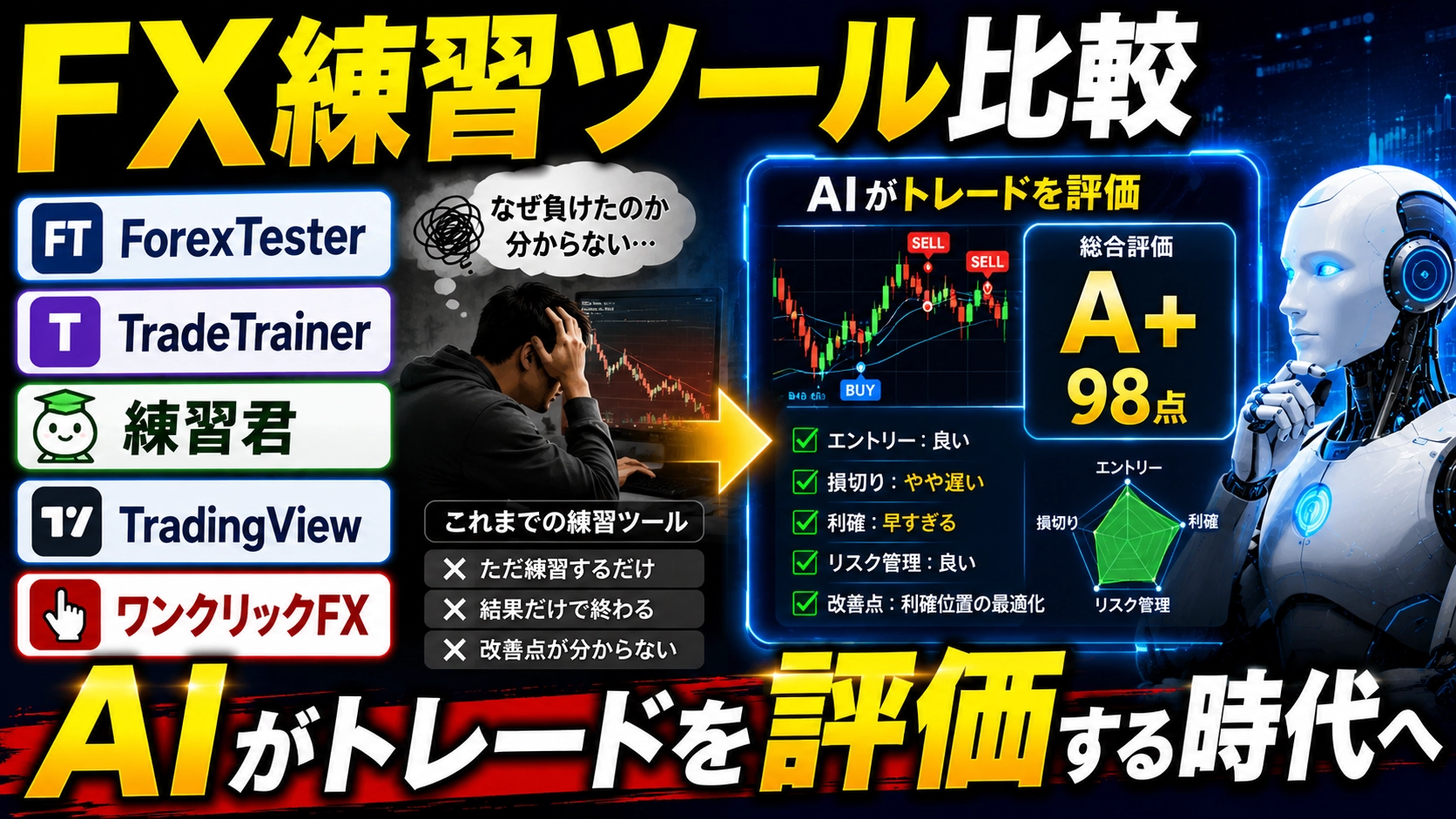
?FX practice tool recommended ranking 2026|Is a simulator that AI cannot analyze already old?
Many people are looking for FX practice tools and trade simulators.
However, as of 2026, many comparison articles are evaluated based on criteria that have remained unchanged for years:
- the ability to replay past charts
- the ability to fast-forward
- the ability to pause
- the ability to place trades
These comparisons are still made using the same criteria as a few years ago.
Indeed, these are important.
But in today’s era, can you really improve just with that?
Because what traders truly want to know is “why did I lose?” and “what should I improve?”
Replaying past charts can be done with many tools.
However,
- Was the entry appropriate?
- Was the stop-loss placement reasonable?
- Was the take-profit too early?
- Was the risk-reward ratio appropriate?
- Were there issues with capital management?
Analyzing these points objectively is not easy for humans alone.
That’s why AI has attracted attention.
In selecting FX practice tools in 2026,“whether you can practice” is no longer the key criterion;instead, “whether AI can analyze” is becoming an important criterion.
This article will compare major FX practice tools and explain the real features needed in the AI era.
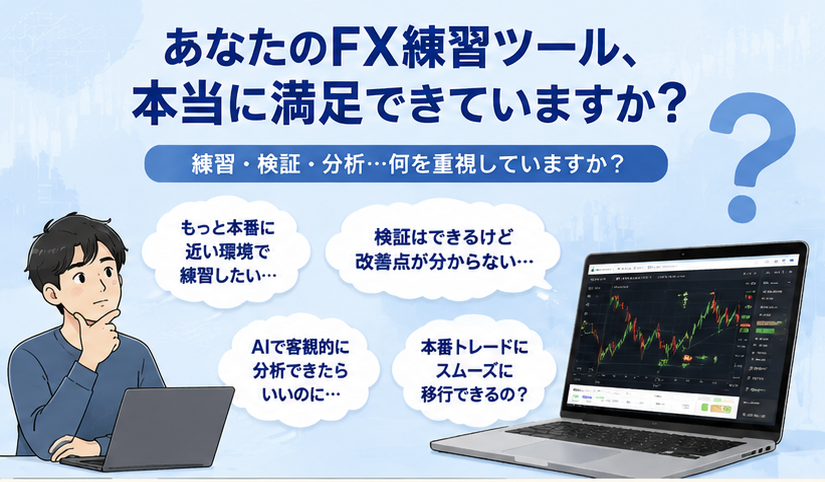
Why has the 기준 for FX practice tool comparisons changed?
Until a few years ago, the value lay in being able to practice with realistic price movements.
Even now, differences exist among tools in chart replay smoothness and usability. However, many practice tools include a past-chart replay feature, so the mere ability to practice is no longer a rare value.
The problem lies beyond that.
After practicing, you must
- analyze
- evaluate
- improve
Without this process, you’ll repeat the same mistakes again and again.
Just as baseball players review game footage after matches, and professional athletes receive coaching,traders also need objective analysis.
As the role to provide that has drawn attention to AI.
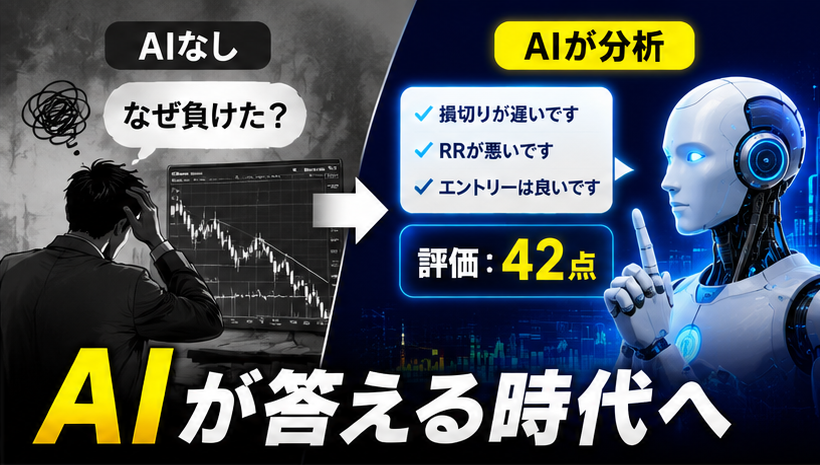
Problems with practice tools that cannot AI-analyze
For example, suppose you make 100 trades.
Looking only at the results,
- win rate 55%
- positive 200 pips
you might think the results are good at first glance.
But in reality,
- take profits were too early
- stop losses were late
- there were many averaging down
- risk was too high
these problems may exist.
To analyze parts not visible by profit/loss alone, in recent years AI is fed not only order data but also chart data,
- scoring
- identifying issues
- improvement recommendations
and this usage is expanding.
In short, AI is beginning to act as a dedicated coach for traders.
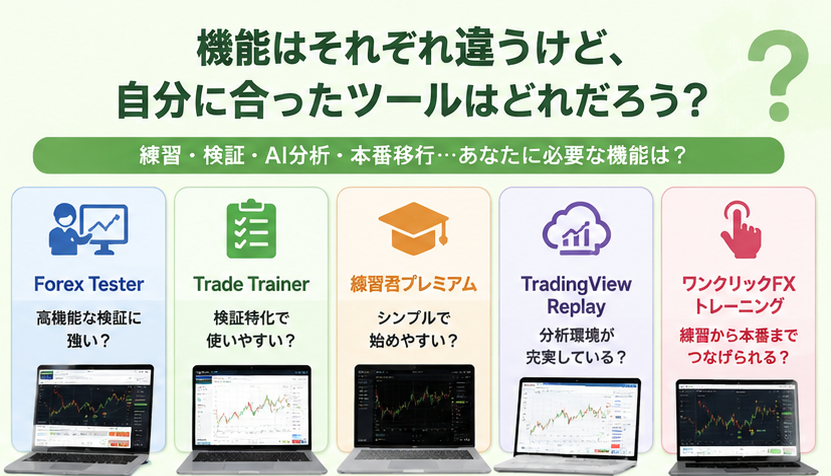
FX Practice Tool Comparison Table [2026 Edition]
| Tool | Practice | Verification | AI Analysis | Live Trading |
|---|---|---|---|---|
Forex Tester |
◎ | 〇 | △ | × |
Trade Trainer |
〇 | ◎ | × | × |
Practice-kun Premium |
〇 | ○ | × | × |
TradingView Replay |
△ | ○ | × | × |
| ◎ | ○ | ○ | ○ |
※Features are based on publicly available information at the time of writing.
As the comparisons show, many tools stop at the “practice” or “verification” stage.
On the other hand, tools that include AI analysis and live trading environments are still very few.
For example, the long-standing practice tool Forex Tester offers “AI Trading Analyzer,” and the One-Click FX series offers “AI Judgment.”
However, the content of AI features, accuracy, and scope vary by tool, so it’s recommended to check details before adoption.
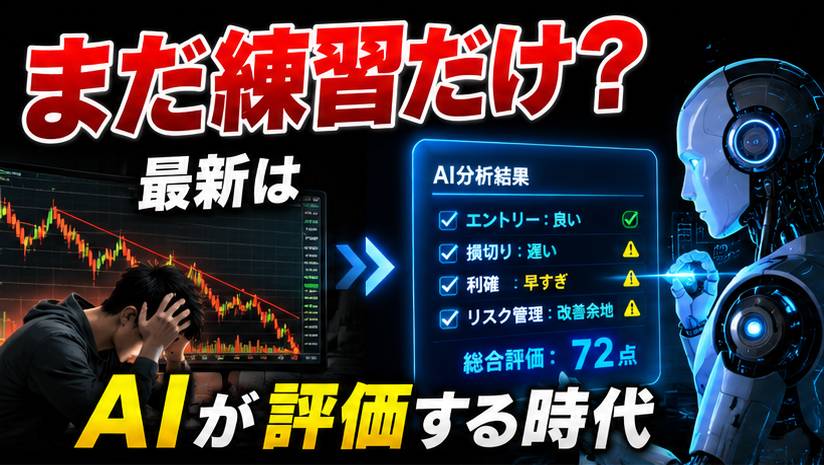
The era of AI scoring trades
Recently, generation AI like ChatGPT can analyze trading history and chart data.
For example,
“Please score this trade on a scale of 100.”
In response to such a request,
- positive points
- points to improve
- improvement suggestions
can be provided.
You may discover habits or tendencies you overlooked from an objective third-party perspective.
Also, since AI has no emotions, you can ask questions repeatedly if you don’t understand something. This is a major advantage, as you can demand explanations until you’re satisfied, something harder with a human.
However, AI's analysis results are only reference information, and final judgments must be made by the trader.
From 2026 onward, AI analysis may become a standard feature in FX practice.
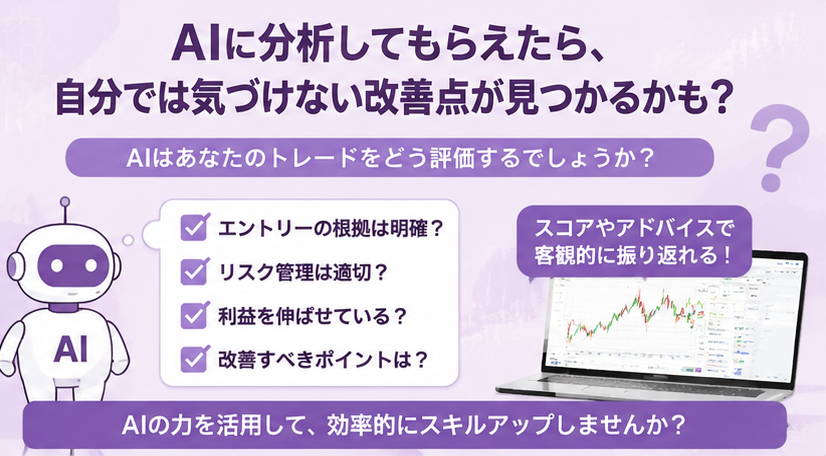
The FX improvement cycle from now on
The ideal flow going forward is
Practice ⇒ AI analysis ⇒ Improvement ⇒ Live trading ⇒ Re-analysis (retrospective verification)
.
When considering a trading environment, what matters is not just practice, but building a cycle of continuous improvement.
Results of win/loss in practice tools alone do not lead to substantial growth.
From now on, trading strategies should first be tested in a practice environment, analyzed by AI to identify improvements, and then refined for live trading.
In these processes, AI is becoming a powerful support role.
In the future, differences in information processing ability and improvement speed may arise between traders who use AI and those who do not. This is not merely a prediction but is already becoming a reality.
Therefore, we may be entering an era where the comprehensive trading environment includes practice, AI analysis, live trading, and even automation support, rather than traditional “practice-only” tools.
The FX environment is rapidly evolving. Your trading can also evolve.
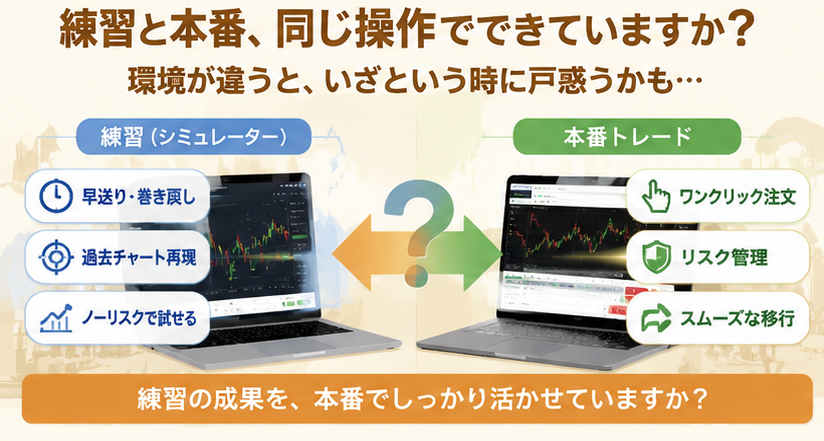
What to choose next…
As of 2026, the expectations for FX practice tools are undergoing a major transformation.
In the past, the ability to replay past charts was of great value.
Now, the ability to receive AI analysis and improvement support is drawing attention as a new value.
Not just practice, but objective evaluation by AI and repeated improvements.
This may become the standard for learning trading in the future.
When choosing FX practice tools, it is recommended to check not only chart replay capabilities but also the status of AI analysis and how it can be utilized.
FX is evolving. The era of satisfaction with just practice is ending.
The next choice may require completely different criteria than before.
Complete no-risk trading simulator for free practice and verification!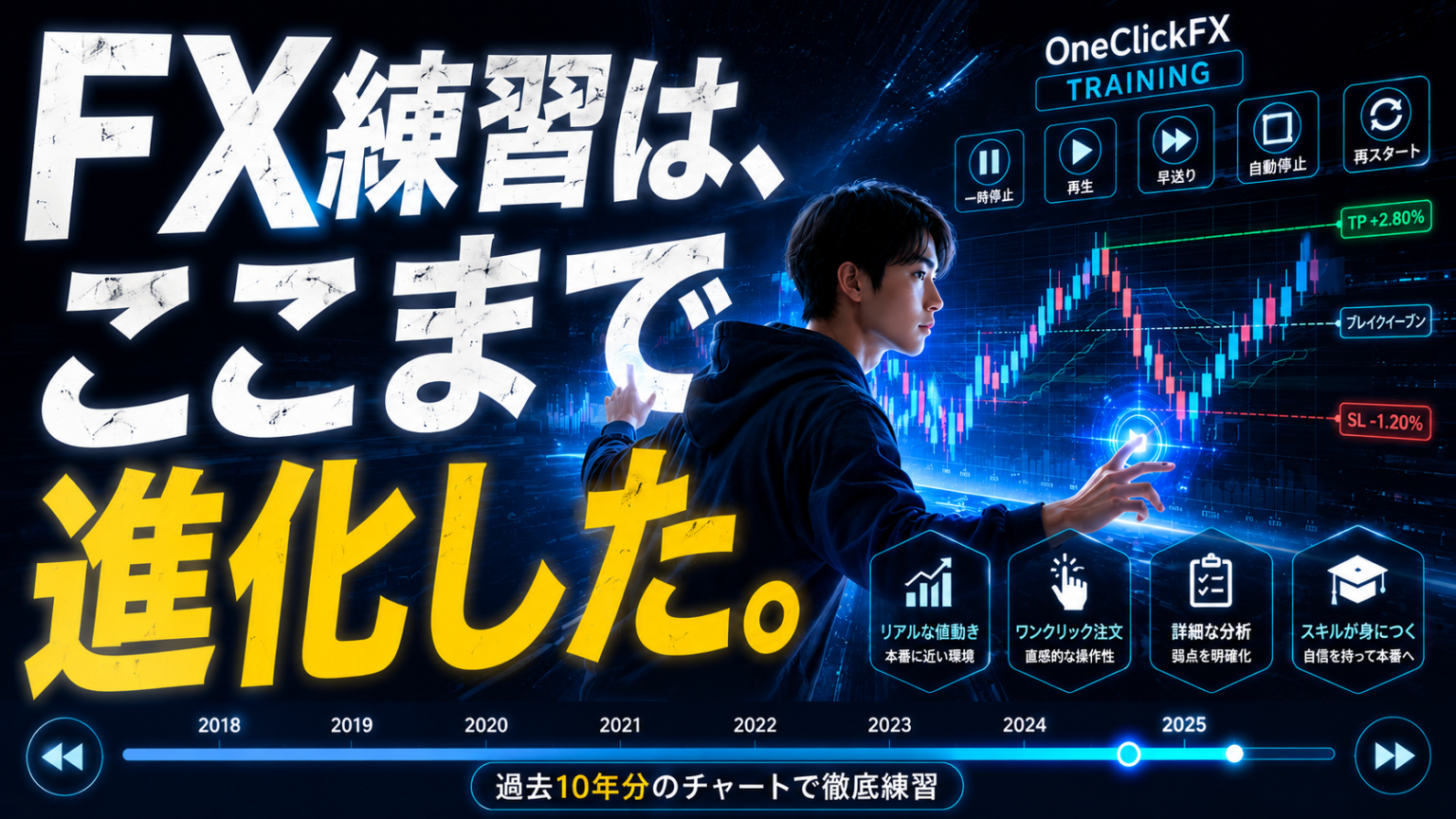
Details page for One-Click FX Training MAX