
Learn professional closing techniques from Dr. Iidacchi: Settlement theory to survive in the foreign exchange market | Episode 1: The correct standard for cutting losses
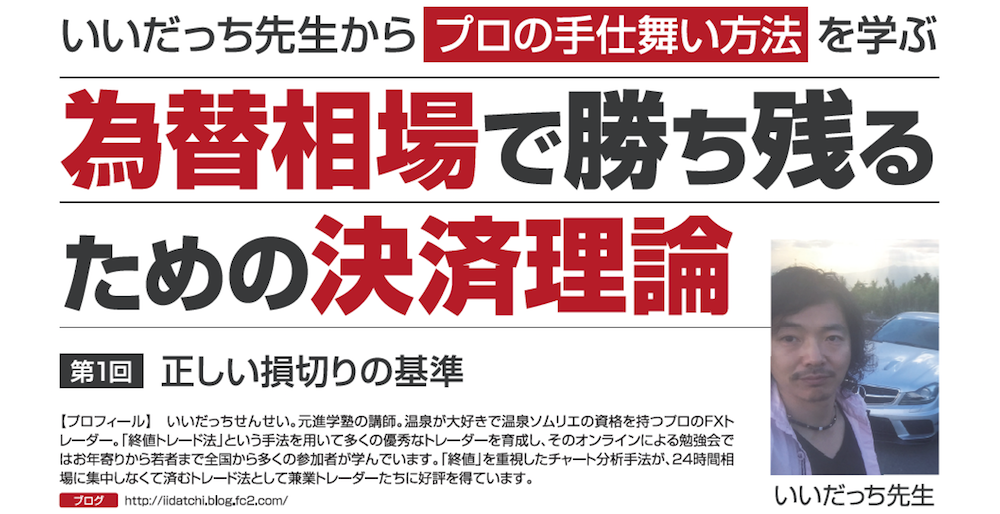
Profile of Dr. Iidacchi

Former instructor at a junior college prep school. Loves hot springs and holds a hot spring sommelier qualification, and is a professional FX trader. Using a method called the “Close Price Trading Method,” he has trained many excellent traders, and his online study sessions attract participants from all over the country, from elderly to young. The chart analysis method that emphasizes the “close price” is popular among part-time traders as a trading approach that does not require constant focus on the 24-hour market.
Blog:The Big Comeback from 100,000 Yen! FX Trader Iidacchi BLOG
*This article is a reprint/edit of an article from FX Tactics (FX攻略.com) June 2019 issue. Please note that the market information written in the main text may differ from current market conditions.
Diversify your settlements
Hello, Iidacchi-sensei here. In this series, up to the previous installment I covered the “perfect pattern” and the “beard-pulling pattern,” introducing the entry theories (entry points) on where and how to enter. Iidacchi-sensei and the participants of his FX study group have been making profits every month with only these two entry patterns, but Iidacchi-sensei places importance on settlement (exit) theory. To consistently generate profits, the “settlement theory” is arguably the most important aspect of trading. Anyone with more trading experience will likely agree.
The concept of settlement held by many traders is the two types of profit-taking and stop-loss. However, settlement, by its nature, does not fit into this binary framework. Since most people only think in terms of profit-taking or stop-loss, their settlement planning becomes sloppy or neglected.
A flawed money-management method
The root cause of the mistaken belief in a binary choice of profit-taking or stop-loss is that the idea that stop-loss should be 5% of one’s own capital has spread widely. It is seen in many books, so it feels a bit awkward to deny it loudly, but if you want to preserve even a little of your important funds, you must recognize that this is clearly a mistaken notion. The theory that determines the loss of precious funds is, in my opinion, too sloppy a logic.