
Silver of the Delay, Will Recovery Come? [Ryuji Sato]
Sato Ryuuji Profile

Sato Ryuuji. Born in 1968. After graduating from a U.S. university in 1993, he joined Genesis Co., Ltd. (later Oval Next Co., Ltd.), an information vendor covering finance and investment, after working at a marketing company. He writes analyst reports and engages in trading, covering macroeconomic analysis, exchange rates, commodities, and stock markets. Since 2010, he has founded "H-Square Co., Ltd.," writing analyst reports and planning/publishing items such as "FOREX NOTE Currency Handbook," while serving as a radio program caster related to investments. He is an individual trader. Member of the International Federation of Technical Analysts; certified technical analyst. Main caster on Radio Nikkei "The Money Doisa-to Forecast" (Monday 15:00–).
Official site:Sato Ryuuji Blog
※This article is a reprint/edit of FX攻略.com June 2019 issue. Please note that the market information written in the main text may differ from the current market.
Silver Supply and Demand
Over roughly the past year, this section has highlighted precious metals that have been on an upward trend, namely gold and palladium. These two commodities continue to show solid momentum. There are eight precious metals in total: gold (Au), silver (Ag), platinum (Pt), palladium (Pd), rhodium (Rh), iridium (Ir), ruthenium (Ru), and osmium (Os). The listed ones among these are gold, palladium, silver, and platinum. This time, we will look at silver, which is expected to have the most price level rise this year.
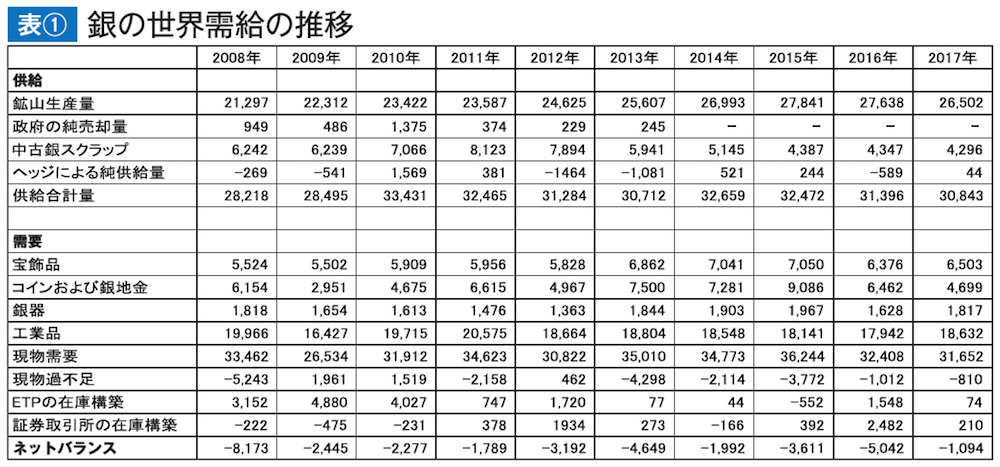
First, let us quickly review silver’s supply and demand (refer to Table ①). Since 2018 figures are not yet released, 2017 figures are the most recent. Silver supply in 2017 was 30,843 tons. There are two main sources of supply: mine production of new silver and above-ground stocks. Above-ground stocks include government stock sales, recovery from scrap, and hedged selling by producers. In 2017, the distribution between new silver and above-ground stock was about 86% new silver.
On the demand side for the same year, 31,652 tons were demanded. About 59% of that, or 18,632 tons, was for industrial use. Silver boasts high electrical and thermal conductivity, making it widely used in electrical products. Other demands were coins and silver bars at 4,699 tons, jewelry at 6,503 tons, and silverware at 1,817 tons.